Powering on: How Scottish local government could be on the cusp of major change
Taking to the stage in a luxury hotel in golf mecca St Andrews, Scottish Secretary Douglas Alexander was ready to preach to the converted.
“Local government has been systematically deprioritised in terms of funding during the era of devolution,” he told his audience, and the sector has “watched powers pulled to Holyrood rather than further devolved to local communities during recent decades”. “We need a new crusade for devolution within devolved Scotland,” he went on, “and local authorities, regardless of party allegiance, must be in the forefront of that cause.”
There could hardly have been a more receptive audience for the material. After all, Alexander was speaking at the annual conference by councils’ body Cosla – which is itself pushing for greater autonomy for the country’s 32 local authorities, including multi-year financial settlements, an end to the ringfencing of budgets, and a shift in responsibility for achieving “restrictive” national targets on things like teacher numbers and delayed discharge.
But Cosla is far from the only organisation to bang that drum. The Mercat Group – a network of former council chief executives – has issued its own paper through the Enlighten think tank calling on Holyrood ministers to “complete the intent of the devolution settlement to devolve public services to the authorities closest to the citizen”.
And, notably, two city regions – Edinburgh and South East Scotland (Eses) and Glasgow and the West of Scotland (GCR) – have issued formal proposals to the Scottish and UK governments seeking Manchester-style deals that would bring further powers and bigger budgets to the areas.
The zones are just two of the six that have been put in place across the country since 2014 – the others are Aberdeen and Aberdeenshire; Inverness and Highlands; Stirling and Clackmannanshire; and Tay Cities – but between them, they are home to more than half of the country’s population and contribute almost £100bn a year to the national economy. Their leaders argue that short-term budgets and a lack of powers are holding them back and preventing real progress in tackling “critical challenges” in infrastructure and services from transport to housing.
Be bold and grasp this moment
“It is the right time to seek greater devolution of resources and programmes from Scottish and UK governments,” the Eses proposal argues. “We are ready to address the wider issues facing the region and take advantage of unique opportunities.”
Glasgow City Council leader Susan Aitken described her region’s call for a £400m per year integrated settlement not as an “ask”, but as an “offer”. “Be bold and grasp this moment,” she urged both governments, adding that “we will deliver the rewards we know we can reap”.
In his speech, Alexander wasn’t taking a new line – Scottish Labour has supported local government reform for years, with leader Anas Sarwar saying he’ll “push power out and into our communities” and, in government, would bring forward a Local Democracy Act to introduce a version of England’s system of regional mayors. Then there’s the Muscatelli Report, which was commissioned by the party from former Scottish Government adviser Professor Sir Anton Muscatelli and which explicitly recommended changes to local government to create economic growth.
However central this is to Labour’s upcoming election manifesto, it won’t be the only party to promise such reform. Because the SNP will too. A fortnight after Alexander’s address, First Minister John Swinney said his party will bring new legislation to boost city regions.
At the State of the City Economy summit in Glasgow, Swinney said regional partnerships need the chance to “expand their strategic capacities and role, with a package of additional devolved competencies available over time”. “On the table,” he said, are “powers such as skills, economic development and planning” because “working in partnership with national government, it is our regions that are best placed to drive inclusive economic growth in a way that is both local and strategic”.
Cosla was delighted. Its environment and economy spokesperson Gail Macgregor, the leader of the Conservative group on Dumfries and Galloway Council, called the announcement “a positive step”. “I particularly welcome the place-based flexibility and empowerment suggested,” she said, “and look forward to working with partners to develop these proposals further.”
For her part, Aitken was more effusive. Swinney’s commitment “puts the devolution of powers and resources to Scotland’s communities firmly on the national agenda,” she said.
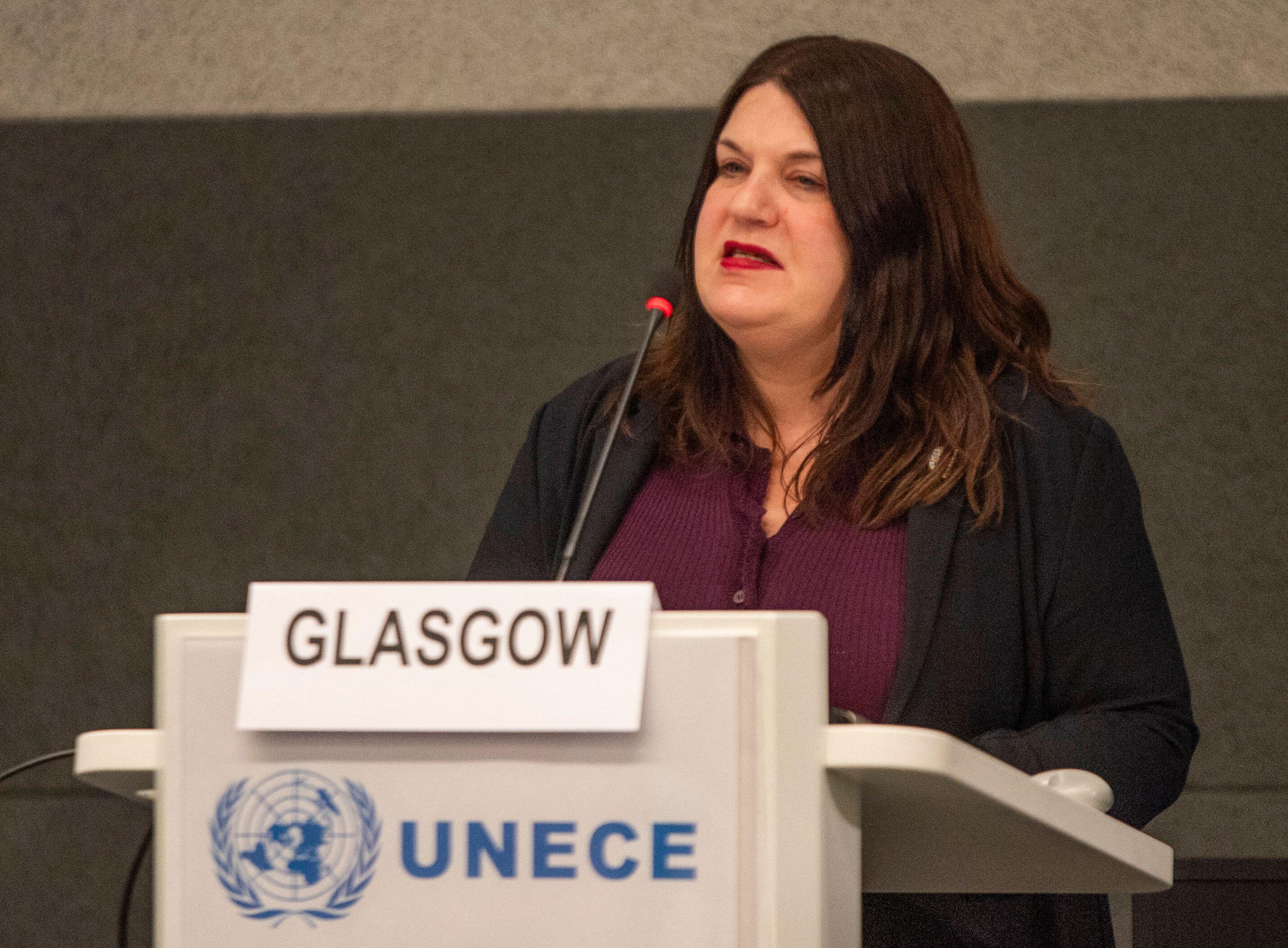
Susan Aitken addresses a meeting by United Nations Economic Commission for Europe in Switzerland | Alamy
If this is a ‘win’ for Aitken, it’s a win she needs. The SNP leader of the country’s largest local authority, she has been the focus of complaints about homelessness, facilities and more. As if to illustrate the point, her speech at the same conference was interrupted by activists from the Living Rent tenants’ union, who said they wanted her to address “poverty, housing costs, the cost of transport [and] our crumbling public services”.
According to the proposal from GCR – which also includes East Dunbartonshire, East Renfrewshire, Inverclyde, North Lanarkshire, Renfrewshire, South Lanarkshire and West Dunbartonshire councils – more powers and bigger budgets will deal with all of that amidst a costs hike that’s led to difficult choices.
The Accounts Commission has reported that councils face a £647m shortfall for 2025-26 – despite increased funding from the government. Cuts, tax hikes, charge increases and reserves have all been used to make up the difference. Perhaps its no wonder that local leaders are looking elsewhere for answers.
It has taken seven separate devolution deals for the Andy Burnham-led Greater Manchester Combined Authority to gain the range of powers it has, including a £6bn health and social care deal, a £300m housing fund, and oversight of police and fire services.
The exact detail of what Swinney is to offer remains to be seen, as does the small issue of what, if anything, will be on the cards for individual councils. And it will take buy-in from the UK Government to get to a deal that local leaders want.
Of all election issues, this is perhaps one that will mean little to the casual voter. But it is also a fundamental question of where power lies and who wields it. And it is one that could become a leading issue for the next parliament.
We have had a lot of problems along the way
“We would always work for more subsidiarity,” Cosla president Shona Morrison told Holyrood. “We want more powers locally – it’s threaded through our manifesto.”
It’s a tune Cosla has been playing for years now, and one which 2023’s Verity House Agreement could have gone some way to silence, had then-first minister Humza Yousaf not almost immediately breached its ‘no surprises’ clause by announcing a council tax freeze without first tipping local government leaders the wink.
The deal enshrined the maxim “local by default, national by agreement”, which recognises that responsibility generally lies, “in preference” with the part of government that is “closest to the citizen”. And for Cosla, that’s its members.
“It’s not perfect by any sense,” says Morrison of the agreement. “We have had a lot of problems along the way. But it’s a living deal and it’s still pretty much in its first iteration. When it comes to high level agreements on things like the fiscal framework, it’s of huge value.”
Now in her second term, Morrison became the first SNP councillor to head Cosla in 2022, and promised at the time to keep party politics out of it. But, with fewer than six months to go until the Scottish Parliament election, everything is political right now.
After a clutch of opinion polls, the received wisdom is that the SNP is on target for a win, albeit one that does not deliver a majority and will force it to work with partners across the aisles. But Anas Sarwar’s Labour is determined to do what it did at the Hamilton by-election and prove pollsters wrong. Its policy conference in Edinburgh last month heard discussions on measures covering major bases from health to transport.
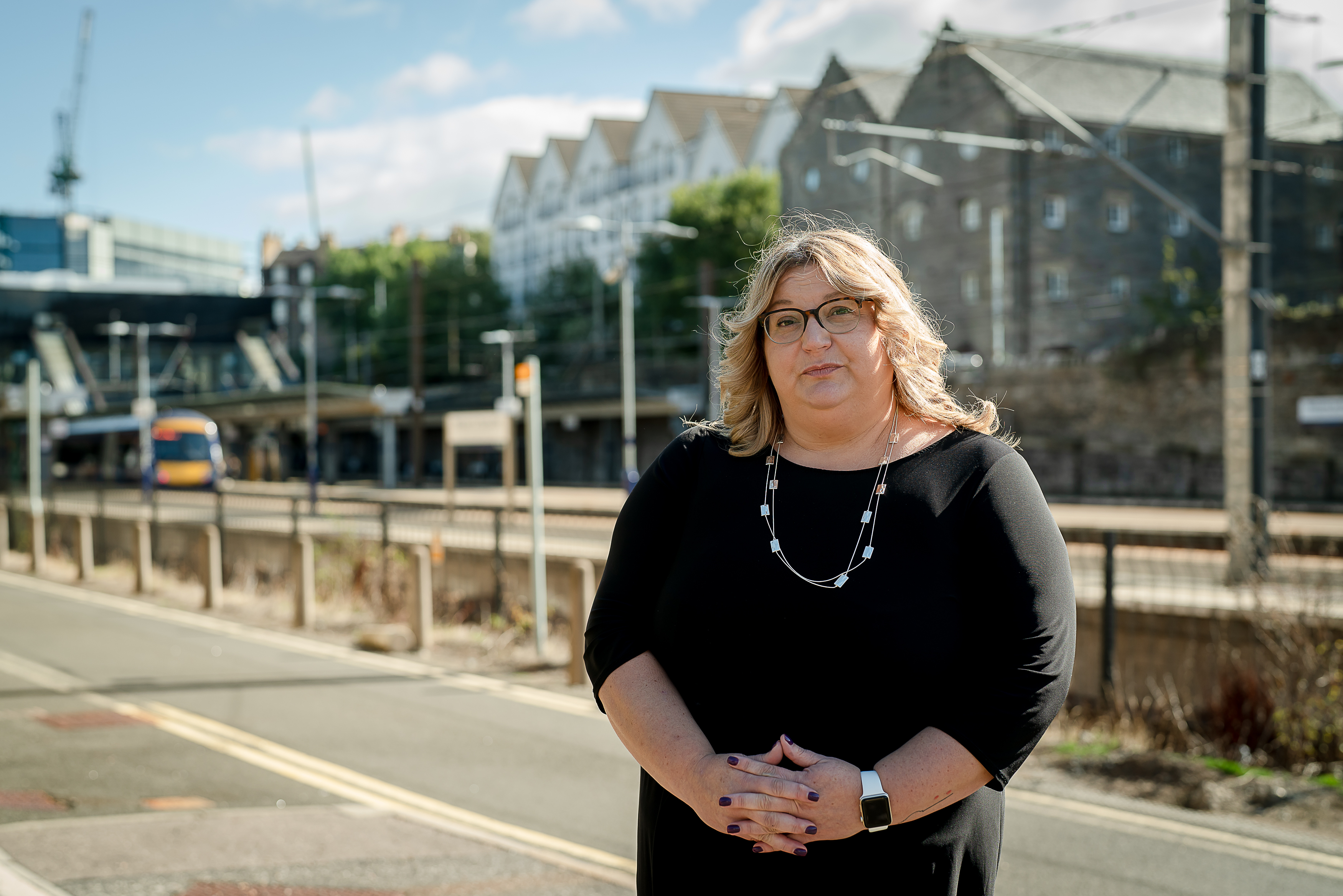
Shona Morrison photographed for Holyrood by Anna Moffat
But that enthusiasm for sharing ‘the message’ doesn’t always go down well. At FMQs the day after the Budget, Sarwar was admonished by the presiding officer three times for delivering a party-political monologue rather than a question. “Mr Sarwar,” Alison Johnstone said in her final intervention, “in future, when I ask you to put a question, put a question at that point.”
Scotland’s six city deal regions constitute half of the UK’s overall tally. Between London and Edinburgh, government has put £3bn into these since 2020 in the pursuit of economic growth.
According to the Mercat Group, the bodies were “welcome”, but also add “another batch of partially democratic bodies to the already crowded landscape of Scotland’s public services”.
There’s been no major reform of local government since 1996, before the devolution era. That saw the regional and district bodies that were formed in the 70s after the Wheatley review scrapped in favour of a model of 32 unitary authorities, with a host of public agencies set up at the same time. The change meant the end of mega-structures like Strathclyde Regional Council, a behemoth so big it was broken into 12 different parts in a step supposed to improve governance and services. But complaints followed about the way boundaries were drawn, with Highland Council ending up with a landmass as large as Belgium, about the ratio of councillors to constituents, and, increasingly, about creeping centralisation, with power drawn over years to parliament.
“Opinion polls have repeatedly found that trust in democracy at both national and local levels has been steadily declining,” the Mercat Group wrote. “In 1999, trust in the Scottish Parliament stood at 81 per cent; this had dropped to 47 per cent in the 2023 Scottish Social Attitude Survey. The latest Scottish Household Survey found that trust in local councils had declined to 53 per cent. After 25 years of the Scottish Parliament and 50 years since Wheatley, the last comprehensive review of public services, it is surely time for Scotland to think again. Despite devolution, Scotland is one of the most centralised democracies in Europe. There is an irrevocable need to repurpose local democracy, but how?”
The group’s answer to that is a ‘Scottish Civic Convention’ which would “reframe the way that all public services in Scotland are organised, financed and delivered” and work to set decision-making at its “most local level”. “The Scottish Parliament has, so far, assumed a top-down approach, and local democracy has perished in its wake,” the group wrote. “Both councils and communities have become less involved in shaping their futures as more decisions are taken centrally. The consequence has been the loss of trust in both councils and the Scottish Government.”
Trust is an issue for Cosla too. “Localism means trusting communities, empowering councils and rejecting unnecessary centralisation,” Morrison said at the body’s conference. “It means recognising that Scotland’s strength lies in its diversity – urban, rural, island – and that one-size-fits-all solutions rarely work.”
We have really huge budget pressures
It’s a common refrain from councillors. And yet there’s some scepticism about what an end to ring-fencing and the shifting of responsibility for national targets would mean for service delivery. “Everybody wants localism,” one councillor told Holyrood, “But no one wants a postcode lottery.”
If Scotland does take forward reforms, it will do so as similar processes continue in England, where the government is working to – in the words of local government minister Alison McGovern – “streamline” its system, replacing the existing two-tier structure with single-tier unitary councils. It’s the ticket to “quicker decisions to build homes, grow our towns and cities and connect people to jobs”, McGovern said, as well as “tackling deprivation and poverty”.
It is what has been referred to as “deep devolution”. According to Muscatelli, Scotland shouldn’t be left behind. “Scotland’s larger cities should be able to access the level of policy flexibility and power available elsewhere in the UK, devolving beyond Holyrood,” according to his report, and ministers in Westminster and Holyrood should “articulate what will come after” city and regional growth deals.
It’s worth noting that the conversation is playing out with just weeks to go until the delivery of Scotland’s annual budget. It was pushed back until January due to the later delivery of the chancellor’s autumn statement.
And whatever the medium and long-term ambitions of local leaders, their immediate priority is to get as beefy a settlement as possible from finance secretary Shona Robison – before they set individual spending plans of their own. “We have really huge budget pressures around energy and the cost of building is unbelievably high. It’s just eye-watering, it really is,” says Morrison. “Add to that the likes of employers’ National Insurance contributions – that was really challenging for all of our authorities in this past year – and add to that the really late notice around budget, and councils are feeling quite anxious.”
Holyrood Newsletters
Holyrood provides comprehensive coverage of Scottish politics, offering award-winning reporting and analysis: Subscribe