A qualified welcome: Are attitudes towards immigration changing?
The Cladhan Hotel lies a short walk from Falkirk town centre, a squat construction overlooked by nearby high-rises. Since 2022 it has housed asylum seekers, young men from Syria, Iran, Eritrea and elsewhere who crossed the Channel on small boats – usually inflatables such as ribs or dinghies – in search of a better life. But while they might have imagined themselves living in London, Manchester, Glasgow even, instead they’ve ended up in a hotel once used for wedding receptions and birthday parties, in an area with a population of around 160,000 where there are currently more than 10,000 applications on the council’s housing list.
The arrival of the refugees has bred fear, resentment and anger in some parts of the community. In 2023, Sadeq Nikzad, a 29-year-old asylum seeker from Afghanistan, raped a 15-year-old girl in Falkirk town centre. This summer, as Nikzad was jailed for nine years, weekly protests began outside the hotel in a bid to get it closed down. Similar protests have been held across the UK, including in Perth where the number of asylum seekers rose from zero in September 2021 to 205 in September 2025. In August, a group gathered outside the Radisson Blu hotel next to Perth railway station to protest against the housing of refugees.
First Minister John Swinney has accused some of those taking part in the protests of being racist. At the end of last month, the SNP leader wrote an open letter to refugees living in Scotland, expressing his “solidarity” and his belief that anti-immigration rhetoric “does not represent who we are in Scotland”. In Perth, in Swinney’s own constituency, the local council has warned of a small rise in racist incidents targeting asylum seekers, including someone being hit with an egg on the day of the hotel protest and racist graffiti featuring swastikas and the words “kill all blacks” having to be removed.
Swinney’s own rhetoric, however, belies the real situation in the country, where wider concerns about immigration are becoming an increasingly important issue for voters. Polling published last month by Ipsos found immigration to be the number one concern of UK voters, with 50 per cent of respondents mentioning it – well ahead of the economy (35 per cent) and the health service (25 per cent). North of the border, the Understanding Scotland Economy Tracker, a report produced by the Diffley Partnership alongside the David Hume Institute, found roughly one in five voters (22 per cent) see immigration as a top three priority – behind health and the cost of living – up from 16 per cent in May.
Migration Policy Scotland, a think tank which receives funding from the Scottish Government, has noted what it calls a “considerable cooling” of attitudes towards immigration. It found 45 per cent of Scots are in favour of a reduction in immigration levels, with 27 per cent happy for the levels to be maintained as they are.
“People tend to hold quite nuanced views,” says Sarah Kyambi, Migration Policy Scotland’s director. “They’re still quite positive in terms of immigration’s impacts. Yes, views are cooling but what we’re not seeing is an outbreak of outright hostility. There’s no room for complacency but it’s also more complicated than just to say people are straightforwardly against immigration.”
Immigration’s growing place in our politics has come at the same time as the rise of Reform UK, with some polls suggesting the party – which currently has just five MPs – could be on course for a sensational victory at the next general election, putting its leader, Nigel Farage, in Downing Street. The party’s next major electoral tests, however, will be in Wales and Scotland, with voters going to the polls in May for the Holyrood elections. A succession of opinion polls has predicted the party will win enough votes to secure a double-digit number of seats in the Scottish Parliament, with recently defected MSP Graham Simpson telling this magazine he hopes to have around 20 colleagues after the election.
Farage visited Falkirk earlier this month, leading to accusations he was stoking fears over the Cladhan Hotel. The protests against the asylum hotel, as with others elsewhere, have been met with counter-protests by those determined to show that refugees are indeed welcome here. During one evening protest in October, police had to lead anti-racism protestors to safety as they were harangued by a group of men, some with their faces covered and waving Union Jacks and Saltires.
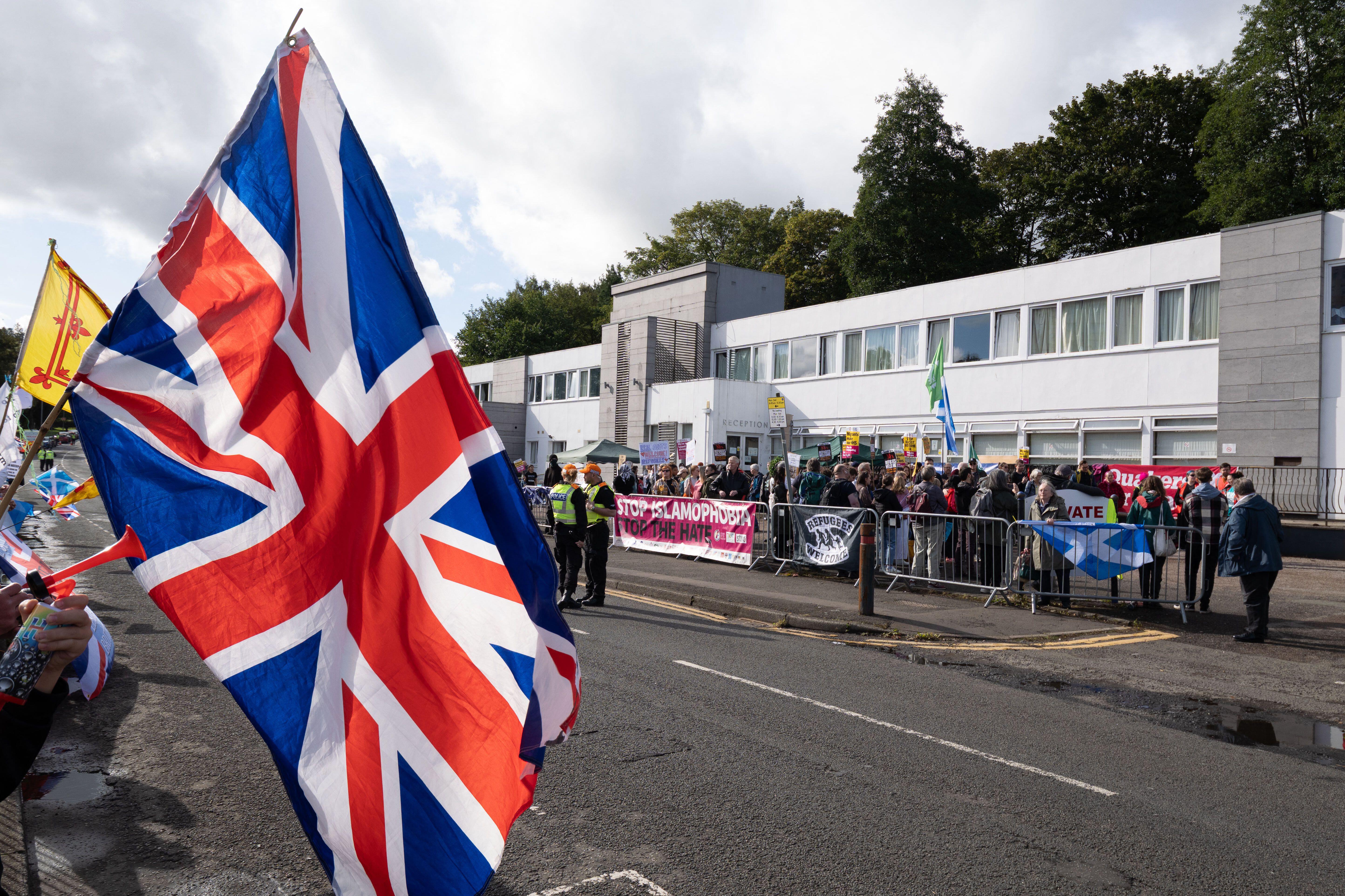 A protest and counter-protest at the Cladhan Hotel, Falkirk | Alamy
Reform’s councillors and candidates have been keen to talk about immigration and asylum, with Glasgow councillor Thomas Kerr, who defected from the Tories earlier this year, describing his city as being at “breaking point”, while giving support to those who have staged protests outside a primary school offering English classes for speakers of other languages (Esol). The city council has said the protest was orchestrated by “right-wing social media agitators” intent on “spreading fear and alarm”.
And yet for all the talk about immigration, these matters remain wholly reserved to Westminster, something highlighted by a row over the housing of refugees at an army barracks in Inverness. The Home Office had seemed intent on pushing ahead with the plan to house around 300 male asylum seekers at the MoD site, which lies close to the city centre, despite concerns raised by the Scottish Government and local MPs. However, late last month it emerged there would be a delay to the plan to use both Cameron Barracks and an army training camp at Crowborough in East Sussex as part of an attempt to reduce the number of hotels being used to accommodate asylum seekers.
Rachel Ormston, a pollster with Ipsos, says that while immigration has featured less in the political debate north of the border, the idea that Scots are more liberal on the issue has “never really been true”.
“Obviously support for Reform has gone up a lot in Scotland but it is still quite a way behind where it is in the UK overall,” she says. “It does look like there could be a fairly close race for second between Labour and Reform at Holyrood but that said, the SNP are still very clearly ahead. Whereas in the UK, Reform has been coming top in polls for a while now.
“I think there is a core of [Reform’s] vote for whom immigration is really important. They have captured the votes of the people who are concerned, even if that is a smaller group [in Scotland] relative to the rest of the UK. There’s also an appetite for change and a general dissatisfaction with politicians and politics… More people trust Reform than the Tories to tackle the cost of living, so I think they’re tapping into some other anxieties, not just immigration.”
Reform’s proposed changes to the immigration system include scrapping Indefinite Leave to Remain, which gives foreign nationals ‘settled’ status, allowing them to live, work and study in the UK for as long as they like and to claim benefits. Instead, Farage’s party wants migrants to reapply for a visa every five years, while barring anyone other than British citizens from accessing welfare. That includes stripping EU citizens of their right to claim benefits, a change which would require renegotiating the Brexit deal. Reform also wants to leave the European Convention on Human Rights (ECHR), arguing that will make it easier to deport those here illegally, a position shared by the Conservatives under Kemi Badenoch.
Labour Home Secretary Shabana Mahmood has for her part already set out sweeping changes to the immigration system, including a proposal which could see some migrants wait 20 years before being given leave to remain. While the standard wait will increase from five to 10 years under the proposals, any migrant reliant on benefits for more than a 12-month period will be forced to wait twice as long.
“I care about the fact I have an important job to do and can see there is a problem here that needs to be fixed,” Mahmood told MPs in a fiery Commons debate. Swinney later told MSPs the proposals risked “undermining the cohesion of our communities”.
 Locals in Kenmure Street, Glasgow block a raid by immigration officials | Alamy
Whether it was the families that arrived in the 1840s fleeing the Irish Famine or the increasing numbers who came from South Asia following Partition a century later, Glasgow has always prided itself on being a friendly and welcoming place. When immigration officials attempted to detain two men during a raid in Kenmure Street, Pollokshields in 2021, dozens of local residents blocked the road in an act of civic defiance which embarrassed the Home Office and gained national media coverage.
But there have been flash points too, such as the 2001 murder of Kurdish asylum seeker Firsat Dag, which led to rising tensions in the city’s Sighthill, or the deaths of a Russian family who jumped from the Red Road flats in Springburn in 2010 after their application to remain in the UK was refused. Despite the message from the Scottish Government that refugees are welcome, there has in recent years been some evidence of a hardening of attitudes.
The city’s SNP-led administration has complained about the growing burden of providing accommodation for those seeking asylum. According to the council, nearly half (44 per cent) of all homeless presentations are from refugee households, with 60 per cent of children living in temporary accommodation from refugee families. Council leader Susan Aitken has said the council will need to find £43m this year and £66m next year to meet the overspend in homelessness services.
Glasgow is Scotland’s largest dispersal area – the process by which the Home Office moves asylum seekers around the country. Figures from the University of Oxford’s Migration Observatory show that as of March this year, the city was providing accommodation for just over 4,000 asylum seekers, the equivalent of 64 asylum seekers per 10,000 residents and over the dispersal policy limit. In contrast, the country’s second-largest city, Edinburgh, was providing accommodation for just 159 asylum seekers, equivalent to three asylum seekers per 10,000 residents. Alongside Belfast, Coventry, Halton near Liverpool, and the London boroughs of Hillingdon and Hounslow, Glasgow is the one of the largest recipients of asylum seekers in the UK.
The story of asylum dispersal in the city goes back over a quarter of a century to when Glasgow became the only council in Scotland to sign up to the scheme following the passing of the Immigration and Asylum Act (1999). Prior to the decision to privatise the provision of asylum accommodation in 2012, the city benefitted from funding to provide wrap-around services and repurpose existing housing stock.
The dispersal scheme was altered in 2022 in a bid to reduce the reliance on hotel accommodation, changing it from a voluntary system to one in which every council participates. While Glasgow’s number of asylum seekers has reduced slightly – to 3,777 in September – other areas of the country have recorded an increase, albeit a limited one.
“The company that runs the dispersal scheme in Scotland has basically said it costs them too much money to house people outside of Glasgow,” says Dan Fisher, a research associate at the University of Glasgow’s Centre for Public Policy. “Based on the numbers we’ve seen so far and what they’ve been saying, it doesn’t look like we’ll see a massive rise in the number of people housed across Scotland – but that was before we saw the move to the Inverness barracks.”
The barracks proposal first came to light in October and led to criticism the Home Office had failed to properly consult on the plans, with Scottish Government ministers and the local Lib Dem MP claiming they first heard of it through the media. The initiative is part of the government’s move to reduce the number of asylum hotels, which cost the taxpayer £2.1bn in 2024/25 – an average of £5.8m a day. Earlier this year, the National Audit Office said the cost of contracts signed by the Conservative government in 2019 with three companies to provide asylum accommodation would likely top £15bn over a 10-year period, when the original cost was projected to be £4.5bn. The government has committed to ending the use of hotels to house asylum seekers by the end of the current parliament, although there is still some way to go with around 30,000 in that form of accommodation as of September. Amid the controversy, the Home Office last month delayed use of the barracks, saying it wanted to avoid rushed plans leading to “unsafe and chaotic situations”.
“Hotels and barracks become very visible points at which people are housed,” says Fisher. “They become a place at which people can protest outside of and also the kind of place where people are very visible because they have nothing to do all day because they’re not allowed to work. So they become a focal point.”
That’s certainly been the case at the Cladhan, where protestors and counter-protestors have faced off for months. In the same week that Farage was in the area, unveiling the defection from the Tories of former Scotland Office minister Malcolm Offord, another asylum seeker appeared in court, charged with two sexual assaults.
The number of those claiming asylum in the UK continues to rise, with figures from the Home Office showing the figure reached a record high of 110,051 in the year to September. Separately, however, net migration fell by two-thirds, with fewer people arriving in the UK for work or study.
This provides a particular challenge in Scotland where the birth rate is at an all-time low for the ninth year in a row. Meanwhile, there has been a 43 per cent increase in those aged 75 and over in the past 20 years. In its response to a UK Government White Paper on immigration published earlier this year, the Scottish Government called for an approach to migration policy which addressed depopulation and encouraged long-term settlement north of the border, while calling out the “unhelpful” focus on whether net migration goes up or down.
Migration Policy Scotland’s polling shows that while attitudes towards immigration may be cooling, Scots are generally positive about those who come here to work. The majority continue to support employers recruiting from overseas to fill vacancies (56 per cent), a figure which rises to 76 per cent for sectors facing shortages such as health and social care.
“A lot of the coverage has been on small boats and asylum hotels,” says Kyambi. “When you look at migration for work, we see very high levels of support for all the work visas – 70 per cent and above. We see very high levels of support for employers recruiting overseas.
“Our politics tries to make something that is really very complicated oversimple and creates an uglier debate around something where people’s views are really much more nuanced and balanced. Scotland needs migration in terms of its economy and its demographics and therefore needs to make a good job of integrating migrants.”
Holyrood Newsletters
Holyrood provides comprehensive coverage of Scottish politics, offering award-winning reporting and analysis: Subscribe