Election messages: Can John Swinney's grocery price plan buy the SNP another term?
John Swinney stood on a podium underneath a disco ball to unveil his party’s 2026 election manifesto.
It wasn’t part of the signage installed for the SNP event, but rather a fixture at the arts venue chosen for it.
With three weeks to go until the ballots close, it’s not time for celebrations yet and in her opening speech, education secretary Jenny Gilruth said there is “no such thing as a safe seat for the SNP” and the party will “fight for every vote, each and every time”.
But polls predict a win for Swinney, with the main point of contention seemingly how large that win will be. A majority will allow him to push forward with his promised indyref2 drive, pressuring Labour ministers to grant authority for another vote – something they have routinely said they will not do. A minority will likely still allow the party to form the next government, albeit with closer collaboration with others.
Those others might be the Scottish Greens, who launched their manifesto at the same venue in the east end of Glasgow.
Regardless, there is a confidence about the SNP now that was lacking some months back. That’s despite weathering Operation Branchform, floundering ferries, NHS waiting list woes and the Jordan Linden row that saw one of its candidates, Tracy Carragher, removed from the list as campaigning began.
Where there was a sense of ‘is that it?’ about Labour’s manifesto, the contents of which had been widely trailed before the launch, the SNP still had some surprises in store: a price cap on “essential” groceries, a £2 bus fare limit, a £200 Youth Culture Pass.
These are all measures geared towards the cost of living, and all will come at a cost to the taxpayer.
Anyone already sceptical about the affordability of other commitments like free prescriptions, school bags for primary one pupils, bus travel for younger and older people and university tuition will find little in these latest pledges to vote for.
But the party is betting on wider appeal to those who feel cut-off and ignored by politics – struggling households who are also being targeted hard by Reform and Labour.
There is an appeal, too, to business, with much said at the launch about efforts to attract inward investment.
Under Nicola Sturgeon, to whom Swinney was deputy, the SNP was increasingly seen as anti-business. Now it plans a Major Projects Office to handle “nationally significant projects” and a High-Growth Unit to find firms with the potential to become unicorns and bring them cash injections, as well as an expansion of the Scotland House network to seek further inward investment.
The plan is to “make Scotland the best place in Europe to start and scale a business”, Swinney said, with the party “hitting the accelerator” and reforming existing systems to help commerce.
The economy is indeed a top issue for voters, as is health. The groceries move will improve public health, the SNP claims, and it is striving to win back trust on that issue as strain on services continues.
That trust is an essential commodity you can’t put a price on. The SNP will be hoping it can do enough in the next three weeks to win over the large number of wavering or undecided voters out there.
Candidates said they believe that’s happening, thanks in no small part to Scottish Labour’s woes.
The party has been unable to recapture lost momentum and Malcolm Offord’s claim that Anas Sarwar had approached him about working with Reform, post-election, looks likely to prove to be one of the moments of the campaign – this contest’s version of Iain Gray hiding in a Subway branch, or Ed Miliband eating a bacon roll.
That’s regardless of Labour’s denial that the comment had been made in the first place.
“Under no circumstances will I engage in any cooperation or collaboration or collaboration with Reform in any way, shape or form, in the next parliament,” Swinney told the crowd. “And I think it would be a good thing if other people were much clearer on that question.”
Nigel Farage has said it would be “reasonable” to hold another indyref sometime in the future – if it becomes “relevant” again. When asked if that means the SNP’s agenda would be better served by a Reform government at Westminster, Swinney cracked back “good try”, adding: “The best way to get an independence referendum is for the SNP to get a majority on the seventh of May and that’s what I’m going to try to do.”
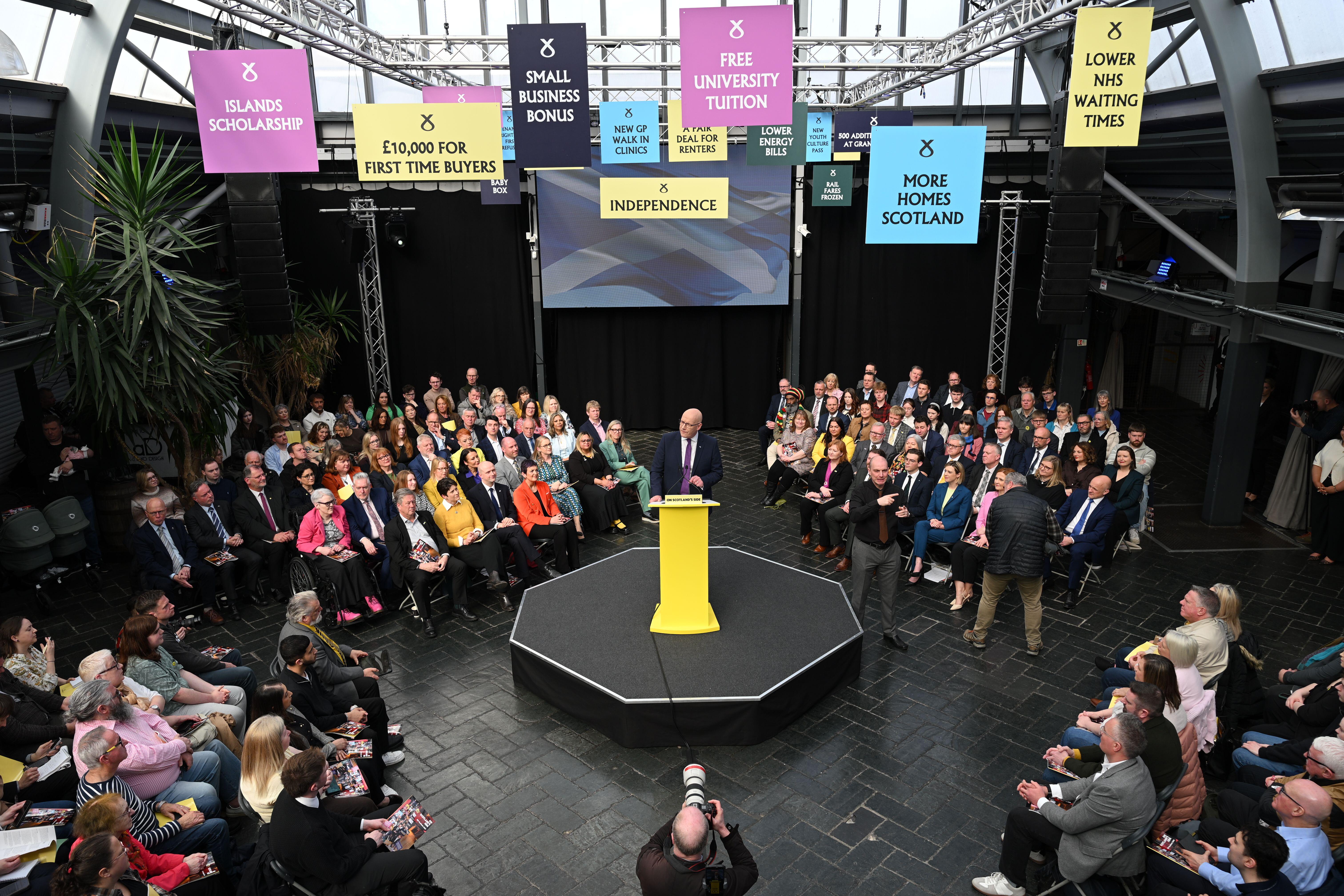
A majority is within the SNP’s grasp, Gilruth told the audience.
If it is achieved, it will prove that Swinney – the ‘bank manager’ brought in to steady the ship after the turbulence of Sturgeon’s later years and Humza Yousaf’s short reign – has reshaped the party, shifting it away from pardons for witches and onto less esoteric concerns.
Despite his nice-guy image, Swinney is a steely politician and there is something of that in the politics of the grocery price cap. If it goes ahead, Westminster must choose whether or not to block it, creating yet another constitutional stramash that will only give more power to the SNP's argument that the union is holding Scotland's parliament back.
And while the party's confidence is palpable, success is not assured by all. Angus Robertson may find his jacket on a shoogly peg in Edinburgh Central, for example, where former Green minister Lorna Slater is in contention, and there are question marks too over the chances for equalities minister Kaukab Stewart in Glasgow Southside.
Perhaps the biggest question marks of all are over deliverability and effectiveness. From a minimum income scheme for artists to an expansion of walk-in GP clinics, Swinney’s party has committed to a raft of actions across its 74-page plan that have raised eyebrows over not just how they will be achieved, but whether they can result in the significant, tangible impacts the public will need to see in the next five years.
For the Institute for Fiscal Studies, it’s all about affordability. David Phillips, head of devolved and local government finance at the think tank, said the party has unveiled £1.4bn-a-year additional spending pledges “without credibly saying how it would pay for this”, and tax rises or deeper spending cuts to lower-priority areas would likely be needed.
The food price policy “could be a radical but risky policy, or a paper tiger”, he said. “It is also possible that the UK Government would decide it is incompatible with the Internal Market Act.
“But it is independence that is front and centre of the SNP’s pitch to voters. As part of this, the manifesto highlights ‘years of austerity’ that Scotland has faced as part of the UK, and the impact of Brexit on the economy and ‘the amount of money available to fund our NHS’.
“Of course, independence is about more than the public finances. And there is scope for genuine debate about how independence would affect Scotland’s economy, public finances and public services in the long-term. Higher growth in an independent Scotland is far easier to promise than deliver, but is a possibility, with the right policies. The manifesto suggests lower energy costs would be one potential benefit, for example.
“But independence would not in itself ease the budgetary pressures faced by future Scottish Governments. Scotland currently enjoys higher public spending per person than the rest of the UK, funded largely via fiscal transfers from London and the South East of England. Those transfers would end with independence. Thus, while independence would give the Scottish Government power over more policies, if anything it would add to fiscal pressures – increasing the need for tax rises or spending cuts – at least in the short-term.”
Holyrood Newsletters
Holyrood provides comprehensive coverage of Scottish politics, offering award-winning reporting and analysis: Subscribe