Stephen Gethins: Nobody’s shouting about Brexit because it’s not been a success
Twenty-five years ago and 3,500 miles from home, Stephen Gethins received one of his first lessons in exactly how global Scotland’s energy sector was.
He had wound up in Baku, Azerbaijan, having spent the previous weeks travelling the wider Caucasus region as part of his job with an NGO. Not having spoken to another native English speaker in weeks, Gethins set out to find a touch of home. Back then, Baku was not “the city it is today” and there wasn’t “much in the way of infrastructure”, he says – but what it did have was three Scottish pubs catering to the high number of Scots in the city thanks to oil and gas.
“I remember on the chalkboards, because you were still using cash, when I turned up with my cash to change there was ‘Anglysky funt’ and ‘Shotlandsky funt’. That’s Russian, the lingua franca at the time, for ‘English pounds’ and ‘Scottish pounds’. They were the same exchange rates. What that told me is this is a sector with a global reach because of the skills and excellence and expertise.”
Fast-forward to today and Scotland’s energy minister says Scotland still retains that global advantage and is ready to move to its next phase. “For the past 40 or 50 years we’ve been leading the world,” he says. “The infrastructure that’s there in terms of the skills, the people, the companies, even the physical infrastructure as well, it gives us a competitive advantage to move into offshore renewables.”
That message is reflected in the Scottish National Party’s latest campaign, ‘It’s Scotland’s Energy’. An echo of the slogan the party adopted in the 1970s shortly after oil was discovered in the North Sea, it deliberately casts the net wider to reflect the move to green energy and the maturity of the North Sea basin.
That isn’t to say the Scottish Government is ready to give up on oil and gas quite yet. Gethins recently led a debate at the SNP autumn conference in Aberdeen to reiterate the party’s support for the sector, despite less than four years ago flirting with adopting a presumption against new developments as official policy.
The policy motion backed at conference called for the “utilisation of domestic production” and then using the “economic benefits… to help fund the transition to a net-zero economy”.
“I think it was important at conference that we had that discussion and debate,” Gethins says. “You’ll have seen as a part of that the areas where there was an open discussion about the climate impact of some of our energy. That’s a live discussion: if you’re importing oil and gas from elsewhere, what impact is that having on your climate ambitions?”
The Scottish Government’s current stance on the sector is that developments should be allowed to go ahead so long as it can be argued that doing so does not undermine the net zero target – an approach supported by the sector but criticised by climate activists, who argue there is no such thing as climate compatibility tests when it comes to fossil fuels.
The policy puts Scottish ministers at odds with the UK Government too, which has recently lodged its Energy Independence Bill. That aims to deliver on Labour’s manifesto commitment not to award any new licences for oil and gas developments. While it does carve out some limited exceptions where fields adjacent to existing ones can be explored, it is a significant step away from fossil fuels.
Speaking at First Minister’s Questions after the bill was introduced in Westminster, John Swinney argued decisions on the granting of licences must be made on a case-by-case basis, taking into account the fact the country would still be reliant on oil and gas for some years to come. The statement was seen by many as the final nail in the coffin for the ‘presumption against’ policy.
Included in the 2023 draft energy strategy, the SNP has been tying itself in knots ever since, trying to keep two very different parts of its voting base – North Sea backers and more climate-conscious types – happy at the same time. But it has been clear for some time that the party under Swinney has been distancing itself from the Nicola Sturgeon-era document.
Even Azerbaijan 25 years ago, with its three Scottish pubs, had a futures fund
Asked outright if the words ‘presumption against’ will be removed from the final energy strategy, Gethins declines to answer. “If I tell you what’s in the strategy before I tell parliament then I’d get myself into trouble,” he says. But, he adds, “a lot’s happened since 2023”.
As for the nearly four-year delay since the draft was released, he says he is “keen to produce that as soon as possible” but it was important to get it right. “The whole idea behind an energy strategy is to try and give the sector a wee bit of certainty to set out what is the direction of travel… We think too much in terms of parliamentary sessions; the energy sector thinks in terms of decades. And that’s something I’m really recognising in this job. The energy sector has to be a longer-term look.
“Now, obviously, with things like the SSEP [Strategic Spatial Energy Plan], there’s a lot that’s not within my gift, right? And I have to work within the powers I have rather than the powers I would like to have. They’re two different conversations. I need to acknowledge the very significant role that the UK [Government] has in all of this.
“I’ll work closely with my UK colleagues, but we were promised that we’d get the SSEP quite soon. If we’re going to get it soon, it would strike me as being unusual that you produce an energy strategy before we get the SSEP, for example. These are all bits of the jigsaw puzzle.”
Energy policy is a complicated portfolio when it comes to the devolution settlement. While many of the main levers – such as licencing – remain reserved, the Scottish Government has power over areas like planning and responsibility for climate change and the just transition. Naturally, decisions by UK ministers have significant ramifications on what actions are available to Scottish ministers. One area where that could not be clearer, Gethins says, is the failure of the UK to set up an oil fund, similar to that established by Norway, which could now be being used to fund the shift to a greener economy.
“That, for me, is the biggest single failure of energy policy of the past half century,” he says. “Now in fairness, I think the Labour government and [Chancellor] John Healey have recognised that with the establishment of a National Wealth Fund, but we’ve got a lot of making up to do. That makes our life, in terms of the transition, that little bit more difficult because it was treated as short-term income rather than getting the long-term benefit that pretty much every other country was doing. Even Azerbaijan 25 years ago, with its three Scottish pubs, had a futures fund at that point, and it was poor. It was one of the first things they did post-independence.”
He accuses successive Westminster governments of “short-termism”, bringing up the Energy Profits Levy as an example of the Treasury using the sector to “plug short-term gaps” in spending elsewhere. “What I want to see is a longer-term strategy,” he adds.
The Scottish Government, for its part, has committed to putting the cash generated through renewables back into the just transition. The ScotWind project – a series of offshore wind developments that aim to deliver 30GW of renewable energy by the mid-2030s – was supposed to be one such example.
Yet ministers have already drawn down £96m of that fund and expect to spend a further £507m of it by 2031, according to an Audit Scotland report published in September – though the watchdog said it is not clear how that cash is being used. It called on ministers to be more transparent. Gethins has said the government is still committed to setting up a ScotWind Wealth Fund by the end of this parliament.
“Look, that’s a conversation I’m really keen to have as we look to establishing that,” he says. But he adds the Audit Scotland report also highlighted the long-term nature of the investment rather than looking for “quick wins”. “The prize here is profound,” he says, going on to highlight the benefits at a local level, such as investment and jobs, to the wider impacts relating to household bills and energy security.
My colleagues in the other parties can’t just say ‘this is all dreadful’. They’ve got an opportunity to engage
These wider issues have shot up the agenda and become more linked in the public psyche following Russia’s invasion of Ukraine and then war in the Middle East. Beyond support for renewables, what can the energy minister of a sub-national government really do to improve Scotland’s energy security?
“The biggest tool at my disposal is probably some of the work that we’re doing on fuel poverty and energy efficiency. The heat in buildings bill that we’ll bring in this year is a significant bit of that work,” Gethins says.
That planned legislation has already hit up against some speedbumps. Due to have been brought forward in the last session of parliament, the bill was delayed following concerns about the extra cost it would heap on households. Decarbonisation of Scotland’s housing stock will come with a hefty price tag, and the government wanted more time to ensure it could be delivered without making fuel poverty worse.
The Buildings (Heating and Energy Performance) and Heat Networks (Scotland) Bill is now set to be introduced this parliamentary year, and Gethins says he’s been “having conversations with my colleagues in other parties” to get it across the line. He says most of the parties “fundamentally agree” on its premise – and he is hopeful proper engagement will ultimately create better legislation.
“My biggest criticism of Westminster was the way in which there isn’t the culture of engaging over things like bills and elsewhere. I actually think it makes for better legislation because it means that I as a minister have to be cognisant of what my colleagues in the opposition might think and try and build coalitions,” he says. “But the flip side of that is my colleagues in the other parties can’t just say ‘this is all dreadful’. They’ve got an opportunity to engage, get some wins, and I think that makes for better governance.”
However, Gethins is also convinced Scotland has a greater role to play in energy security beyond what he can achieve domestically. Perhaps that is why his full portfolio covers all three of energy, Europe and external affairs – an unusual combination at first glance.
“When I spend time in any other European capital or speak to colleagues in other European political parties and elsewhere, what’s on their mind is pan-European energy security. When I talk to [the energy] industry, as I said earlier on, they think in terms of 30, 40, 50 years. The thought that in 30, 40, 50 years we will not have greater energy union, or interconnectedness, is for the birds. If we don’t, we’ve failed. And so, we’re having to think about the world as it exists decades from now, where I’m no longer in this post and somebody else is doing it.
“We’re a massive exporter of electricity, right? We are part of the solution. I’m pleased we’re an exporter of electricity because that creates jobs and investment at home. So there’s a huge opportunity here.
“The full-scale invasion of Ukraine in February 2022 changed the world profoundly. [It changed] how Europe saw its own strategic autonomy, not just in terms of hard security but also food and drink and energy, and Scotland’s got a distinctive role to play in that.”
Indeed, improved security is one of the reasons Prime Minister Andy Burnham is currently prioritising building a new relationship with European counterparts. While Gethins welcomes the change in attitude – because “unpicking any of the damage [of Brexit] is to be welcomed” – he says all that means for now is “making things less bad; you’re not making them better”.
He suggests the Labour government is “tinkering” when what is needed is fundamental change. Ideally, that would look like the UK rejoining the EU. Short of that, he would welcome some movement on the “red lines” on the customs union and single market.
“Progress is good and it’s good to see the prime minister opening up that discussion, that the inertia of Brexit is starting to come to an end. We just went through the 10th anniversary of the referendum. If that had been a success, those who argued for it would have been shouting about it because in politics you shout about your success. Nobody’s shouting about this because it’s not been a success. But I think we’re in danger of tinkering.”
Gethins has a decidedly international perspective on politics. This might be typical of much of the modern SNP, but for him it is born of experience. Before entering politics, his NGO role saw him spend a great deal of time in eastern Europe and the Caucasus – largely focused on “small arms proliferation, the aftermath of war [and] how that was driving conflicts”. He also worked in Brussels, before becoming a special adviser on Europe and international affairs to Alex Salmond.
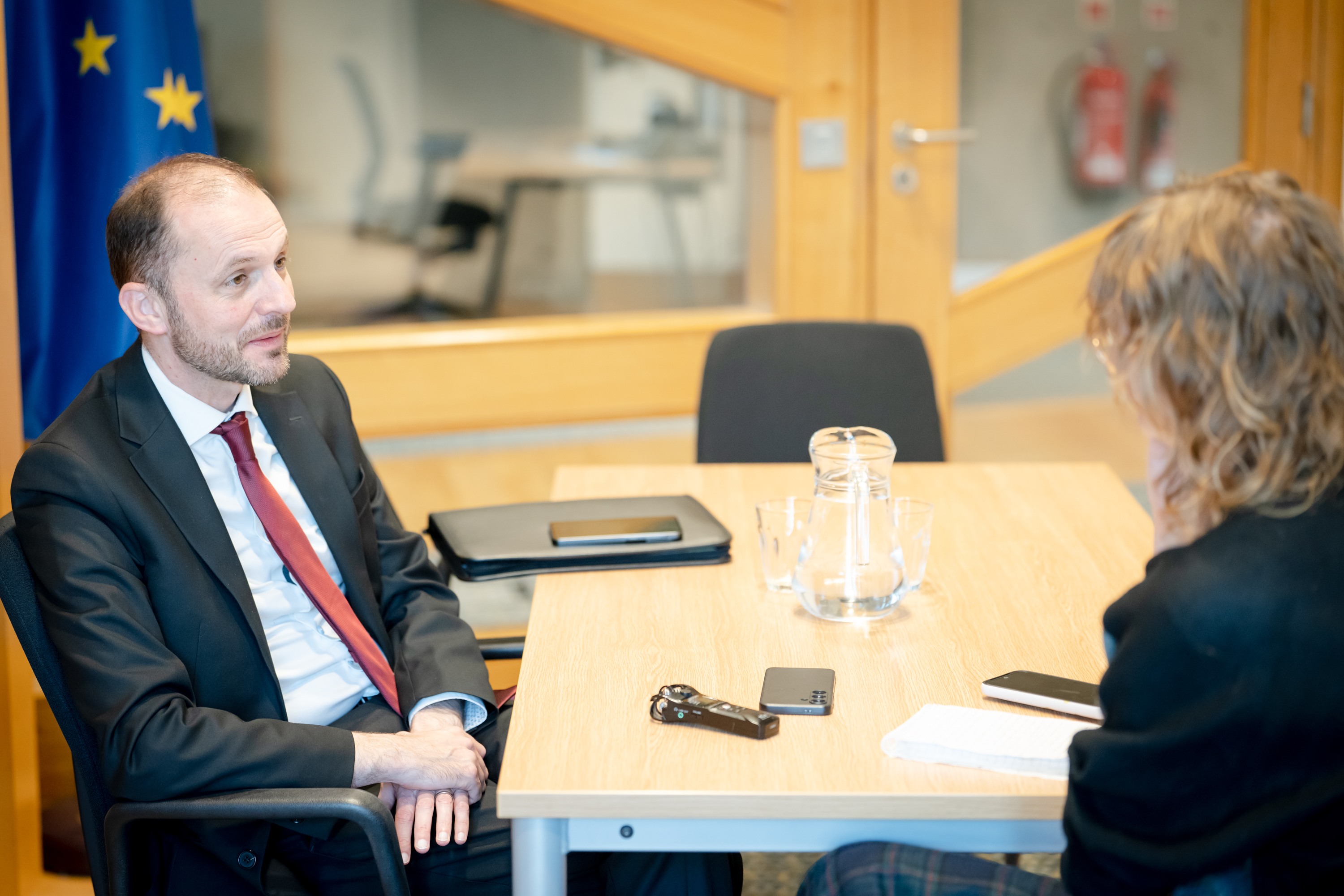
How has all this experience shaped his worldview? “Profoundly,” he replies. “We live in an interconnected international world. I’ve got a European flag up for a reason. I think that is the future… How do states interact with each other, how do we bring society together?”
He believes that recent choices of the UK have meant it is “in danger of losing” that interconnectedness. That could have significant ramifications beyond the immediate impacts of Brexit. “In the face of Russian aggression and challenges in the world like China, the USA withdrawing in and of itself – because even with the midterm results as they were that it doesn’t change the United States – it means that democratic Europe has to pull closer together.
“We need to be more interconnected with our energy, food and drink, security. That’s the future. You sit outside that, you leave yourself in danger.”
Holyrood Newsletters
Holyrood provides comprehensive coverage of Scottish politics, offering award-winning reporting and analysis: Subscribe