Going in reverse: Is it time for the UK to rejoin the EU?
The Brexit we were given has not worked,” Prime Minister Andy Burnham said in his speech at last week’s Lord Mayor’s Banquet, “we have lost more than we have gained.” Those words are largely uncontroversial – even the most ardent Brexiteer would concede that a decade on from Britain’s vote to leave the European Union, the act of ‘taking back control’ has not been an unalloyed success. Indeed, Nigel Farage, an architect of Brexit and the politician who has profited most out of the past decade of drift and division, has admitted as much. But while Burnham’s language is not particularly new – his predecessor used the same event the previous year to say Brexit’s cure-all promise had been “proved wrong” – his willingness to entertain the possibility of reversing the decision is.
Whether you regarded Brexit as an exercise in sovereignty or an act of national self-harm, the figures speak for themselves. In the decade since the vote and the six years since Britain formally left the EU, it is estimated the overall size of the economy shrunk by around six per cent. Analysis carried out by Stanford University’s Institute for Economic Policy Research reckons that by 2025, investment reduced by 12-18 per cent and productivity by three to four per cent due to a combination of elevated uncertainty, reduced demand, diverted management time and increased misallocation of resources from a protracted Brexit process. According to the Office for Budget Responsibility, the UK’s economy could end up being around four per cent smaller in the long run as a result of leaving the EU.
And that’s just the economics. One of the promises of EU withdrawal was that ‘independence’ from Brussels would reduce freedom of movement and allow for the securing of borders. The opposite happened. Net migration hit a record 900,000 in the year to June 2023 amid the relaxation of visa rules for students and care workers and the worsening of the small boats crisis. In the period 2021-2024, the population of the UK grew by more than two million due to the so-called Boriswave of immigration. All that made for a period of political tumult unlike anything in living memory. Since David Cameron’s resignation on the day after the Brexit vote, Britain has had six further prime ministers. By comparison, there were just 20 occupants of 10 Downing Street in the whole of the 20th century.
“I know it would be much easier to say nothing about the EU,” Burnham said. “That’s probably the conventional Westminster view. But if we are going to be serious about growth, then we are going to have to have this conversation.
“It’s like the emperor’s new clothes – where no one is prepared to say the obvious truth.”
The government is expected to introduce legislation in the Commons this week, part of a Brexit “reset” signed at the UK-EU summit in Brussels on Friday. The agreement will make it easier for British producers to export food and agricultural goods in return for the EU setting rules on veterinary and food standards, including regulating what pesticides can be used on British crops. Farage has already said he will scrap the deal if he ever comes to power.
While Burnham has been willing to finally address the elephant in the room and acknowledge Brexit’s drag effect, these are but the first tentative steps towards a possible rapprochement, an attempt to take the temperature by dipping his toes in the potentially choppy waters of the Channel. Polling suggests that most voters support a reappraisal of Britain’s relationship with the EU, with a narrow majority perhaps in favour of rejoining. But polling can be wrong – just ask David Cameron.
It was Cameron, himself a Remainer, who called the EU referendum to end the long-running row about Europe within his own party but succeeded instead in ending his premiership, while setting Britain on a course towards populism and the less-than-stellar governments of Boris Johnson and Liz Truss. Now Lord Cameron of Chipping Norton, the former Tory leader has warned Burnham that the journey back towards full EU membership would be “long and painful”.
“If you start endlessly producing this idea that we’re actually on a path to rejoining, I think you’re in danger of getting a less good partnership deal because of course the EU countries will just think, well, these guys are going to rejoin anyway so what’s the point in giving them a good partnership deal,” Cameron said.
One politician who supports re-joining the EU is Labour’s new leader in Scotland, Michael Marra. In his first major speech since replacing Anas Sarwar, Marra said Scotland would be stronger as part of Europe, although he conceded there were “serious questions” to be asked about borders and possible currency convergence.
“The UK should rejoin the European Union and Scottish Labour will work to make that happen,” Marra said. “I don’t pretend it will happen quickly. But I believe we should set it as a long-term objective for the UK, and that Scotland should lead the change in making that happen.”
Just a few weeks earlier, Marra had struck an entirely different tone, telling delegates at his party’s conference in Liverpool that returning to the EU was not a “realistic prospect” due to the “huge political instability” across Europe. But while Keir Starmer attempted to stifle any suggestion of a return to full EU membership, Burnham has eased some of the restrictions on internal debate about Britain’s relationship with its nearest neighbours. Marra took Burnham at his word about an “honest discussion”, becoming the first major Labour figure to call for Brexit to be reversed.
In truth, that position is considerably easier to take for Marra than some of his counterparts south of the border. In 2016, Scotland was the most pro-EU part of the UK, with a majority of voters in every council area and 62 per cent nationwide voting to remain. In contrast, just 47 per cent of voters in England did the same, with most councils in the north of the country voting to leave. While Burnham’s position has been backed by high-profile figures in the Cabinet such as Angela Rayner and Ed Miliband, as well as former chancellor Rachel Reeves, litigating the arguments of the referendum all over again is likely to be deeply unpopular with Red Wall MPs who face a significant challenge from Reform at the next general election.
North Northumberland MP David Smith, a Scot who backed Remain, has called the vote a “generational” decision which shouldn’t be revisited. Meanwhile, Jonathan Brash, the Labour MP for Hartlepool, said his party could not keep “playing a sort of Brexit Hokey Cokey”, while Jon Trickett, MP for Normanton and Hemsworth, said reopening the Brexit debate would “betray” Labour’s manifesto promises and “plunge the nation into paralysing polarisation”.
Earlier this month, Alloa and Grangemouth MP Brian Leishman became the first Scottish Labour MP to admit to voting for Brexit. Speaking to The Scotsman, he said he hadn’t changed his mind in the decade since the vote.
“I voted leave because the EU is a pro-capitalist, pro-imperialist project,” he said. “You can see it right now. It is terrifying. This re-arm Europe, getting all the member states to five per cent.
“It’s just going to feed the military-industrial complex, and what that then means is you’re going to then have extreme austerity across Europe, where people’s living standards will deteriorate to then fund your arms manufacturers.”
For understandable reasons, Scottish Labour has been less than enthusiastic to entertain much talk of constitutional politics in recent years. Marra knows that revisiting the result of the 2016 EU vote will inevitably lead to calls to do the same thing with another referendum held just two years earlier. But with membership of the EU remaining popular north of the border, the Labour leader realises that arguing in favour of re-entry helps blunt at least one SNP argument, namely that a vote for Scottish independence is the quickest route back into Europe.
“Brexit has been an abject disaster,” First Minister John Swinney said. “People in Scotland knew this would be the outcome of cutting our close ties when they voted against leaving the EU a decade ago.
“The prime minister has acknowledged the huge damage caused by Brexit but at the same time appears to be ruling out the only way to reverse that damage, which is rejoining the EU. Our interests are best served by returning to the EU as quickly as possible, while the UK Government appears to be intent on sticking with its opposition to the single market, the customs union and freedom of movement.”
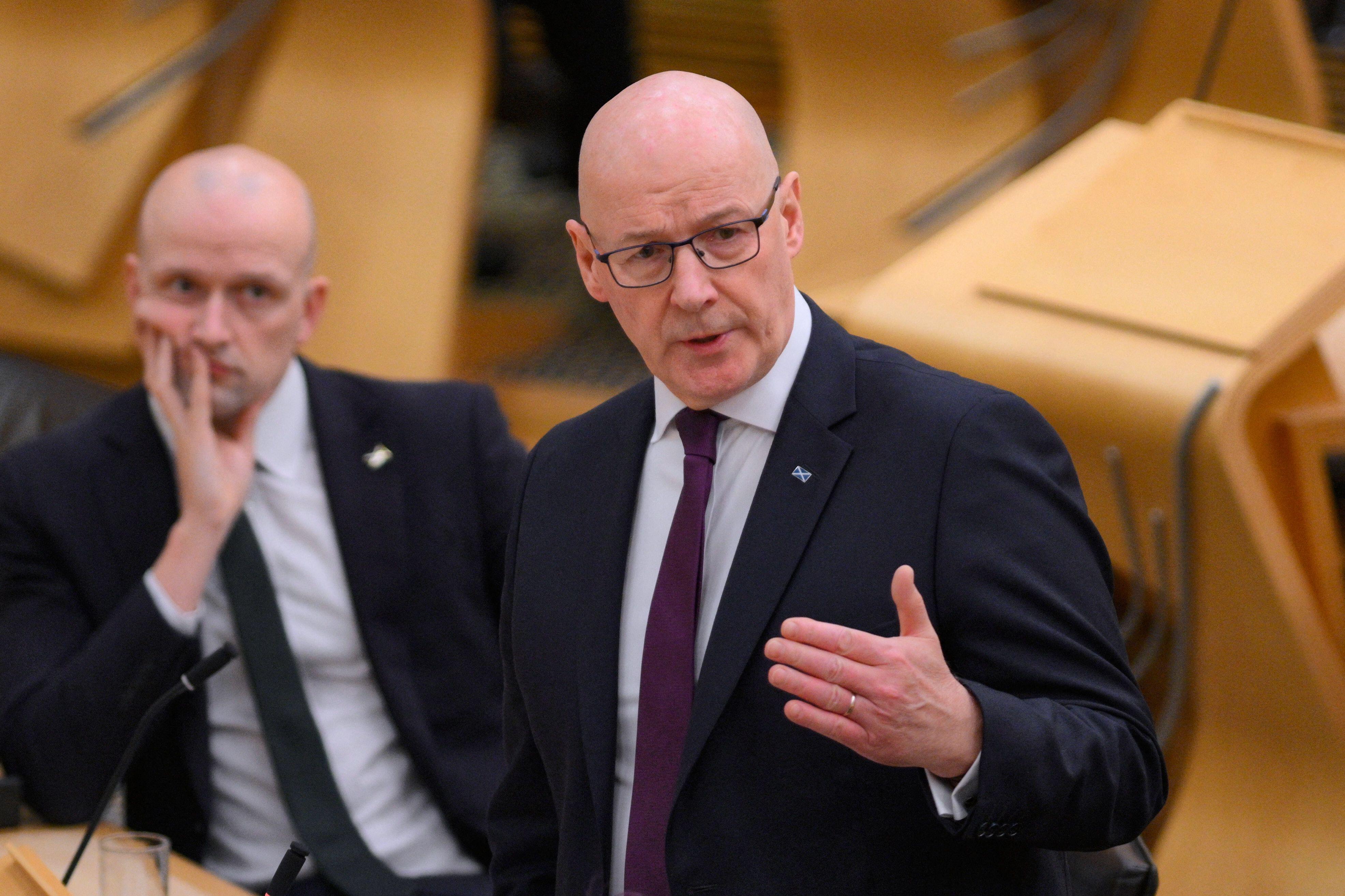 John Swinney says Brexit has been an 'abject disaster' | Alamy
Marra, who said he didn’t “really care” what the SNP made of his proposal, can at least argue that there is a sound economic basis for reversing Brexit while Scottish independence remains a leap into the unknown. But Burnham has so far shown himself to be less than adept at navigating Scotland’s own constitutional question, seemingly opening the way for another referendum in an answer to a question about Northern Ireland and the Good Friday Agreement only to get back on message days later by ruling out another indyref. A similarly shaky position on Europe could prove to be a huge asset for both the Conservatives and Reform ahead of the next general election.
The prime minister has sought to place Britain’s decision to leave the EU not only in an economic context but a geopolitical one. He said a harder than expected Brexit deal had “burnt bridges” with friends and neighbours and was the “first domino to fall” in a global move towards isolationism and protectionism. Russia’s invasion of Ukraine has certainly focused minds in Europe, with longtime refuseniks Sweden and Finland becoming full Nato members and Germany massively increasing defence spending, having recently signed off its second-highest level of borrowing since the Second World War.
“Russia wanted disunity within Nato and a weaker Europe less able to counter its plans for Ukraine,” Burnham said. “In 2016 it looked a lot easier to go it alone. Today, not so much. We can’t ignore this reality, nor the fact that we have a club of democracies on our doorstep which shares so many of our values and our interests.”
But despite a united front in support of Ukraine and against Russian aggression, Europe could be about to undergo a major realignment with important elections taking place in France next year and in Germany in 2029. The current favourite to be the next occupant of the Élysée Palace is Marine Le Pen, leader of the far-right National Rally which is currently paying back a €6m loan to a Russian company to help counter attacks from opponents about alleged links to the Kremlin.
While Le Pen has committed to continuing military support for Ukraine, she has promised a re-evaluation of France’s relationship with Brussels, proposing a referendum on the primacy of EU law over immigration, although her party has abandoned plans for a “Frexit” or leaving the eurozone. In Germany, the far-right Alternative for Deutschland (AfD), assessed by the country’s own intelligence services as “right-wing extremist”, recently made a significant electoral breakthrough, winning the eastern state of Saxony-Anhalt. The party’s leader, Alice Weidel, has called on Chancellor Friedrich Merz to stop funding Ukraine’s war effort against Moscow.
Burnham is right that a lot has changed in the decade since Britain’s decision to leave the EU. For starters, the world has become a more dangerous and unpredictable place. As the prime minister prepared to meet Ursula von der Leyen in Brussels last week, Donald Trump was having his own meeting with Vladimir Putin and Xi Jinping. The three men would no doubt like to divide the world into spheres of influence and the US is not the reliable partner it once was.
Rejoining the EU is far from being a fait accompli. Senior European diplomats are reported to have cautioned Britain against a piecemeal approach to re-entry, saying they will not entertain talks until the PM has committed to undoing the result of the 2016 referendum. Putting things into reverse on the question of Europe makes sense for Britain in a world of changing international partnerships but Burnham can be in no doubt that full EU membership will be a long road back.
Holyrood Newsletters
Holyrood provides comprehensive coverage of Scottish politics, offering award-winning reporting and analysis: Subscribe