Paul Higgins: So many people are one bad decision away from disaster
Paul Higgins pressed play and recorded a message for his friend’s teenager daughter. “Don’t fail your exams like some clueless f***ing egg c**t,” he snarled.
“She loved it,” he smiles.
Higgins was channeling one of his most enduring characters, The Thick of It spin doctor Jamie McDonald, the angriest man in Motherwell and a member of Malcolm Tucker’s “Caledonian mafia”.
A New Labour-era satire starring Peter Capaldi as a veiled version of Blair administration enforcer Alastair Campbell, just 23 episodes were made, with Higgins’ Jamie appearing in only a fraction of these as well as its feature-length spin-off, In the Loop. Regardless, he became a cult figure. Direct to the point of harassment, encouraging to the point of abuse, McDonald hates everyone – the opposition, the media and certainly the ministers he is supposed to make look good. Viewers loved him. And so, 20 years since the series first aired, Higgins finds himself recording the odd sweary voicenote for the lucky members of this new generation of fans. “It’s a weird thing to do for a young woman you don’t really know,” he concedes.
The day before we meet opposite the Houses of Parliament, Higgins had to confirm to a 20-something assistant in Holland & Barrett that, yes, he was in the BBC series. Moments after we say our goodbyes, he will walk past Michael Gove, who will give him “a big grin”.
Born in Wishaw, Higgins lives in London with his actor wife Amelia Bullmore, star of Riot Women and The Buccaneers, with whom he has two daughters.
But he’s been thinking a lot recently about his past – the early, difficult years when he crammed into a room with his four siblings in a council house without a bathroom. It wasn’t until after he’d left home that the facility was put in, meaning he bathed in a tin bath in the front room or kitchen until the age of 18. It’s a world away from the life he’s built for himself, which spans everything from Shakespeare to Celebrity Mastermind. “When I tell guys at work, they just can’t believe it,” he says. “When we’re hanging about in the dressing room or whatever and it’s come up, they thought it was stuff that had gone out with Dickens.”
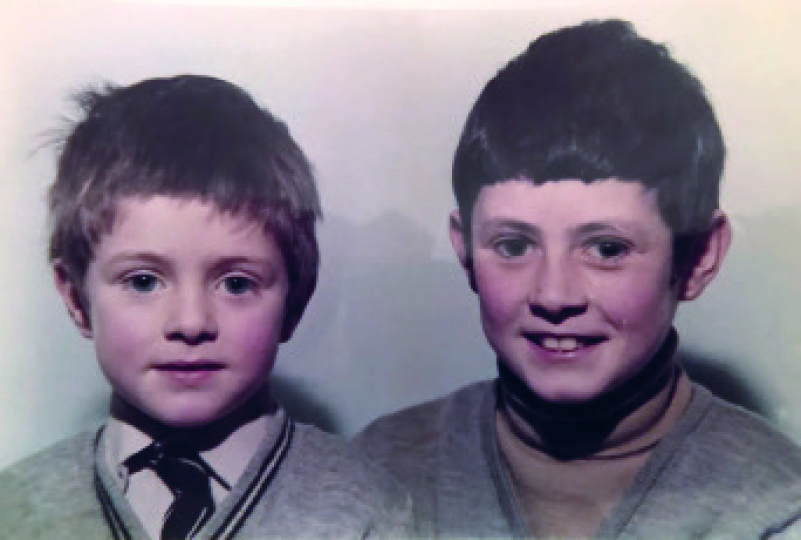 Higgins with brother John | Paul Higgins
As the 1970s turned into the Thatcherite 80s, the family was hemmed in by worklessness, addiction and poverty. His Catholic parents wouldn’t divorce but had spent years in unhappy matrimony. His father drank heavily and sometimes there wouldn’t be any food, but Higgins and his siblings were ordered not to take the free school meals they were entitled to, because then “everyone would know” how bad things were. At 12, he made an escape to a seminary but that ended prematurely when, at 17, he was caught sneaking out to meet a girl and told to choose between a lumber and the Lord. By the time he was leaving school he wanted to get as far away as possible and landed in London to study drama, courtesy of a grant from Strathclyde Regional Council.
All the hardship inspired his 2008 play Nobody Will Ever Forgive Us, which starred Gary Lewis as a volatile patriarch, and is outlined in a blog post Higgins published in 2021 which details his break from alcohol abuse. “It is surprising but true that having got pretty much drunk, pretty much every night, for 30 years, I left alcohol behind with barely a glance back,” he wrote, but noted that his first sober Christmas “was like spending the night alone in a haunted house”.
He’s been thinking hard about the limitations poverty places on families like his, in part because of a film he made for the charity ATD Fourth World, which fights deprivation. The organisation founded the International Day for the Eradication of Poverty, which has been taken up by the UN, and he’s been taking testimony from people living on low incomes. “I was hearing a lot of people feeling really disrespected and like they are not useful, valuable members of society – like poor people don’t do anything except sponge off the state,” he says.
“There isn’t any need for people in Britain to live in poverty, with the size of the British economy, but there’s a political desire for people to live in poverty, because the only way to have a low-wage society is for people to live in fear of poverty.
“In the last few days I have been going over and over this kind of thing of how a few thousand quid can make a huge difference in someone’s life,” he goes on. Take his older brother John, for instance, who died at the age of 37.
He’d also been a heavy drinker, having wound up in London too. Higgins says the catalyst for that move was that he’d made “a big mistake”.
If we’d had any spare money, I think his life might have been very different
Sitting in the café of the Supreme Court, he doesn’t want to elaborate, but in his blog Higgins writes that John had “escaped/been banished… after getting a young Protestant woman pregnant”. He later married and had a fatal heart attack one morning before work.
“If we’d had any spare money, I think his life might have been very different,” Higgins says of John.
“He made a big mistake and he ran away from it, and he ran away from it because he couldn’t financially cope. A lot of people make mistakes when they’re young and your family can help you out. If my children got into a mess, we would have the resources to help put things right and to be able to think ‘how can we do the right thing here?’ A little bit of money makes an enormous difference to people, to their choices and to their possibilities.”
The cogitation is creative. Higgins has written a film script inspired by these themes and is developing it into a play which is now “nearly finished”. “It’s amazing that it’s doable without really changing the core of it,” he says of the screen-to-stage process. “I’m really excited about it.”
Is it the sort of project he could see coming to the Traverse Theatre, as with Nobody Will Ever Forgive Us? “I have a feeling I’m going to have to generate the whole thing myself, and I don’t think that’s necessarily a bad thing,” he says.
After all, “new work is risky” for theatres. Scotland’s culture sector has been vocal about its financial challenges in recent months. Higgins says that’s not an isolated situation. “I think that’s true across the board, it’s even true of the National Theatre,” he says. “That’s the economic necessity. A place like the Donmar [Warehouse] where I have worked a lot, they lost all their subsidy – all of it – and the Almeida didn’t lose all of it, but they lost a lot. These are places where new work goes on and that has a massive impact,” he goes on, but crowd-pleasers now take up more of the programme because “they need to make more of their money from ticket sales”.
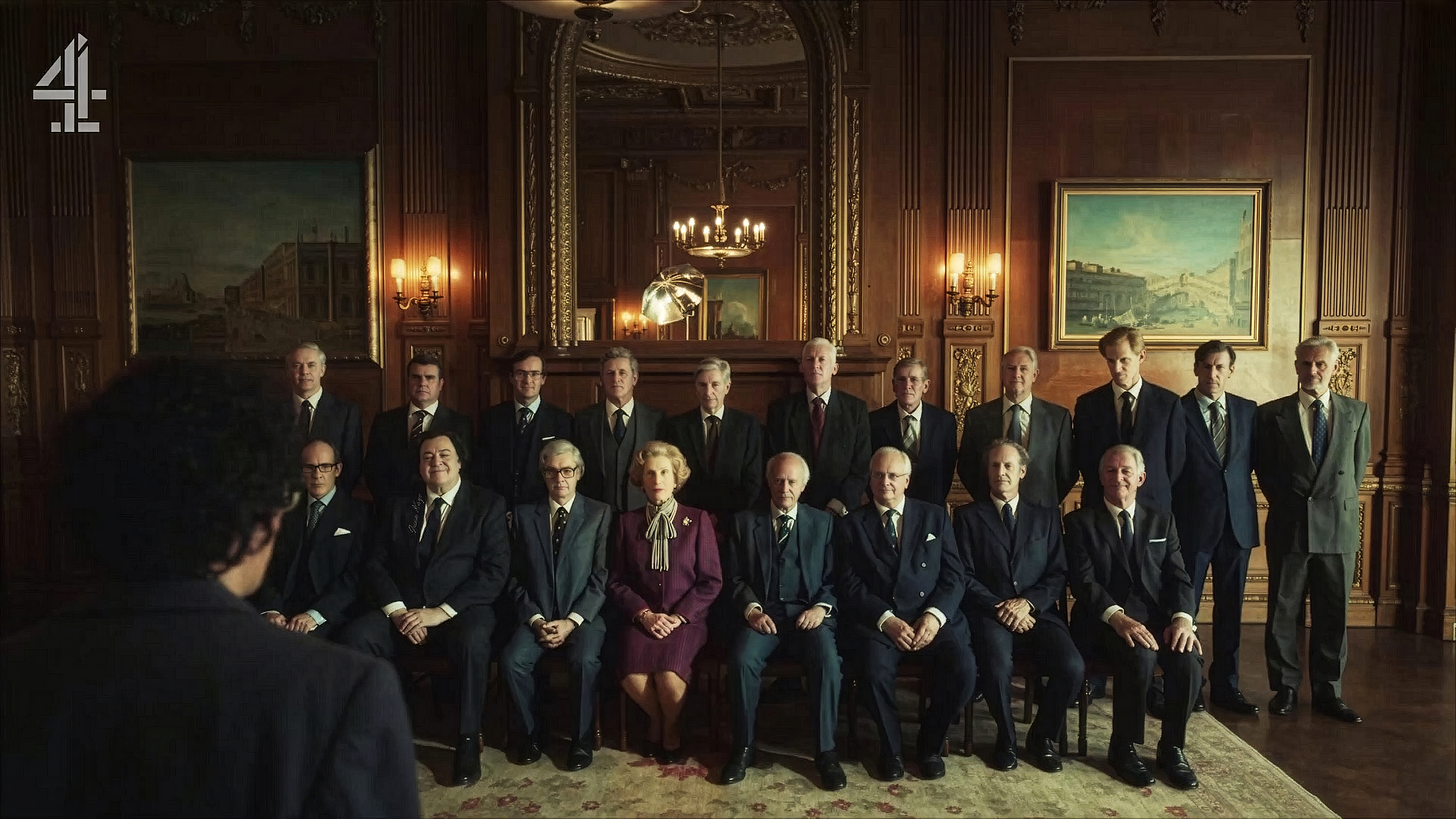 Higgins as Howe | Channel 4
Higgins is wary of state intervention in the arts, however, because after all “you don’t want government interfering in what people write or what they TV companies put on”.
His career has seen him assume government roles several times, from playing a compromised civil servant in Channel 4 series Utopia to the minister of defence in ITV’s remake of The Ipcress File and even Geoffrey Howe in last year’s Brian and Maggie, which dramatised the 1989 TV interview that triggered Thatcher’s downfall.
The latter was one of those jobs where Higgins was baffled to be called in. He often wonders why casting directors want to see him, he says, and has decided it’s because “actually they do have an eye on different voices, different accents”. He initially didn’t see himself as a fit for the role, but a play about with speech and mannerisms proved otherwise, and then there he was getting a grey wig custom-made. “What a weird job,” he says of that one.
Higgins is, he admits, a political animal. Why else would he have gone on Celebrity Mastermind with Watergate as his specialist subject? He won the series in 2019 and is somewhat obsessed with the scandal that brought down Richard Nixon.
“The reason I did the series is I’ve always known what my subject would be. It has everything. People don’t understand now that for a long, long time nobody knew about the tapes, they thought it would always be one person’s word against another and you’d always have to make your own judgement about what was true.”
We speak one day after the death of Alexander Butterfield, the White House aide who revealed the existence of the damning recordings revealing the Nixon administration’s involvement in the cover-up of a break-in at the Democratic National Committee offices in 1972.
he still felt like a piece of shit, and he was really out to get his enemies
Higgins sees the whole thing as something like a Shakespearean tragedy driven by the animosities and ambitions of its players.
“He came from a poor family and he made it to be the president of the United States of America by the skin of his teeth the first time, but by the time of Watergate he’d won a massive landslide and found out it didn’t make a difference to how he felt about himself,” Higgins says of Nixon.
“I think he still felt like a piece of shit, and he was really out to get his enemies. He had this mean streak for punishing people who he thought looked down on him, but there was so much projection. He’s just a prime example of somebody who gets everything and feels hard done by.”
But, he goes on, “at least Nixon conned the American electorate” about who he was. “Trump is very obviously what he is,” he goes on. “I listen to the news a lot, but I listen to less of it when he’s in power.
“He has realised that he can be himself and that some people lap it up. That’s the scary thing.”
 Higgins in Black Watch | NTS/Manuel Harlan
You won’t find many Trump-style strongmen on Higgins’ CV. Instead, he’s played a series of characters wrestling not with power, but with the lack of it. Many of the roles he’s taken on have been about exploring weakness, he explains, such as in Gregory Burke’s celebrated play Black Watch, the Iraq war drama in which he played both a writer and a sergeant. Higgins fought to take on the dual role as a way to explore “the fear of the soldier and the weakness of the writer” who interviews squaddies about their experiences.
The National Theatre of Scotland production was a massive hit, the first of the company’s shows to go international. It proved so successful, in fact, that even the BBC Scotland documentary about it won awards.
Part of the attraction for Higgins was the chance to explore conceptions of courage. “There’s no way I believe that a sergeant would go to Iraq or Afghanistan thinking ‘this is great, I can’t wait to get out there’,” Higgins says, “and although the soldier thinks the writer is a wee weedy guy, he’s quite brave to sit in this pub with these guys who are getting drunk and aggressive.”
So, what of his character in runaway BBC hit Line of Duty, Chief Superintendent Derek Hilton, a corrupt cop trying to politick his way through his career? “He was such a bad lot,” Higgins concedes, “but I was trying to work out what his basic human motivations were – what might have happened to him, anything to get behind him. I’m always looking to get behind whoever it is [I’m playing] and why they are stuck.
“My huge frustration with a lot of writing is that it only gets behind a few characters – the ones the writer’s empathised with – and the rest are there for the purposes of illustration or to make bad things happen. I just think it’s bad writing.”
The way to combat that is to put more of yourself into a script, he says, to work out how they justify their actions to themselves. Which is another thing that Higgins, who has spent some time in therapy, finds fascinating. “People think it’s alright when they do it,” he says of the double standards many of his characters have.
so many people are one bad decision away from disaster
As an example, he turns to this season’s Old Firm fan disorder. And, as someone who grew up watching Celtic, he takes it from that angle. “You might say it was just a bit of exuberance,” he says, “but if Rangers fans invaded the pitch at Parkhead you wouldn’t be saying that.
“It’s not that they don’t have any moral sense,” he says of those who rewrite the rules as they go, “it’s just that they work out some sort of rationalisation that allows them to say ‘I’m doing the right thing’ when doing something that in other circumstances they would find completely immoral.”
Which takes us back to his preoccupation around money and resources. “Sometimes people get trapped. If you borrow money from someone and you can’t pay it back, you start to avoid them. There are places you can’t go, people you can’t talk to, then you get into borrowing from people you shouldn’t, which can lead to all sorts of trouble – the kind of trouble that people with a little bit of money behind them never get into and don’t understand.
“Lots of people never compromise themselves,” Higgins goes on. “But so many people are one bad decision away from disaster.”
As well as the keen observation of others, it has taken a hell of a lot of self-reflection for Higgins to get to where he is in life. He’s quit the fags, quit the booze, and quit religion, also untethering from many of society’s more tribal associations. He’s not only a “lapsed Catholic”, but he’s also a “lapsed everything”, he says. Yes, he’ll watch Celtic, but he’s not fanatical about it and has been accused of “being a Hun” while in the terraces. He’s also been an ambassador for The Vegan Society for years, having long ago had his last plate of mince and tatties. “There’s a philosophical element to it,” he explains, “an anti-religious thing”.
“One of my big quibbles with Christianity and Judaism and whatever,” he continues, “is this idea that the world was made for us. I’m an animal – I think it’s undeniable. We do a lot of things to try and pretend we aren’t, but we are. I think that religious idea about ‘do unto others…’ applies to animals as well. I don’t want my children to be killed at six weeks, I don’t want to be chopped up or kept in a cage, so I feel I have no right to do that to another animal.”
.jpg) Paul Higgins | Contributed
Paul Higgins | Contributed
Renouncing Christianity hasn’t meant cutting himself off from former classmates at the St Francis Xavier College in Coatbridge, however. Higgins has just returned from a class reunion which was also attended by the priest who gave him the ‘girls or God’ ultimatum that sent him back to secondary school. “It really did me a favour,” he reflects. “I knew I was going to get a talking to, but I didn’t think it was going to be so black and white.”
The reunion was “fantastic”, and “the number of those guys who went into philanthropy is remarkable”. But none of Higgins’ classmates became priests. He says the class above his held the record for that – three in a class of 27.
He’d been a keen singer and dabbled in drama at school, when the director of Cumbernauld Theatre came to see them and spotted his potential. Higgins had been set to achieve a family first and enter university, but pivoted on the director’s advice, applying to drama courses and winding up in his first choice, The Royal Central School of Speech and Drama in London.
But he needed a grant and could only get one if his local academy – what is now the Royal Conservatoire of Scotland – turned him down. Higgins wasn’t taking any chances and wrote to its director of drama, Ted Argent, asking for a rejection. The older man organised a meeting at which Higgins had to state his case.
The bottom line is that Glasgow was just too close to home. “The train from Wishaw to Glasgow is about 25 minutes. That wasn’t right for me. There were all sorts of things I wanted to get away from. Whether I told him or not, I can’t remember, but that would have been more persuasive than anything else I could have said.
“I don’t know how consciously aware of it all I was,” he says of his motivations, “I just know I wanted to go somewhere else and have a fresh start, a new beginning. So I get this letter saying they’re very sorry, they can’t offer me a place, and I send that to Strathclyde council, and they gave me a grant.”
Higgins wishes he had made more out of his time at drama school, having left with technical skills but not much idea about how to make things happen. But given that he was rebuilding himself, away from an overwhelming home life, I suggest there’s a limit to how much more he could have done. He tilts his head. “I found myself having to work out how to do everything, not really knowing how to do anything,” he says.
“I didn’t really have a clue. It took me a long time to get one.”
It would be years before he entered therapy, but having done so he thinks he’s learned about things he should have been taught in school: projection and confirmation bias. “To understand those concepts about yourself, that a lot of what’s going on for you is actually you going against yourself, and that you’re putting those things onto other people – that’s valuable.”
Holyrood Newsletters
Holyrood provides comprehensive coverage of Scottish politics, offering award-winning reporting and analysis: Subscribe