Alastair Campbell: If the Labour government doesn't succeed, we're going to a pretty dark place
It’s 18 years since I last interviewed Alastair Campbell and in the intervening period politics and the country have seen seismic change. There has been the Scottish independence referendum (“more impressed by Salmond than I wanted to be”); we have left the EU (“won by liars and conmen”), endured prime ministers Boris Johnson (a “liar”, “crook”, and “narcissist”) and Liz Truss (“utterly unsuitable for high office”); and Donald Trump (“should be in jail”) has been elected president of the United States – twice (“doesn’t bear thinking about”).
As Campbell and I reunite, a war has just begun in the Middle East (“a form of madness”) bringing with it unwelcome echoes for him personally of the fall-out from 2003 and Blair’s ill-fated decision to invade Iraq; his long-term friend (“it’s complicated”) and close party colleague who helped him shape New Labour, Peter Mandelson, has been arrested, with his links to paedophile Jeffrey Epstein under the microscope; Anas Sarwar, the Labour Party’s Scottish leader who Campbell highly rates, has just called for Keir Starmer to quit (“I wish he hadn’t done it”) and to top it all, the Labour PM’s popularity ratings (“needs to get a grip”) make for appalling reading.
It’s a tough time for an avowed Europhile and a passionate Labour Party supporter (although not now a member) who was central to creating the New Labour project. But while geopolitics and those on his own doorstep might have become ever more fractious – and inevitably Labour’s former arch King of Spin has opinions on it all –he has also mellowed somewhat. And a large part of his ability to now disagree more agreeably, as he might put it, has come from the record-breaking political podcast which he launched in 2022 with his co-host, former Tory minister Rory Stewart. An unlikely cross-party partnership which Campbell tells me has come as something of a surprise to him, let alone anyone else, but one that definitely works given the listening figures and the sell-out live shows in big arenas.
The two don't always meet face to face as the podcast is often done virtually, which might have something to do with their bonhomie, but it is perhaps no small coincidence that both of them wear the badge of honour of being expelled in 2019 from their respective parties – Campbell for saying he had voted Lib Dem in the EU elections and Stewart for voting against Boris Johnson’s government to block a no-deal Brexit.
The pair largely agree on Europe, Trump and Johnson. And while the tribal allegiances are sometimes evident, they still manage to not fall out. They bring a nuance, a deep intelligence and a difference of approach to almost every subject they discuss. They are very different people – Stewart is very posh, well-mannered and a Royalist and Campbell is none of those things – but what they share is a passion for politics and for it being a force for good.
“I am somebody who is instinctively very tribal, likes a good argument, doesn’t step back from a fight, and it’s just been very interesting to sort of try a different way and realise that actually there’s an appetite for that,” Campbell says.
The podcast, like the children’s books on politics that Campbell has since written and the school visits he frequently makes, has exposed him to some uncomfortable truths about who is to blame for where we are in politics but also brought politics to a whole new, younger generation which will likely view Campbell as an important piece of ancient political history rather than someone to point a finger at. A national treasure might be a stretch, particularly for those of us with long memories, but it’s worth pointing out that this 68-year-old former political attack dog has shifted the venue for our interview to his north London home so he can babysit his seven-year-old Cavalier King Charles spaniel, Skye, after an operation on her foot.
I start by asking him the same question I asked 18 years ago about how he, as a self-proclaimed honorary Scot, defines his Scottishness.
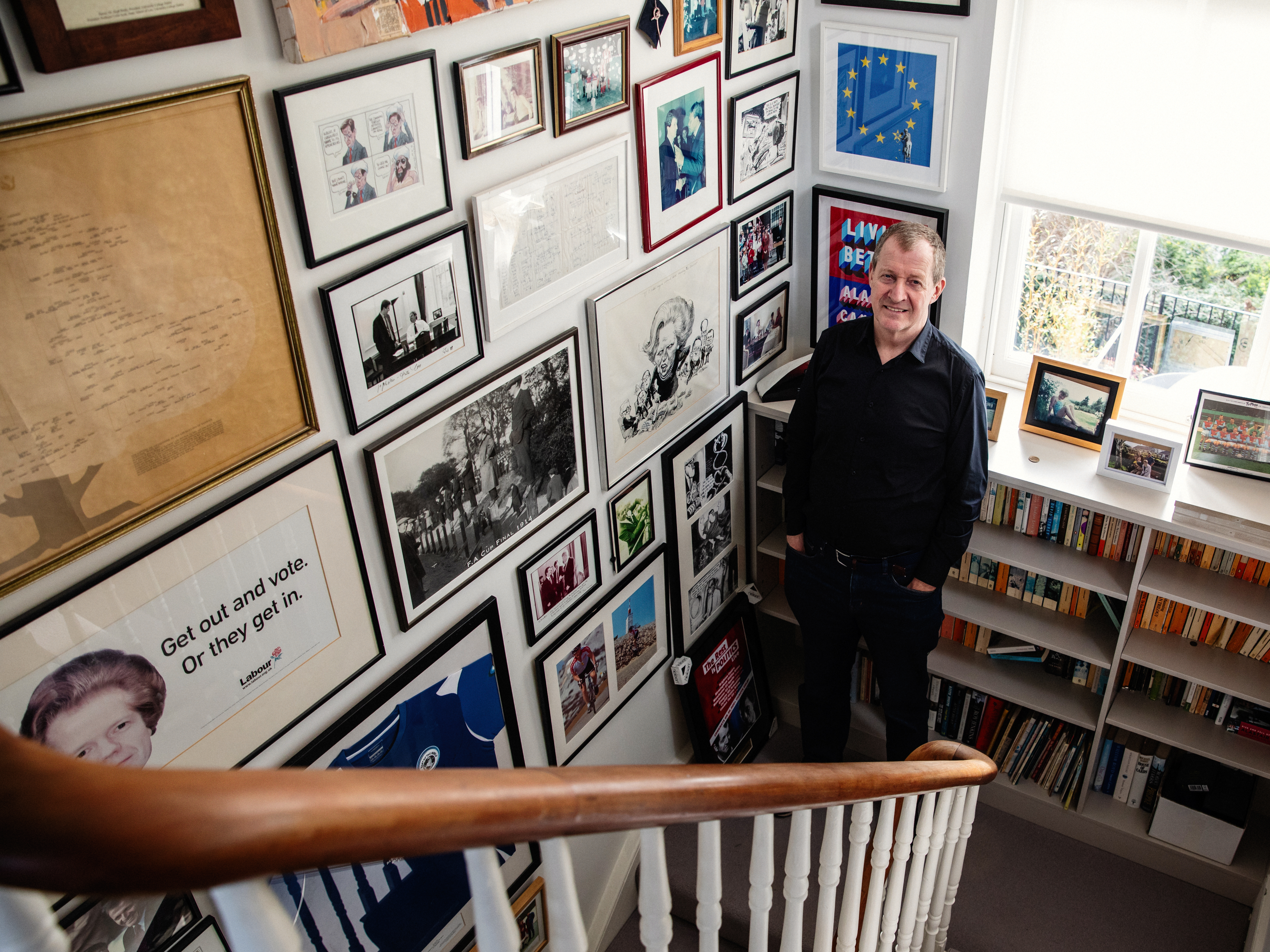
“Wow, well, I would say my Scottishness has deepened. For all sorts of reasons. But I think principally, the fact that both my parents – who were Scottish – are now dead and both of my brothers are also dead, including Donald, who was the most Scottish of us all; was in the Scots Guards and a Glasgow University Piper. Donald died a few years ago and I think since then my Scottishness, insofar as it is reflected in music, is deeper than it’s ever been. Partly through the pipes. I play the pipes a lot and I write pipe tunes, but I’ve also really got into Scottish folk music in a way that I never had before.
“It’s also in the football, naturally, and I feel really bad at the moment because I’m not going to the World Cup and Scotland has qualified. I just think I wouldn’t have supported the Olympics in 1936, and I don’t feel like supporting this World Cup because of Trump, because of what America’s become, because of what football’s become. Trump and Infantino together are just destroying the thing. And then I was watching a Scottish football podcast the other night, and these guys were complaining about the stadiums being all out of town, and you’ve got a drive there, you can’t get public transport etc, and anyway, I’m not doing that and I do feel bad about that.
“But also, as I’m talking, I’m just thinking that I did an interview a while back with Canadian television and when the researcher came on before, and said, ‘oh, by the way, we’re going to describe you as the British broadcaster and strategist’, I immediately said, ‘can you say Scottish?’ And it was instinctive. So, I feel my Scottishness is much, much deeper than it previously was and I think it’s partly, as I say, to do with my family, but I think there’s also just a sense that a lot of what Britain has become post-Brexit, I don’t like.”
Principally, I am back here because Campbell was at Blair’s side as devolution was being shaped on the back of the 1997 general election. And as Scotland prepares for its seventh Scottish Parliament election, I wanted to get Campbell’s thoughts on where devolution now sits.
First up, I ask him whether he or Blair, when helping to shape Scottish devolution, ever envisaged a time when a Scottish first minister would be framing a Scottish election as an opportunity to remove a UK prime minister from Westminster. His answer? An emphatic “no”.
Scotland and Scottish politics matter to Campbell. He is technically English, having been born in Keighley, Yorkshire, in 1957, but he regards himself as an unofficial Scot. His late parents, father Donald, a veterinarian and Gaelic speaker, came from Tiree and his mother, Elizabeth, from Ayrshire.
“My parents lived in England most of their adult life but they never, ever felt English, never saw themselves as English. My dad and the whole bagpipes thing was the kind of most obvious manifestation of it but he was also with the Caledonian Society. And so all of that and the pipe band and speaking Gaelic. He was very, very, Scottish.
“I didn’t know this story until after he died, but when they first got together, when my dad was a vet student and my mum was working on the farm in Ayrshire, he told her that he would never leave Scotland. And she had said that was an absolutely ridiculous thing to say and she actually went to work in a hotel in London and they split up for a bit. And then, anyway, when he qualified, he just found that there were just more opportunities for vets in England than there were in Scotland and that was that.”
During school holidays, Campbell and his brothers and sister spent most of their school holidays on Tiree with their cousins and he has a love for the Highlands where he frequently retreats for holidays. He plays the pipes, wears a kilt and can do a passable impersonation of a dour Scot.
Campbell’s family moved to Leicester when he was 11, and where he was educated at the City of Leicester Boys’ School. Cambridge followed, where he studied French and German and left with a 2:1, no career plan and a legacy of hate for the upper classes.
With no life plan, he put on a kilt, picked up his bagpipes and went busking round Europe for 18 months, eventually landing in the south of France where he taught English to French children and had a brief stint as a croupier with a sideline as a contributor to the erotic magazine Forum – the more journalistic sister publication of Penthouse.
Having caught the writing bug, he applied for a traineeship with the Mirror group and the fact that he had had the precociousness to write for Forum at such a tender age helped secure him a place. He started on the Tavistock Times where on the first day he met his partner, Fiona Millar, and his best friend, John Merritt, who he later followed to the Mirror and Fleet Street. Campbell says he felt he belonged there.
However, in autumn 1985, Campbell accepted a job as news editor on the short-lived Eddie Shah newspaper Today. The paper was poorly managed, under-funded, and its anti-union philosophy was at odds with Campbell’s own political views. It was his decision to take this job and leave the Mirror which has been cited as the first evidence of his impending mental breakdown. He left his comfort zone, was out of his depth, drinking heavily and out of control.
That came to a head when he literally broke down in the reception of Hamilton Civic Hall. He was Today’s news editor at the time and was in Scotland shadowing his friend and former leader of the Labour Party, Neil Kinnock. This was considered strange behaviour in itself for a journalist who had been promoted to a desk job to be out on the road. Campbell was reduced to a quivering psychotic wreck as he lay on the floor in a state of undress, shredding bits of paper from his pocket and desperately trying to make phone calls on a council owned phone that was connected to an unmanned switchboard. The police arrested him, detained him for his own safety and he was eventually hospitalised and referred to a Paisley-based psychiatrist for treatment. He was diagnosed with nervous exhaustion, which had been exacerbated by excessive alcohol and stress.
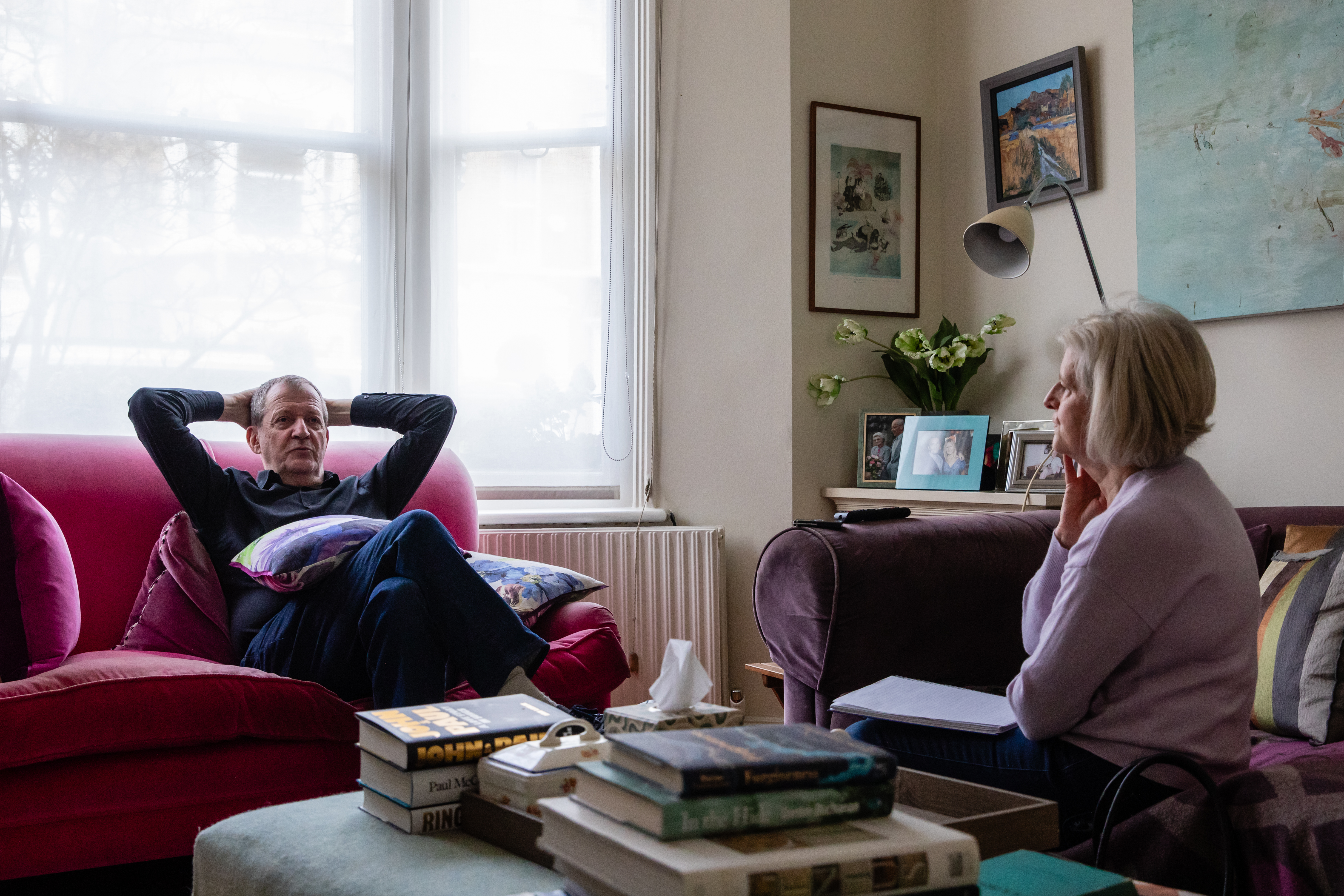
In very typical all-or-nothing fashion, Campbell immediately stopped drinking and says that the breakdown “was the best thing that ever happened to me because I came out of it”.
He still suffers from depression but largely manages it and uses his many platforms to be very open about his own mental health issues and in removing the stigma for others. Campbell’s approach to most things in life is full-on and compulsive. When he drank, it was to excess; he didn’t just get depressed, he had a full-on catastrophic mental breakdown; he doesn’t just run, he ran marathons; when he swims, it is in the wild. And it’s the same with his politics, his football (lifelong Burnley FC fanatic), his writing, and his podcast, that if you’re going to do it then you do it in an all-consuming manner and with passion.
So, of course, The Rest is Politics is ranked as one of the most listened-to political podcasts in the UK with reportedly over a million listeners per epidode and earns both Campbell and Stewart a very healthy living. Stewart has described their earning as akin to “Championship footballer money” and said he has earned more doing the podcast than anything else he has done in life. According to The Guardian, estimates of £70,000 each a month have not been disputed. And at one point in 2023, Campbell’s book But What Can I Do? – his nineteenth – went straight to No 1 in the Sunday Times bestseller list in the same week that The Rest is Politics was ranked the most popular podcast in the country.
Post-breakdown, Campbell returned to the Mirror where he rose to political editor before joining Tony Blair as his press secretary. During nine years at Tony Blair’s side, from opposition through the first six years of New Labour rule, Campbell was regarded as the second most powerful man in Britain and dubbed the real deputy prime minister.
Campbell was by Blair’s side every step of the way towards Scottish devolution and continues to have a “watching brief”. However, he stays largely out of Scottish politics although did come up during the 2007 election to support Labour, campaigned against Scottish independence during the 2014 referendum and has been known to offer behind-the-scenes advice to the party’s leaders. In 2016 he launched the campaign for his long-term friend Ken Macintosh to get re-elected and at the time drew parallels between the surge in support for the SNP since the referendum with the rise in popularity of New Labour, and that came with a health warning: “I do think there’s a little of inhaling their own propaganda too much and I think that’s dangerous for them. There will come a point where they think they have a divine right to rule.”
Campbell has interviewed all the SNP first ministers – Salmond for the magazine GQ and Sturgeon, Yousaf and Swinney for his podcast. I ask him why he thinks their popularity continues despite their record in government.
“I think what they’ve all been good at in very different ways, including Humza, is that they’re all very, very good at giving a sense of being real people. And, of course, they embrace a sense of Scotland – and Scottishness – that actually most people outside and inside of Scotland like.
“It isn’t even that twee shortbread tin version of Scottishness, it’s a niceness, and I thought that even last night when I saw John come on the news about the fire in Glasgow, that you’d think, ‘oh that guy, seems like quite a nice guy’. I used to think Nicola Sturgeon had that as well. She had this ability to communicate in a way that was serious but also warm. She could be cold, I know that, but she could also be really warm in her public presentation. A sort of common touch. Salmond had it in spades. And I think Humza had it in his own way as well. So I think what they’ve done is present themselves in a certain way that is framed around Scottishness and standing up for Scotland that has obviously worked.
“A memory of Salmond that sticks is that on the day that Tony Benn died, I was in Aberdeen with Salmond. I was doing an interview with him for GQ. And that’s when he said the thing about admiring aspects of Putin which really made quite a lot of waves. But the reason I ended up staying there most of the day was because both of us were in demand because Tony Benn had died, and the broadcasters were all bidding for anybody in politics to talk so Alex and I agreed that we would do these interviews and then do our interview, and that meant that I had to change my flight. So we ended up having quite a long time together, and that was when he basically said to me, ‘I know you’re against independence, but if we win, I want to bring people in from all sides and given your experience of transition into a government from opposition, I think you might be useful’. I thought it was really interesting, that he was thinking about what to do if he secured independence. I think he had a vision of independence. Although, I’m not sure there was a plan, as such. Did I think that he was serious in offering me a role? Yeah, it wasn’t as if he mentioned it once, and that was it. He texted me a few times and said, ‘I’m serious about this’.”
In the event, given the ‘no’ vote, there was never a choice to be made about whether he would have become an architect for a new Scotland or not, but has his view on independence changed?
“When my fundamental view of being against Scottish independence felt itself challenged was when Brexit happened and Johnson was prime minister. I just thought if there was a way now of me having a Scottish passport, access to the European Union, I’d go for it. But I think that view’s gone backwards since then because I don’t think I changed fundamentally, I think I changed emotionally. I still think, about how hard it’s been for the UK to extricate itself from the European Union at such a cost, then I imagine Scotland extricating itself from the United Kingdom, even more complicated, even more difficult. So, on balance, I’m still a Unionist on the question of Union, but I’m not nearly as passionate about it as I was.
“Had there been another referendum at that moment, would I have had a different view, I don’t know. I think what I would’ve done is got less involved.
“The other thing I remember about the interview I did with Salmond, by the way, was I remember saying to him, ‘what did you say to Cameron to stop him giving exiles a vote?’ because that seemed such a fundamental mistake from Cameron’s side that if you came from Latvia or Lithuania and you were settled in Glasgow, you get a vote, but if you were my mum and dad, you don’t. Salmond said that Cameron hadn’t even considered it. I couldn’t believe that. I do get the feeling that Salmond worked out how to get the question in his favour and the timing in his favour, and fought a pretty good campaign, but I do think in the end the combination of the economic questions and Project Fear had a really powerful effect. And while I think Salmond had a vision for independence, I don’t think there was an actual plan for it and still isn’t.”
As the official election campaign started for 7 May, Campbell was in Scotland interviewing Anas Sarwar in front of an audience of business leaders and he says that Sarwar has that same ability as Salmond to project warmth and that sense of identity rooted in Scotland.
“I’m really sad for Anas, who I think is terrific. I think he’s done a really good job as leader of the Labour Party in Scotland, and it looked like he was absolutely in place to win this election, but the Labour government nationally has acted as a massive drag on him. So I think ultimately the SNP are likely to do better in these upcoming elections than they would have done if we hadn’t had the winter fuel payment, Gaza, all the other stuff that we know of, but do they deserve to do win? No. Is politics fair? No.
“And yes, I understand why Anas called for Keir to quit and no, he didn’t speak to me before he did it. I understand why he felt the need to do it and I definitely understand his desire to kind of differentiate his leadership from Keir’s but there’s this other thing, that say Tony Blair goes to a dinner, says something, somebody spins it in a certain direction, suddenly there’s screaming bad headlines for Keir Starmer, and I guess because of my particular experience, I have a kind of inbuilt sensitivity for the Labour prime minister, and right at the point at which Anas did his thing, I thought, you know, Keir’s got enough going on right now without this. Now, as it happens, I think the reaction helped Keir get through the next quite difficult 24, 48 hours, so maybe it has worked out for both of them and none of us knows exactly how it will play out in this election yet, so we’ll see.
“But look, I’m a big admirer of Anas. I think he’s got something very, very special about him as a person, as a politician. I get his frustration. And I get the sense that Labour UK is not always sufficiently sensitive to the impact that it’s having in these different political equations, be that Wales, be it Scotland, be it local government, whatever.
“But in a way, I also do kind of see it from Keir’s perspective, because I think it’s so unfair, what’s happened to him. Look, he’s not Barack Obama. I’d be the first to say that you look at Keir, and you know, Trump says he’s not Churchill, he’s not, he’s not Tony, he’s not, but he’s the prime minister and he’s not terrible.
“I don’t know how to explain this, really. I think he reminds me, to this regard only, of George W Bush. George W Bush was somebody who if he was there now sitting on that sofa chatting to you, you would think, what a charming, funny guy. And why has he got this reputation of being stupid, because he’s really clever? As soon as the cameras came on him, he was a different being. And I sometimes feel like if you could only see Keir in a kind of real human setting, he can be impressive, he can be charming, be all the things that you’d want a political leader to be. There’s something about the mechanism of modern political communication that I think sometimes stops him being himself.
“And you know, the podcast has been interesting in this because some of the most interesting episodes we’ve done have actually been where – Theresa May is a good example, Jeremy Hunt was another example, Sajid Javid was another example – Tories free from government, I just found them so much more impressive than when they were in government. Now there’s a lesson in there for the current government. What is it about being in government that makes people speak in a way that isn’t real?
“There’s something in the way our politics and political debate have developed that I’m not sure anybody right now can be popular in the conventional sense unless you’re coming from a position of opposition. And of course, to get back to your point about Anas calling for Keir to quit, was that I guess Anas worked out is that he had to re-establish himself as a victim of opposition, as opposed to taking on all the sins of the government.
“I’d also be very surprised if Anas doesn’t rebuild a brilliant relationship with Keir. Could be wrong. But if I had to put money on somebody able to rebuild a bridge that was blown up quite spectacularly, I would back Anas. And yeah, I think that there’s definitely an argument for making that if you’ve got a Labour UK Government, and that UK Government has really good relationship with a Labour Scottish Government, then that’s a good thing to start with. We’ve had that before; we can have it again.
“And look, if you actually were to do a proper audit on the SNP and its record in government, setting it against all the things that have been promised at various stages of their development, they’re totally beatable.
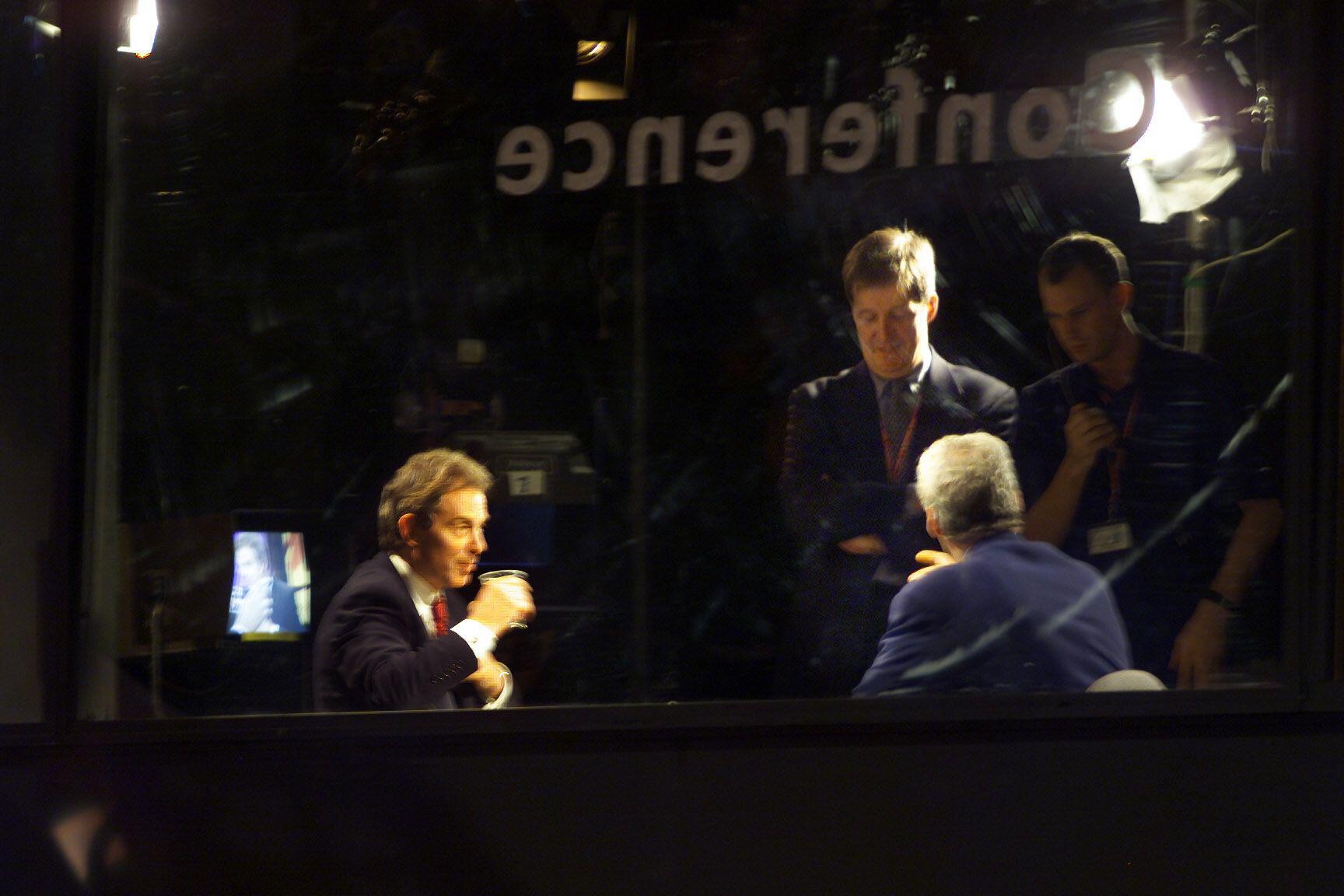 Campbell hovers as his boss prepares for an interview with Jeremy Paxman in 2000 | Alamy
“I think there are two things Anas has got to do. The first is to make the campaign against the SNP and the government record. Never, ever, ever tire of doing that. People say they don’t like negative campaigning, but we’ve got to keep hearing about how bad the record is and also demolish the claim that none of it is their fault, which has always been part of their dialogue. I also think a campaign that is founded on Anas’s warmth, personality, energy, alongside absolutely going for the SNP as having failed Scotland, I think there’ll be a lot of mileage in that.
“And then I think the other thing you’ve got to do is recognise that some people will be voting for something not to happen, i.e. not an SNP government. Now, if Labour can somehow be the driver and the recipient of that, then that will be to their advantage. And the other thing I’d say is you’ve got to go into a campaign thinking you’re going to win. Got to. So I’m actually encouraged that you said that the recent party conference felt upbeat and that members seemed – and this is your word, Mandy – delusional. I get that it’s bloody hard. It’s really hard right now. But I, a bit like the delusional Scottish Labour Party that you describe, I’m determined to remain confident that it can be turned around. If it isn’t turned around, by the way, we are in deep shit. Because if this government, if this Labour government, doesn’t succeed I think we’re going to a pretty dark place.”
Holyrood Newsletters
Holyrood provides comprehensive coverage of Scottish politics, offering award-winning reporting and analysis: Subscribe