Kate Forbes: I'm a harder person now, a more cynical person
Call it an epiphany if you like, and when it comes to Kate Forbes, the reference seems apt, but for Scotland’s economy secretary there was just a blinding moment of clarity during a family holiday to India about where her future lay, and that was outside politics and focusing more on being a mother.
And, as you would expect of a politician with a reputation for being principled, and clear-thinking, Forbes can pinpoint when that decision crystalised in her own mind. Lunchtime, Friday 25 July, last year when she looked at her two-year-old daughter Naomi sitting on the floor of an Indian orphanage in a rural village in Maharashtra surrounded by more than 40 young boys, aged five and six, who came from the slums. The boys were dressed in ill-fitting clothes and hand-me-down shoes twice the size of their own feet and Forbes says, as she viewed the scene, she so acutely felt the privilege her own daughter enjoyed compared to these young motherless boys, and it was then that her future fate was sealed.
“There was part of me firstly thinking how cute this vision was of Naomi sitting on the floor eating lunch with these young lads who had nothing but then it struck me what a responsibility I had as a parent to parent well. I was so moved by the workers – one couple caring for all these children – who sacrificed so much of their lives to give them an education, and without any real acknowledgement, glory or fame.
“It’s fair to say that I had struggled in my own mind with balancing my responsibility as a mother with my role in government and it just hit me at that moment that I could make a direct, big difference in other non-political capacities without sacrificing or neglecting my own family. I guess my own privilege became so obvious and, in the past, I had justified not being with my family and Naomi full-time on the basis that I was making a difference politically. But then, in the orphanage, I could see so clearly that there were other ways to make a difference in this world, and I no longer wanted to make the sacrifice of not being fully present in Naomi’s life or in the lives of any future children.”
It was a fairly momentous, life-changing moment, but one Forbes didn’t immediately share with her husband, Alasdair ‘Ali’ MacLennan, and she tells me that her biggest obstacle to finally making the decision to quit a reality was in fact Ali and her father, who both believed she had found her calling in politics and was too good at it to stand down.
“Ali was the last person to be persuaded that I really wanted to leave, and the turning point was when I finally managed to persuade him that I was serious because he saw his role primarily as enabling me to do my job. That’s what he will tell you himself. And if he’s ever had a calling, that was his calling. And actually, what happened the weekend before I decided to publicly announce that I was going to stand down was that he finally came round to it, he saw how adamant I was, and he’d never been persuaded before that I really meant it. I think I laid it on really thick, which, to be fair, I had done for quite some time, but after India this was different and I made it really clear that at the end of the day, this is what I really wanted to do. And interestingly – and not to make this all about, you know, us being the creation of men and all that – but my dad was the other one that had to be persuaded. So my dad and my husband are the two who have believed in me the most in this role, and they were also the hardest to persuade that I was going to stand down.
“Ali felt like I was too good at my job, that I had particular skills and abilities, and that I had a contribution to make in a world that is increasingly disillusioned with politics. So that authenticity and that integrity was of greatest value, and he saw it in me, and he saw it matched with the ability to do a job. And he speaks to lots of people, and he hears that from a lot of the people he speaks to. I think from his perspective, as an outsider of politics, looking in, that even if I weren’t his wife he’d want me to be in politics.
“And look, I also don’t want to make it all about Naomi but possibly it’s been the exhaustion of the logistics too. And I’ve often thought I could just have hardened up and said I’ll leave her at home every week, that’s the price of the job, get over it. I could have done that, but I took the approach when I had her to say I was going to balance it as well as I could, which is why I was bringing her down to Edinburgh every week then dealing with the logistical challenges of all of that. And it was just exhausting. You can fight through the exhaustion, but it’s just exhausting to get up, get out to nursery, to work around things when childcare falls through, and get on with your job. And I didn’t want to go on feeling exhausted.
“But also, was it fair to have her build a life around a city that isn’t her home, go to nursery where she isn’t with her own little friends that live in the same community? So yesterday was the first day of her new nursery, and I’m not there, and that’s fine, you get over yourself. I’m not so soft-hearted that I can’t do difficult things, but I also know now it’s not for long and that this is for her benefit.
“There was also another element to all of this which is something I have always felt when thinking about this decision in advance of actually making it – and the bit I struggled most with is a sense of letting people down, like internally, privately and also externally, because a lot of people have believed in me and wanted me to go on, and I don’t want to be seen as somebody who, when it got tough, took a step back, but I know I am making the right decision at the moment for me and for my family.”
Five days after the orphanage visit, Forbes flew back to Scotland with her husband, three stepdaughters and Naomi, arriving home in the Highlands on the Wednesday and the decision to announce that she would not be standing for election again in May was made by the Sunday with, one suspects, much horse-trading between husband and wife. On Monday 4 August – coincidentally Naomi’s birthday – Forbes sent a letter to the first minister detailing her decision to quit and published it on social media. The post immediately went viral, throwing political commentators and cross-party politicians across the country into a tailspin, making headlines and prompting an outpouring of grief about the loss of her talents to Holyrood and what that would mean for the political future of Scotland.
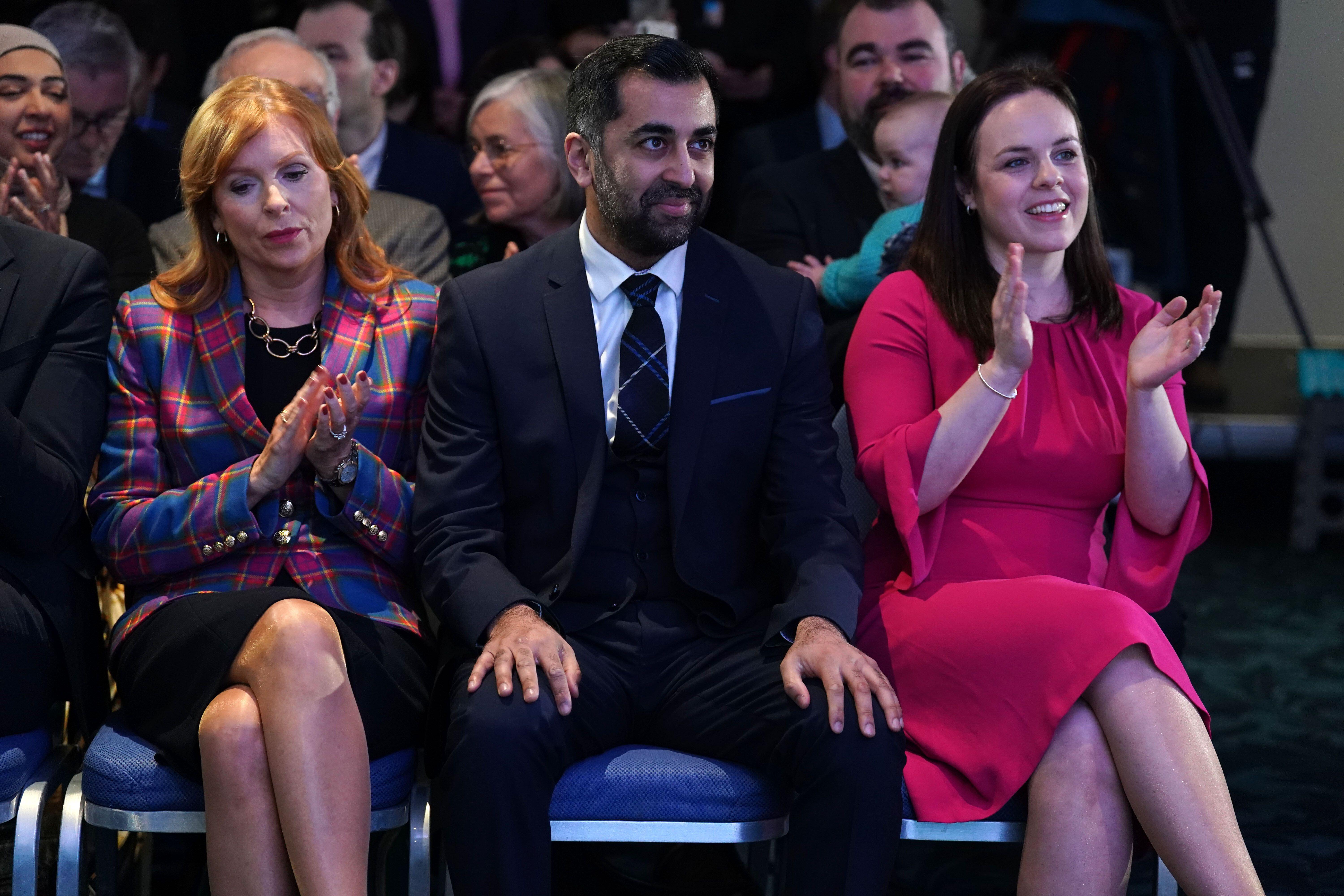 Forbes loses out on the SNP leadership to Humza Yousaf | Alamy
There is no doubt that in a parliament criticised for its lack of talent, she will be missed. Forbes studied history at Selwyn College, Cambridge, before going on to achieve a master’s degree in diaspora and migration history from Edinburgh University. She joined the SNP in 2011 and worked as a researcher in the Scottish Parliament before training to be an accountant, working for Barclays bank in London. Selected as a candidate for Skye, Lochaber & Badenoch, she took a career break from the bank and fought the 2016 election not really expecting to win.
In the event, Forbes nearly doubled the majority of her predecessor and was tipped relatively early as one to watch, and while she had to wait until 2018 to become a junior minister her rise through the ministerial ranks since then to now, to become deputy first minister and economy secretary, has been stratospheric.
She tells me that every stage has been “terrifying” but her approach was to “never appear cowardly”.
“I don’t subscribe to so-called imposter syndrome. That’s not how I would describe myself. I would say that I learned very quickly that confidence is the currency of politics. Whether you feel confident or not, you have to exude confidence – point number one. Point number two, there was no shortage of new experiences or areas that I was ignorant of, and so you had to lean into it all, and you had to pursue answers, and you had to be prepared. So I always prepared within an inch of my life. It used to really frustrate me when I started as a minister going in front of committees because I would have prepared so extensively for the difficult questions and then they would just ask me the same political questions that didn’t require any intelligence or knowledge. So, I don’t think it was imposter syndrome. I didn’t feel like I didn’t have a right to the job or didn’t have a responsibility to do well at the job. I think it was more a case of you have to be as good as you can be. And I guess, as a young female, I knew I had to be better than the old boys.
“The finance committee was always slightly different, I think, because it was really technical. But you know who really knocked it out of the park? It was Michelle
Thomson. I remember her coming in, in 2021, and she was obviously used to Westminster committees and she would always ask the left-field question, not to catch me out but on a matter of technical substance. That made me think, wow, I actually feel out of my depth answering that. That is 100 per cent how committees should be making ministers feel, testing them and really probing for answers. They shouldn’t be there to just make you feel comfortable.”
There is a strength about Forbes, a steely resilience, that has served her well through some tumultuous times in politics since her election, not least when she stood to be leader against Humza Yousaf and Ash Regan following Nicola Sturgeon’s decision to stand down. It was then that her religious beliefs – she is a member of the Free Church of Scotland – were put on trial and she was vilified for comments she made about same-sex marriage and abortion even when she made clear that she was talking about her own life decisions and not those of others. At the time, John Swinney backed Yousaf and questioned whether someone who held Forbes’s views was suitable to be the leader of the country. Notwithstanding that criticism, he subsequently made her deputy first minister, to which we will return. She tells me that not once, despite all the slings and arrows thrown her way because of her faith, has she doubted her belief in God and further, she says that it is that which has given her the strength to get through hard times and retain confidence in who she is and what she stands for.
“Have I ever doubted my faith because of the criticism that has been levelled at me because of it… absolutely not, never. If anything, the abuse made me feel that sense of self-confidence in who I am, not egotistical and not arrogant and not that I have something over other people, but that I have just as much of a right to be a citizen and to be a representative of citizens in Scotland as the next person.
“I would say that throughout my life I have been conscious of God and of the power that comes through faith in God. And I guess, to the onlooker, they see the leadership contest as a particularly challenging time, but for me it was just one of many experiences where I have been so grateful to believe in something that is bigger than myself.”
Forbes didn’t choose religion; she was born into it. Both her parents were, and are, devout Christians although at the time of her birth were not in the Free Church and they have since joined. Her uncle was a relatively recent Moderator of the Church of Scotland. And Forbes recognises that her faith is what has shaped her. Forbes’s mother is a qualified teacher and her father, a trained accountant who eschewed the more comfortable material life that his profession could bring to instead serve God in India. He worked as a missionary for various religious charities that offered free healthcare to the poor. Forbes describes being surrounded by “brilliant medical professionals” who worked alongside her father and who had also chosen to follow their faith to “treat the most marginal in society”. Forbes’s father later studied for a PhD in the Indian Stock Exchange and managed various hospitals, but the family mainly depended on charitable donations because he never took a salary. His children went to local Indian schools, and they lived in tied housing.
Forbes talks of her time in India to age 15, when the family eventually returned to the Highlands of Scotland, as her formative years, happy years with a family that had very little in terms of material wealth and parents who weren’t afraid to expose their children to the harsh realities of poverty.
“I guess, for me as a child, it normalised that state of poverty, of inequality, as being the state of the world, or at least, the state of some societies. Let’s just say nobody needed to ever give me a briefing on poverty or social injustice. Nobody had to tell me about it; I could see it. And therefore, as a 10-year-old, if you’re standing there doing PE in the schoolyard and you see children younger than yourself carrying bricks on their head to assist with building part of the school, you’re going to question why, and you’re going to figure it out that it’s wrong, and you’re going to ask yourself, how do you resolve that kind of thing? What can you do?”
This backstory tells you much of what makes Forbes tick – she is a deep thinker, is spiritual, and her childhood experiences gave her an innate sense of the world being bigger than just herself.
When the family decided to return to Scotland, she was against it. She says she arrived back “not particularly happy” and with new classmates in Dingwall not sure what to make of this exotic teenager who had been born there, spoke Gaelic, but who had grown up mainly in India. She says the family had very little and depended on handouts and hand-me-downs. She remembers her teenage self being mortified by being driven around in an old Volvo that someone had donated to the family. And those things matter when you’re young. Now, she is unmaterialistic and has admitted in the past that she would do her job for nothing if she had to.
Much of this helps to explain why a politician at the top of her game can walk away from a role with such obvious power and privilege and why it was so important to her for her young daughter to experience poverty in the raw, just as Forbes had done in her own childhood.
I ask her if she has considered whether her decision to quit has wider ramifications for other women – indeed for her own daughter and step-daughters – and if it is an admission that, despite the fight for equality, women can’t have it all?
“No,” she says, without hesitation. “It means that women are empowered to make their own choices and they don’t have to feel shackled by this overwhelming sense of responsibility that they need to prove they can do 1,000 things and everything. If somebody wants to do that, they can. I came to the realisation that the thing that was stopping me from actually making the decision I secretly wanted to make was me and the sense of responsibility of proving I could do it, and I can do it well. And I could have continued to do it, you know, just for absolute clarity.
And for somebody who always measures performance, my own performance, I could have continued to do it well, but not happily. So I had to ask myself, are you allowed to be happy? And I figured that, when push came to shove, I wanted to be happy. I’m 35 going on 36 – I’ll be 41 at the next election. You do the maths. I want to be able to invest in Naomi and do that job really well and potentially invest in other members of a future family and do it well. And I just decided that in five years’ time, which would I regret the most? Would I regret not continuing to build a political career or not continuing to invest in family? And when you feel like that, it’s actually really simple. So for me, it was a question of empowerment. Do I have agency to make this choice? I do. So it was exercising my agency. And another woman should also exercise her agency and do what she wants to do.”
Forbes was elected in 2016 at a time when there were three women party leaders in the Scottish Parliament, and of the SNP MSPs elected that year, 43 per cent were women. Perhaps tellingly, of that new intake of female politicians in her party who were elected for the first time, only a handful – Gillian Martin, Jenny Gliruth, Maree Todd, Emma Harper and Clare Haughey – remain and are standing again in May. I ask her if she agrees with Nicola Sturgeon that there won’t be a female party leader any time soon.
“No, I disagree, because there’s a lot of competent, really good women in parliament and I think politics is an unpredictable game, and so my hope is that while we are losing some great women at the next election, I hope that there’ll be some great women that are elected. I think it’s unpredictable, but I think there’s as much of a chance of a woman leading a party as there is a man.
“Reflecting on that 2016 election, I do remember being conscious of how unusual it was in any jurisdiction to have so many female MSPs and you’re right, we also had three women party leaders. Did it make a difference? Well, I do think women and men debate differently and, speaking from personal experience, when I was newly elected I remember trying to force myself to debate in the same sort of aggressive manner, a shouty manner, as male politicians, and feeling like it was so unnatural and therefore having to reassure myself that I could take a more thought-through approach and still be effective. I’m not saying the way women approach debate in parliament is less aggressive – but I do think it’s less empty. I think male politicians often argue in a very noisy way. And to be fair, women can be just as adversarial, but you listen to a lot of male politicians and there’s basically a lot of oomph behind basically empty words. I think women argue in a slightly more thought-through fashion.”
Dissecting the differences between men and women naturally brings our conversation around to one of the most divisive debates that has run through this last parliamentary session, that of sex and gender. Forbes had an early taste of the vitriol that goes along with the issue when she signed a letter in 2019 calling for a pause on the government’s gender recognition reforms. She was privately reprimanded and, at the time, believed that the move could cost her a ministerial job.
The letter, a response to a speech in which Nicola Sturgeon, then the first minister, had said transgender rights were not “a threat to me as a woman”, sparked a social media storm, with LGBT activists in her own party claiming Forbes had “questionable views” on equality because of her religious beliefs.
Despite her critics, less than a year later, she was promoted to cabinet secretary for finance – the first woman in either Holyrood or Westminster to do so – and speculation about her being a potential next leader gathered pace. She was on maternity leave when the Gender Recognition Reform Bill was eventually voted on in December 2022 and declined to vote, telling me later that she had a responsibility to other women to take her full maternity leave.
Two years later, and six months before the Supreme Court ruled against Scottish ministers in a judgment that ruled that ‘sex’ and ‘woman’ in the Equality Act refer to biological sex, Forbes told me that many politicians were being prevented from saying what they “instinctively feel” on questions of sex and gender because of a “very fearful culture” which had been created. But that for her, her difficult labour in giving birth to Naomi – that time had brought into sharp focus why single-sex spaces for women were so important.
“That’s the most vulnerable I’ve ever felt as a woman. And you look to other women in that room for your help and support.
“And I think it’s a good example of the need for a single-sex place, which in the moment I would not have thought through the political implications of what I was asking for, but I tell you, that in that vulnerability, in that place, I know what I needed, and it was the help of other women.”
Following on from the Sandie Peggie tribunal, and with the Scottish Government seemingly dragging its heels on getting the law around single-sex spaces properly implemented, even going back to court to argue that trans-identifying male prisoners should be housed in the female estate, I ask Forbes if the SNP has a problem with women.
.jpg)
“I have heard that kind of claim, but it doesn’t match my experiences on the ground. If I think of my local party, the women in my local party branches are the ones who have continued to campaign through thick and thin and who really believe in the party. Now you could say that’s anecdotal, that’s localised, and I understand what you’re asking and why there’s that wider portrayal because of the particular issues that you mention which have brought it all to the fore again, but for me – and I’ve talked to you before about my experience during childbirth – I think even more powerfully, I started taking Naomi to swimming lessons when she was a few weeks old and I don’t know how many people have ever had to change a baby into a swimsuit and change themselves into a swimsuit, and worse, change out of wet swimsuits in a tiny cubicle. It just doesn’t happen the way you would want. You can’t do it discreetly; you have to change in public, in full view. And the importance of knowing that there are only other women in that room is critical – even knowing that the cleaners that are walking in are women matters. You’ve got a little baby girl, got yourself, got too many towels, not enough hands, you feel vulnerable and that sense of security and safety in a changing room is crucial.
“On the wider point about the nature of this debate, it’s always sad for me when any issue becomes so toxic and divisive that you can’t have reasonable conversations. But having said that, I think the conversation has moved on so far with the wider public and, actually, I think in general conversation with ordinary people you find that there’s a fairly settled view on all of this. I don’t think it’s as toxic any more out there and I think that we need to accept the Supreme Court ruling, and I think we need to demonstrate to the public that we are implementing the Supreme Court ruling.”
The DFM’s language is interesting because while she may see that the public has moved on, the political bubble itself has perhaps still to catch up. The first minister himself appears to want to ride two horses at the same time in saying he agrees with the Supreme Court judgment, while also going to court to seemingly fundamentally argue against it in the case of trans-identifying male prisoners. And on that question of saying one thing but doing another, I ask Forbes how she squared John Swinney’s comments about her unsuitability as a potential first minister with then appointing her to be his deputy.
“Look, the approach that I took with John Swinney was that if we were going to work together, you couldn’t go into that conversation with uncompromising negotiating positions. So, if there was to be a partnership, and if you were to heal some of the divisions in the party, then it had to be a genuine, mature, grown-up conversation, and that is the approach that I took. So you asked about me being resolute, and I think it’s just in my character to be far more interested in diplomatic conversations than in sticking flags in the ground and saying, this is where I am. It’s fair to say there were quite a few conversations, warm conversations, over a period of time and each of those conversations moved things on to get to the position we eventually did, and I came back into government feeling like we could work together and do that well.”
As far as exit interviews go, Forbes leaves politics at the top of her game, at a time of her choosing, with many urging her to stay and the door open for any return. How would she rate her own performance?
“Oh, I am the biggest critic. The biggest critic. I look back on those first years and see somebody that was very much learning the ropes. For me, the biggest change came with the leadership contest. I felt that completely transformed my sense of confidence, in a good way, my ability to stand on my own two feet and my skillset too, in terms of engaging with the media and engaging with the public. But more than anything else, it gave me a huge sense of self-confidence, which I don’t think I’d have had without it.
“But I’m a harder person. I’m a more cynical person. I think, probably, I’m a less sympathetic person. None of which I admire. And one of my hopes of getting out of politics is actually to recover a bit of that sense of warmth and empathy – cynicism is ugly. And I think I really fought hard in the first half of my political career to retain that sympathy and that warmth and that ability to open your heart. I think now it’s really important to take a step back and just recover some of that and I hope the distance from politics will do just that.”
Holyrood Newsletters
Holyrood provides comprehensive coverage of Scottish politics, offering award-winning reporting and analysis: Subscribe