Hard Partying: Alba's difficult year
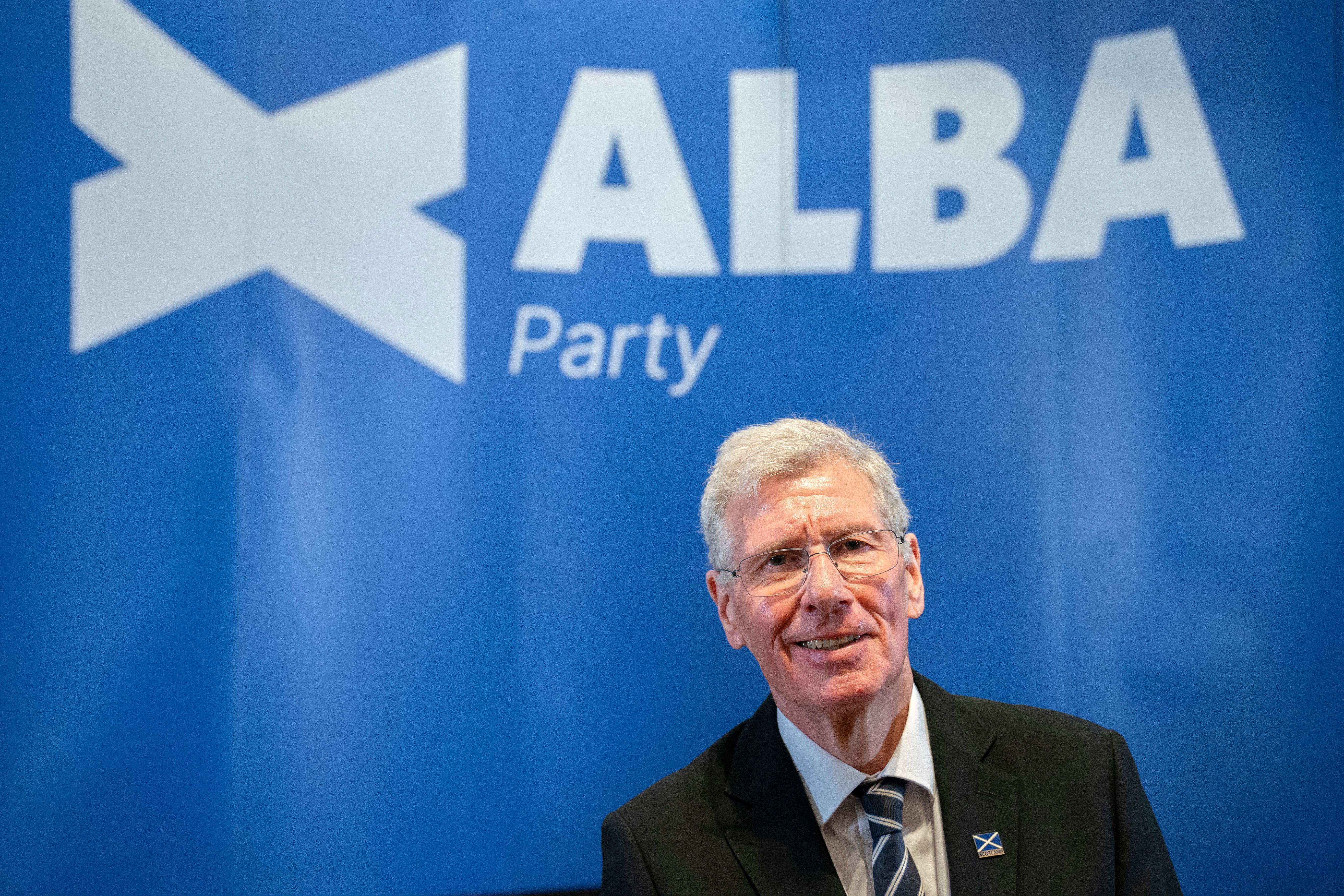
“We’re getting to crossing the ‘T’s and dotting the ‘I’s,” said Kenny MacAskill. “It will come.”
The veteran politician was talking to Holyrood about a problem that threatened to bring his party’s progress to a complete halt.
Alba, the party he has led for less than one year, had reached something of an impasse. Chris McEleny, its former general secretary, had been removed from post and expelled from its membership.
But the connection had not been entirely severed: McEleny, who had been Alex Salmond’s right-hand man, was still the party’s nominating officer, and as such was the only person who could give authority for election candidates to run under Alba’s banner. With Holyrood 2026 just months away, it was something of a problem.
Ordinarily, a signature would be required to pass on the baton – something easily sorted out with a friendly conversation. But McEleny, who joined Alba at its foundation, is no longer on speaking terms with the party’s leadership and, backed by one of the UK’s most powerful trade unions, is taking his former employer to tribunal claiming unfair dismissal.
They said he refused to sign the relevant paperwork to make the administrative switch; he said they failed to follow proper procedure. And so Alba turned to the Electoral Commission: would the UK’s election regulator accept an application to install ex-SNP MP Corri Wilson as its new nominating office without a signature proving McEleny’s agreement?
The party is still kind of nowhere
Rewarding MacAskill’s confidence, the answer to that turned out to be ‘yes’. “The commission’s view is that Mr McEleny can no longer be considered one of the ‘responsible officers’ of the party,” wrote Electoral Commission chief executive Vijay Rangarajan.
Welcoming the change, Alba said the trouble had been due to “complete intransigence” from McEleny, who in turn said it was caused by the leadership’s own “incompetence”.
And the saga is not quite at an end: the party is still registered to an address in Greenock which is associated with McEleny.
It’s just one of the internal dramas that has characterised the year since Salmond’s death in North Macedonia. Alba has asked Police Scotland to probe alleged inconsistencies in its accounts, and its sole MSP, Ash Regan, has left to go independent, a decision which cost the party a share in public funding.
Regan, who came second to MacAskill in the leadership contest forced by Salmond’s death in October 2024, said she left over differences in direction, and will serve out her parliamentary term as an independent.
It’s the kind of scenario that might overwhelm an inexperienced hand, but political veteran MacAskill – a former MP, MSP and Scottish Government justice secretary – is unperturbed. “We’re quite chirpy,” he told Holyrood. “We have our approved candidates, we’re good to go.”
That’s not to say this is how MacAskill would have wanted to spend his first months as leader, and he concedes it has been “debilitating”. “It’s been a distraction,” he said, “but we will get through it.”
And while MacAskill has worked to progress his party’s push for a plebiscite election to settle the constitutional question, and on progressing its energy agenda – which includes a halt to onshore wind developments and the introduction of zonal pricing – there have been more headlines competing for attention, such as the defections to Your Party from Alba of ex-Labour MEP Hugh Kerr and former UK ambassador Craig Murray.
“It’s two out of a membership of five or six thousand,” MacAskill said. “I concentrate on our own game.”
According to polls, that game, being played out in a competitive political landscape, does require work.
Now approaching its fifth anniversary, Alba – which does not stand constituency candidates – has yet to break into double digits on voting intention for the regional list at Holyrood. It hit a peak of seven per cent in April, a result that psephologist John Curtice said could translate to seven seats. But more recent research has recorded results of around five per cent, a level unlikely to mean success.
It had been Salmond’s intention to stand for Holyrood in 2026, and in that case he would have been considered his party’s best hope of election. After his death, Regan was viewed as the most likely to take a seat. Now pollster Mark Diffley, of the Diffley Partnership, is sceptical about its chances of victory. “I don’t see it,” he said. “The party is still kind of nowhere.
“It looks pretty unlikely at this stage that they will, based on current polling, get any MSPs returned.”
Founded in 2021, Alba’s formation came at a time of tumult for the independence movement, which was in part down to personality, and in part to policy. In the years prior, sexual assault allegations against Salmond, leaked from within Nicola Sturgeon’s SNP-run Scottish Government, had created bitter division. His acquittal in a criminal trial, victory in a civil case and the outcome of a parliamentary inquiry, which found that the government had mishandled the matter, did nothing to heal those wounds. Allied to the Salmond-Sturgeon split was disagreement over independence strategy amongst Yes backers, with some dissatisfied by the SNP’s inability to clear constitutional roadblocks to change. And then there was the Scottish Government’s gender recognition reform bill, which saw a swathe of gender-critical women leave the SNP in protest.
Canny Salmond positioned Alba to become a home for independence supporters who had found themselves, for these reasons or others, politically homeless, and he persuaded then-MPs MacAskill and Neale Hanvey to join as well as ex-Westminster politicians like Wilson. But the defectors were unable to defend their seats in election campaigns that also ended in disappointment for Alba’s 17 other hopefuls. At 2.8 per cent, incumbent Hanvey achieved the party’s highest vote share, and all candidates lost their deposits.
The result came two years after Alba’s local government washout, in which all 111 candidates fielded were unsuccessful.
Regan, having months earlier lost out to Humza Yousaf in the election to replace Nicola Sturgeon at the top of the SNP, gave Alba a Holyrood foothold in autumn 2023. Resigning last month, she spoke of differences in direction between herself and the party, and said she would focus on securing the passage of her ‘Unbuyable’ bill on prostitution before the end of the parliamentary term.
It’s batshit crazy. The party has turned into a 1970s tribute act that nobody wants to see
The news came around six months after her defeat by MacAskill in Alba’s leadership contest in what had been a close but fractious race, with just five per cent separating the candidates. It was a contest coloured by in-fighting that included allegations of bullying and harassment, and McEleny’s dismissal on the grounds of gross misconduct.
Now the subject of an employment tribunal claim, the sacking took place even as McEleny, who declined to be interviewed for this article, contested the deputy leadership, which was won by Hanvey. The case, having been sisted once, is expected to be heard next month.
Responding to the Electoral Commission’s move, McEleny described himself as “a private citizen that has moved on with [his] life, currently at college seeking to update [his] electrical qualifications in order to rebuild a career as an engineer.” “The continued public harassment of me, and the vindictive behaviour of Alba Party towards me is bitterly disappointing and upsetting,” he said in a statement.
If the tribunal proceeds, it is expected to cost the party a five-figure sum. McEleny is supported by trade union Unite, but Alba will want to limit its exposure in a case that will eat into its finances. “It’s batshit crazy,” said a source close to McEleny. “The party has turned into a 1970s tribute act that nobody wants to see.”
The party took in almost £418,580 in 2023, the latest year for which accounts are available, but spending outstripped that sum by £80,690. Assets halved and liabilities doubled that year, compared with 2022.
Since its inception in 2021, Alba has brought in more than half a million pounds in funding, with most of that – £433,020 of a total £567,580 – coming from public funds. At a total of £50,000, its biggest donor to date is Craig Mackenzie of sourcing and procurement firm Continuum (Scotland) Ltd. The firm itself, which made £47m in a pandemic deal to supply face masks for the NHS in Scotland, has also contributed to party funds, giving £20,000.
Behind them, Salmond is the party’s third biggest donor to date, contributing almost £13,170, and all in 2021. Outwith Electoral Commission funds, no donations have been registered for the party since spring 2022.
The former first minister’s finances have been splashed across the news this month. It’s emerged that he died with debts of close to £350,000, and assets of only £2,300. Details emerged as a trustee was appointed in the sequestration of his estate and it was said that money amassed by Salmond during his lifetime had been spent on court cases aimed at restoring his reputation.
Law firm Levy and Macrae, acting for the estate, said “not a penny” of the £512,000 secured from the Scottish Government over its handling of the initial complaints went to Salmond, but instead was used to cover his legal fees.
There has been speculation that his widow, Moira Salmond, may have to sell their home, revelations of a £7,000-a-month flat in London shared with McEleny and former MP and serving Alba chairperson Tasmina Ahmed-Sheikh, who was also involved in his broadcasting activities, and assurance that his £3m compensation claim against the Scottish Government will still go ahead.
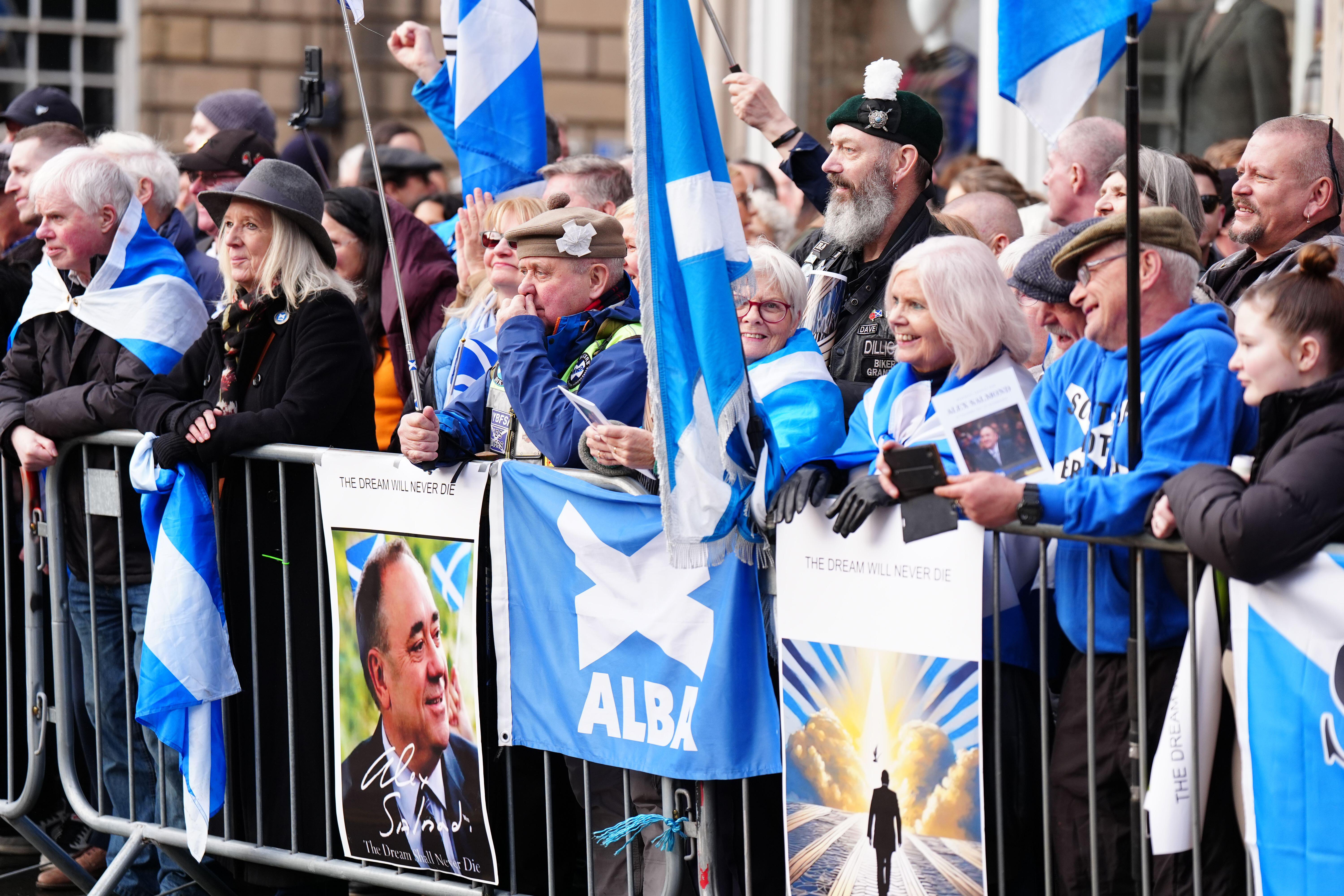
There has been much talk over the past year about Salmond’s legacy, with the Scottish Parliament Corporate Body reportedly considering the question of whether to mark the anniversary of his death.
In Alba’s internal wrangles, there has been claim and counter-claim on what Salmond would want, which strategy he would prefer, and how he would take the party forward. “Alex is not here to be able to defend himself,” MacAskill said of “scurrilous claims”.
“I think the broader proportion of the public recognise Alex was the outstanding politician of his generation, if not several generations; that he drove Scotland forward and pursued the case of Scottish independence for its merits and not for fortune or honour.
“My view is, the Alba Party, the best thing we can do is seek to deliver Alex’s dream, and that is what we focus on. Others can make claims of whatever.”
That dream included the formation of a “supermajority” for independence at Holyrood, in conjunction with other Yes-leaning parties. But the cooperation Salmond argued for has yet to be delivered. A letter sent to the SNP’s John Swinney has not been answered, MacAskill says, while the Scottish Greens have ruled out working with Alba in a cross-party indy convention.
“We’re putting out the hand of friendship,” said MacAskill, “I know that hands are extending towards ours.
We do it because we believe in it
“I’m not talking about parties uniting, but the spirit of the Yes movement that was broad-based, I think, can be resuscitated for 2026 as it was in 2014.”
Even with that policy difference on independence strategy? SNP members have backed Swinney’s plan to declare a mandate for another referendum if the party wins a majority in May 2026 – a plan MacAskill, who favours using the election as a plebiscite, has said is “taking us nowhere”. “The ship has sailed,” he said. “Why do you want a referendum? How many times do you have to be told you’re not getting a referendum before you do what the Supreme Court has said, which is you use a democratic event as a mandate, and that’s why we require a plebiscite election.
“It doesn’t matter who asked, and it doesn’t matter who says it, whether it’s Rishi Sunak, Keir Starmer or Nigel Farage, you know that the answer is going to be ‘no’.”
Alba voters are solidly in favour of independence – even more than the SNP’s, according to research. “Alba voters are exclusively independence supporters,” said Diffley. “Even the SNP has a few No voters knocking about. They’re ex-SNP voters and they’re almost all pro-EU, pro-Remain. They trend older and that older cohort is equally male and female.”
The trouble is, Diffley said, there are just too few of them, and that’s not simply due to the loss of Alex Salmond, he contends. “They have never really threatened for the whole of their existence,” he says.
Indeed, Alba’s first electoral outing in the 2021 Holyrood election ended, as predicted by Salmond, without a single seat. “Our objective, because we are not an ordinary political party, is to help secure the independence of our country,” he said at the time. “Alba has a role, it has a significance, and that role will develop, grow and bloom over the next few years. Alba is rising.”
Today, MacAskill agrees. “We do it because we believe in it,” he said. “The tragedy of Scotland is not how bad things are, but how much better they could be and should be. Over my lifetime, countries such as not just Norway, but Ireland, Denmark, Finland, have all outperformed us, have less hardship and more benefits. But that can be changed.”
Holyrood Newsletters
Holyrood provides comprehensive coverage of Scottish politics, offering award-winning reporting and analysis: Subscribe