Single(-sex) issue: What next after the Sandie Peggie ruling?
Rarely do employment tribunals make headline news, yet the recent case of Sandie Peggie v Fife Health Board will have far-reaching consequences. At the same time, it remains unclear as to what those consequences will be.
Rather than providing clarity, the 312-page judgment, handed down last week by judge Sandy Kemp, seems only to further muddy the waters of what is and is not law. As one individual familiar with the case told Holyrood, this is a curate’s egg of a judgment for everyone involved.
Sandie Peggie launched legal action against her employer, NHS Fife, in May 2024. The nurse, who worked at Kirkcaldy’s Victoria Hospital, had been suspended pending a disciplinary investigation four months before, following an altercation between her and transgender medic Dr Beth Upton in the female changing rooms at the hospital on Christmas Eve.
Upton, who started working for NHS Fife in August 2023, had been given special permission to use the female changing room by the health board. Peggie raised her issues with this informally with her line manager not long after, claiming that having to share the space with Upton impacted her sense of privacy and dignity.
Aspects of the judgment are hugely problematic for women, leaving the onus on them
However, NHS Fife failed to respond quickly enough. The pair ended up sharing a changing room in late October 2023, and then again on Christmas Eve.
It was at this point the tension came to a head. Peggie confronted Upton about the doctor’s use of the female changing room, saying she found it “intimidating” and making a comparison to “that person in the prisons” (understood to be a reference to double convicted rapist Isla Bryson).
Upton would later make a formal complaint to the health board about Peggie’s behaviour, resulting in the latter being placed first on special leave and then suspended while an investigation took place. She was able to return to work in April 2024, with the health board’s solution being to adjust rotas so Peggie and Upton were never on the same shift.
Peggie’s behaviour towards Upton on Christmas Eve “amounted to harassment”, the tribunal concluded, but the judgment also stated that had the health board acted sooner, “it is likely that what occurred on Christmas Eve that year would have been avoided”. It is on these grounds that Peggie won a partial victory against her employer.

All claims against Dr Beth Upton, above, were dismissed | Credit: Alamy
NHS Fife was found to have harassed Peggie under the terms of the Equality Act in four ways: failing to temporarily revoke permission to Upton to use the female changing room after Peggie complained; taking an “unreasonable” amount of time to investigate the allegations made against her about the Christmas Eve incident; making reference to patient care allegations Peggie had been unaware of at a meeting at the end of March 2023; and wrongly instructing Peggie not to discuss the case.
However, the majority of the 47 claims made by Peggie were dismissed. That included all claims against Upton and claims against NHS Fife relating to direct and indirect discrimination, and victimisation.
Responding to the judgment, Peggie said: “I am beyond relieved and delighted that the tribunal has found that my employer Fife Health Board harassed me after I complained about having to share a female only changing room with a male colleague.”
However, this will not be the end of the matter. Her solicitor Margaret Gribbon has confirmed the intention to appeal this ruling. Fuuther legal action has also been launched against NHS Fife and senior staff, including outgoing chief executive Carol Potter, with the intention being to push the health board to confirm that transgender women should not be able to use female changing rooms or other facilities.
It is understood NHS Fife has not made any change to its policy on allowing trans staff to access the facilities that match their acquired gender rather than their biological sex.
What this appears to mean is that blanket exclusion of trans people from services and facilities that they need at work is likely to be unlawful in most cases
Many gender critical activists believe this to be the incorrect reading of the Equality Act, following the Supreme Court ruling earlier this year in the For Women Scotland v Scottish Ministers case that ‘sex’ refers to biological sex. This interpretation means spaces can only be considered single-sex if they are only available to people of that biological sex – in other words, giving trans people access to spaces concurrent with their acquired gender makes them mixed-sex spaces.
But the conclusion of the tribunal runs contrary to this interpretation. It states the health board was “entitled” to grant Upton permission to use the female changing room because it was the “least intrusive measure” in a test which seeks to balance the rights of those with the protected characteristic of gender reassignment and those with the protected characteristic of sex.
It was “not known, nor was it reasonable to expect that it be known, that [that decision] would lead to an adverse impact on another employee”, the judgment adds. That changed when Peggie raised her concerns, at which point permission should have been temporarily revoked while a long-term solution was found.
This is because, the judgment states, it is not “inherently unlawful” for trans women to be given access to facilities for women. However, where it gets muddy is the ruling goes on to state that it is not “necessarily lawful” either. That seems to suggest that whether or not permitting trans people access to single-sex spaces depends on the context, and specifically on whether other users of those facilities complain about such a policy.
The Equality Network, a charity which promotes LGBT+ rights, said in a statement after the judgment: “This was about how NHS Fife handled the process, and not about their policy with regards to use of facilities. That remains as it was and was not found to be unlawful… What this appears to mean is that blanket exclusion of trans people from services and facilities that they need at work is likely to be unlawful in most cases.”
Surely we should have one consistent approach across Scotland, where the legal advice for boards is the same, where a woman does not need to first complain
Similar logic appeared to be in play in another tribunal ruling, published a week before Peggie, which concluded defence firm Leonardo UK could allow trans women to use the female toilets at its office in Edinburgh.
That case was brought by Maria Kelly, who alleged harassment, and direct and indirect sex discrimination over the firm’s toilet policy – but all these claims were dismissed. During the case, Leonardo had argued that Kelly had the choice of using a number of different toilets if she required privacy. Ultimately, judge Michelle Sutherland concluded the trans-inclusive policy was a “proportionate means of achieving a legitimate aim”.
The Equality Network statement continues: “For now, these cases confirm that the Supreme Court ruling in April this year… does not require a blanket ban of trans people from the services, facilities and toilets that they use in line with their gender. This also suggests that anti-trans or gender critical campaigners, and many in the media, as well as some pushing in parliament, have been incorrectly and harmfully misstating the law in this area.”
Yet many gender critical people believe this is the wrong approach. Maya Forstater, who heads up sex-based rights charity Sex Matters, criticised the tribunal for attempting to find a “spurious balance” between the rights of those with different protected characteristics. She has called on the Health and Safety Executive to step in and provide guidance on the provision of single-sex facilities in the workplace.
Forstater added: “This problem cannot be solved by leaving individual women to upend their lives, fundraise to take court cases and then endure cross-examination and public scrutiny – all simply to win back what was a right that was beyond question until recently, and which most people still support.”
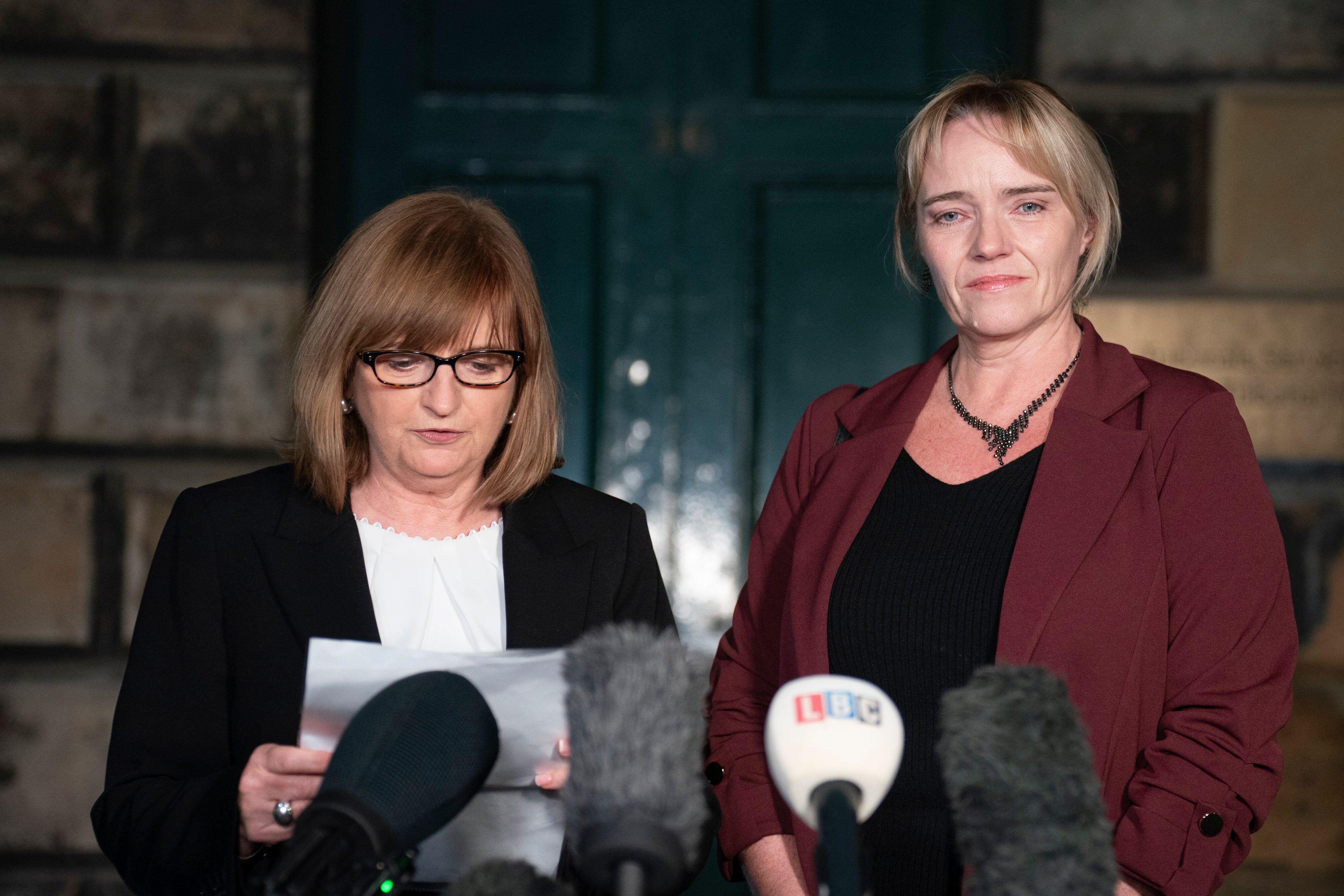
Gribbon and Peggie respond to the ruling | Alamy
Gribbon appeared to agree in her statement after the ruling, setting out the reasons for the appeal. “The judgment places responsibility on female employees to raise complaints if they feel uncomfortable about sharing single sex spaces with men... The judgment also places employers in the invidious position of having to make decisions about single sex workplace facilities based on the physical appearance of transgender employees, and by asking them intrusive questions.
“For these reasons and more, I can confirm that the tribunal’s judgment will be appealed and work on this is already underway,” she said.
A similar point was made by Scottish Labour deputy leader Jackie Baillie in parliament the following day, who said part of the problem was a lack of overarching advice from the Scottish Government. Ministers wrote to all health boards in September about the Supreme Court ruling, but left it to individual boards to consider how to respond in terms of their policies on single-sex spaces.
“Surely we should have one consistent approach across Scotland, where the legal advice for boards is the same, where a woman does not need to first complain to have her employer follow the law,” Baillie said, “or is it the case that the Scottish Government expect individual frontline staff to be their own experts on human rights law?”
That health secretary Neil Gray did not provide a concrete answer is emblematic of the government’s wider response on these issues. Ministers have been hesitant to issue advice to public bodies since their interpretation of the Equality Act – that ‘sex’ was not restricted to biology – was ruled incorrect by the Supreme Court. It has resulted in even government employees not being certain what the policy is inside government buildings.
Yet this tribunal ruling suggests this more careful approach, rather than rushing to restrict access to single-sex spaces to biological sex across all services, was perhaps the right one. Guidance from the Equality and Human Rights Commission will therefore become vital in understanding how to operate single-sex spaces – yet the updated code of practice was delivered to the UK Government in September and there has been no sign of movement since.
That code of practice only gains legal weight after it has been signed off by ministers and laid before the UK Parliament for 40 days. Holyrood understands this won’t happen until at least the New Year, and perhaps even longer.
In the meantime, cases like Peggie’s and Kelly’s, and the Darlington nurses who are awaiting the conclusion of their own employment tribunal in a similar case, continue to create a confusing legal picture.
But as Dr Michael Foran, an associate professor of law at Oxford University, told the BBC, these tribunal rulings only relate to the matters brought in those specific cases. While they “certainly place us in a more complicated position than we thought we were in”, he said: “Unless there’s an appeal, this decision has no binding or wider legal effect.”
We will now take time to work through the detail of the judgment alongside our legal team to understand fully what it means for the organisation
Peggie’s legal team has 14 days from the judgment to pursue an appeal, which they intend to do. This would first go to the Employment Appeal Tribunal (EAT) – chaired, coincidentally, by Scottish judge Lord Fairley. Foran believes the issues raised in this case may “warrant having further consideration by a more superior court”.
Despite the furore that has followed the Peggie judgment, it’s worth noting the Supreme Court cannot be overruled by any lower court. Neither the tribunal ruling, nor any subsequent appeal at the EAT or Court of Appeal, changes anything about what judges ruled last April. But again, interpretation of how public services and indeed employers deliver the law in practice will come down to the EHRC guidance.
In the meantime, NHS Fife has committed to considering the implications of this ruling. In a statement, the health board said: “We will now take time to work through the detail of the judgment alongside our legal team to understand fully what it means for the organisation.
“We want to recognise how difficult this tribunal has been for everyone directly and indirectly involved. Our focus now is to ensure that NHS Fife remains a supportive and inclusive environment for all employees and our patients, and to deliver health and care to the population of Fife.”
Holyrood Newsletters
Holyrood provides comprehensive coverage of Scottish politics, offering award-winning reporting and analysis: Subscribe