Is there a way out of the housing emergency?
Scotland’s national housing emergency is now almost two years old. Solving the crisis has been anything but easy.
According to the charity Shelter Scotland, 2.3 million adults are impacted by the acute pressures on the housing system, and the country must build a minimum of 15,700 homes per year over the next parliament to tackle homelessness. “It’s not about passing new laws, it’s about political will and national leadership,” the charity has said.
The Scottish Government would argue it has that will and is showing that leadership, having laid regulations to drive up standards through Awaab’s Law, which aims to protect tenants from harmful damp and mould, announced plans for a new national housing agency and allocated up to £4.9bn towards housing in the next parliament. “More Homes Scotland will meet the needs of this time,” First Minister John Swinney said of the new body. “It will deliver – for a new generation of Scots – new homes more quickly, more affordably, in more liveable, climate-friendly communities.”
That’s not been good enough for Scottish Labour leader Anas Sarwar, who has promised to deliver “the biggest housebuilding revolution in the history of devolution” if his party gets in, pledging the supply of 125,000 homes over the next parliament.
“We will change how Scotland finances and delivers housing for good, with a new Housing Investment Bank to support long-term building, a £1 homes scheme to bring derelict properties back into use, and housing development trusts with the power to deliver homes in every region,” Sarwar told his party’s spring conference. “This is how we lift people out of poverty, create jobs, grow the economy, and give more families the chance to own a home.”
Housing is a top-five issue for voters, according to recent polling by Savanta, and so there are strong political, as well as moral, imperatives for parties to be seen to lead in this area.
And there’s strong evidence on that moral imperative, with the number of children languishing in temporary accommodation reaching a record high in September and 230 people dying while homeless in 2024, the last year for which figures are available. Overall, waiting lists run to 115,000 households.
It’s no wonder, then, that housing is on the agenda at this election. But away from the race for votes, social landlords feel uneasy.
According to the Scottish Housing Regulator (SHR), providers face “hugely challenging” rent-setting exercises this year, amidst rising costs and the continued squeeze on tenants’ finances.
Average rent rises outstripped inflation last year, and this year insurance costs are way up, with significant funds also needed for planned investment on top of existing service and maintenance commitments.
The National Panel of Tenants and Service Users found one third of tenants had experienced difficulties in affording their rents, and three quarters were concerned about the future affordability of the charge. As council tax rises around the country, those financial pressures aren’t getting any less acute. Still, the SHR forecast above-inflation rent increases until 2029-30.
Around 80 per cent of landlord income is collected from rent. Collection slippage of less than half a percentage point could lead to a £40m shortfall over the next five years, according to analysis from data and tech firm Mobysoft, which specialises in the housing sector.
With tight margins, the whole picture raises the possibility that future development plans could be thrown off. Indeed, there are signs that this has started to happen. In its own work, the SHR found that twice as many registered social landlords (RSLs) show a drop in their forecast level of development than an increase. Just 10 RSLs added more than 100 units to their stock last year.
The need for new housing provision is undeniable. But delivering it, the associations say, is much too hard under current frameworks. “The strong desire among our member associations to help boost new housing supply is absolutely not in question. The passion and commitment are very much still there,” said David Bookbinder, director of the Glasgow and West of Scotland Housing Forum (GWSHF), which represents more than 60 housing associations and co-ops from Cumnock to Rutherglen. “But it feels like we’re at a very worrying point in terms of the capacity in the system to build new social housing quickly and effectively and in a way that ensures all the money is spent on time.”

First Minister John Swinney and Housing Secretary Mairi McAllan | Alamy
In GWSHF member feedback seen by Holyrood, one social landlord said planning processes are “painfully slow”, with contractors’ capacities and capabilities “severely limited” and “bureaucracy” taking up organisational bandwith which is in short supply.
“We are not developing as risk [is] too great with high build costs, low grant rates, planning and associated delays, as well as the general lack of labour and material supplies,” one social landlord reported. “Most of our delays are due to the under-resourcing of the statutory authorities, whether that is building control in Renfrewshire or land contamination approval in Glasgow,” said another. “We haven’t built for some time and have taken the decision that we won’t over the next five years,” said a third.
It’s not just social landlords experiencing difficulties in expanding their stock. City of Edinburgh Council had a near-£60m underspend this year. The figure includes £45m for buying-up existing housing and £14.3m for new construction, something opposition councillor Kate Campbell has said “shows a complete lack of focus on the number one issue facing the city”, where more than 2,900 households were assessed as homeless last year. Council house allocations have been frozen for 10 months, and the council said there had been “slippage” in its new homes programme. “Capital budgets being underspent is not unusual and there are many complex factors at play here, not least market pressures and availability of housing,” said finance convener Mandy Watt.
Glasgow City Council’s housing convener Ruairi Kelly was quick to say his authority could “happily find use for any and all underspend” not just from Edinburgh, but nationally. “A little slippage in your build programme is one thing, not spending nearly half your budget is another,” he said, arguing that “working better across local authority boundaries so we can fill empty houses in areas of lower demand while building in areas with greater capacity” would be a “good regional solution to a national challenge”.
Figures from last year show just how acute that challenge is. Just over 4,100 social homes were completed to the end of September in what was the lowest level since 2017. It was a 15 per cent decrease, and the private sector hasn’t done much better, recording its weakest performance since 2018 in a five per cent drop which saw 14,200 homes finished.
More Homes Scotland is supposed to help reverse the trends. More details about what it will look like and how it will work are expected this month. But we do know that it is projected to be up and running by 2027-28, influenced by similar bodies in England and Canada, and is expected to be able to buy-up land and carry out preparatory remediation and infrastructure upgrades to make development easier. It’s being developed with council umbrella body Cosla and will carry set-up costs of around £2m.
Unless, of course, the election doesn’t go the SNP’s way and the commitment falls, along with its promise to deliver a £100m First Homes Fund which will chip up to £10,000 in to deposits for first time buyers.
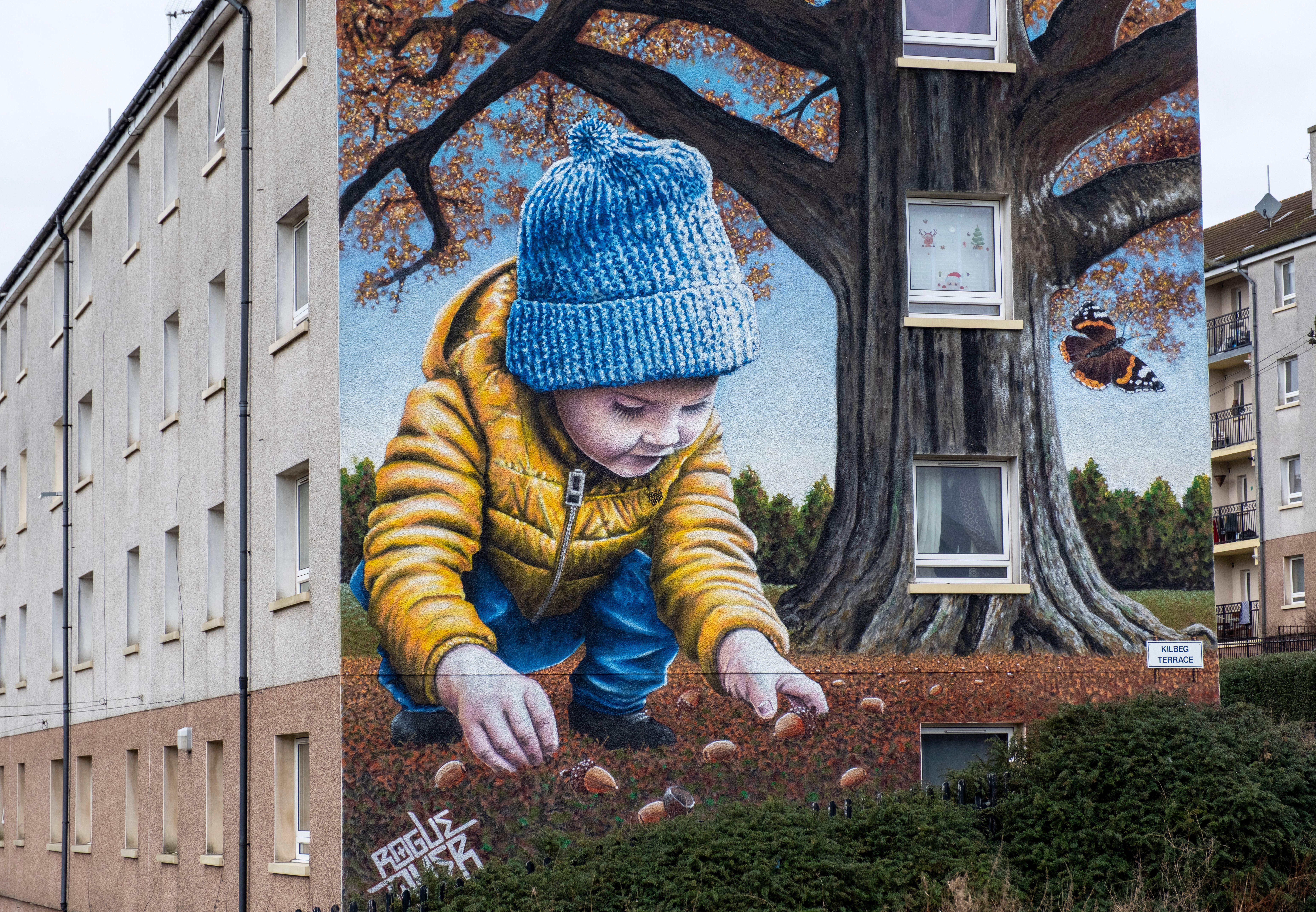
Mural by street artist Rogue One for Glen Oaks Housing Association, Glasgow | Alamy
Within the housing sector, it all feels a bit familiar. After all, a pilot scheme funded deposits for more than 10,000 homes from 2019 to 2022. And it wasn’t too long ago that Communities Scotland had a similar remit covering improvements to the supply and quality of affordable housing stock. Set up in 2001, that agency lasted just seven years until the Scottish Government moved its policy and funding functions back in-house in a step that was supposed to drive up value for money and accountability – much in the way its new replacement is promised to.
“A new national agency will mean less duplication, greater expertise, increased efficiencies, and making our substantial investment go further,” Swinney said, announcing the proposal for More Homes Scotland while on a visit to a Wheatley Homes building site in Wallyford, East Lothian.
“It is a new body that will offer simplicity, scale and speed – boosting delivery, and maximising savings, as part of our commitment to a decade of public sector modernisation and reform,” he went on, adding that it will work with the Scottish National Investment Bank to attract more commercial investment.
Jonathan Guthrie, chair of the Scottish Property Federation, agreed, saying that “a single national agency with a clear focus on delivery had real potential to accelerate decision-making and make better use of public and private investment to get more homes built, more quickly”.
That investment would go some way to taking pressure off social landlords. Because for some, the costs involved in construction projects are simply prohibitive. “Development is becoming more unviable, with more realisation of the cost of management and compliance, particularly with flatted blocks, against the rental income, creating the potential for long-term financial concerns over borrowing and reticence to progress on available grant levels,” one Glasgow housing forum member organisation said.
But there are strains everywhere, and Shelter Scotland director Alison Watson has said social housing delivery is simply “too little, too slow, too late”. “This hasn’t happened overnight,” she said. “This is decades in the making.”
The charity has given its welcome to More Homes Scotland. But Watson warns that “intent alone won’t build homes”. “Without the funding to match the ambition, homelessness will only rise. And we need the new agency to deliver for the people waiting for a home,” she said.
“We must be clear about the cost of failure. Failing to build the social homes we need means more families waking up without a place to call home, more children trapped in temporary accommodation and in poverty with rising costs for councils, health boards and the taxpayer. We can’t afford not to invest in Scotland’s future.”
Holyrood Newsletters
Holyrood provides comprehensive coverage of Scottish politics, offering award-winning reporting and analysis: Subscribe