Home truths: The impact of asylum on Scotland's housing emergency
Have well-intentioned changes to who can apply for social housing heaped further pressure on a system already in crisis?
There were groans across the chamber as Malcolm Offord, Reform’s leader in Scotland, got to his feet and began his question on immigration. It was only his third appearance at First Minister’s Questions, his two previous outings marked by rambling contributions which helped underscore that despite his party’s historic election result, it still has a long way to go to become the polished political operation it strives to be. It would later emerge the former Tory peer had been diagnosed with prostate cancer on the day of the election, a very good reason for why he may not have been entirely focussed on the job at hand in the weeks since. This time, however, Offord managed to get under John Swinney’s skin, the first minister accusing Reform of “inciting racial hatred” after its leader asked a question about the housing of refugees.
Earlier that week, a large group of young white men, some wearing balaclavas and face coverings, had marched through Glasgow city centre carrying out what police described as racist attacks, injuring five people in the process. That action followed an outbreak of violence in Belfast after a knife attack that was filmed by mobile phone and widely shared on social media. Hadi Alodid, a Sudanese national who claimed asylum after arriving across the Irish border, was later charged with attempted murder and is currently awaiting trial. His alleged victim, Stephen Ogilvie, lost the sight in his left eye.
So tensions were already running high before a session of FMQs in which Offord divided the public into “locals and strangers” as opponents accused him of “fanning the flames of hate”. While immigration is a matter reserved to Westminster, Offord wanted to ask the Scottish Government about changes to so-called ‘priority need’ and the local connection rule, interventions Reform and others argue have made it easier for refugees – many of them single men – to make their home in Glasgow, a city currently in the grip of a housing crisis.
“Will the first minister now take immediate action to restore the priority need for local Scots for scarce housing resources, and give priority to local Scots ahead of strangers?” Offord asked.
Changes to priority need date back to 2012 when, amid falling levels of homelessness, Holyrood unanimously backed legislation abolishing the test, giving all unintentionally homeless people the right to housing, not just those deemed particularly vulnerable, such as families with young children or women escaping abusive relationships. A decade later the SNP government went further, scrapping the local connection rule which required those making a housing application to have a link to the area in which they were doing so. Both changes have put Scotland at odds with England where, for the most part, rules around priority need and local connection remain in place.
Local connection powers had already been made discretionary before they were fully scrapped in 2022. The move was welcomed by homelessness charities who said it would give people more agency over where they chose to make a housing application. Shona Robison, the housing secretary at the time, said it would allow people to find a settled home as quickly as possible in an area of their choosing, although she acknowledged it would likely put additional pressure on some councils rather than others.
Of the more than 17,000 households assessed as homeless between April and September last year, 87 per cent had a local connection to the local authority where they had applied, while four per cent had a local connection to another local authority – up from between two and three per cent previously. More than 1,400 households (eight per cent of the total) had no known connection to any Scottish local authority.
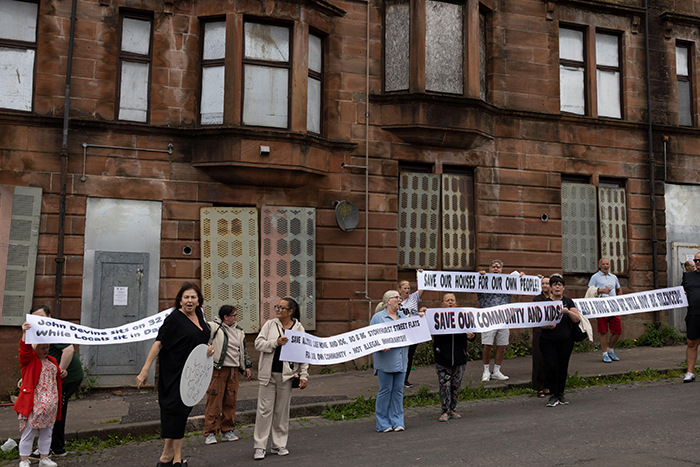 Locals stage an anti-migrant protest in Glasgow’s Possilpark in July | Alamy
Critics contend the changes have put further strain on places such as Glasgow which declared a housing emergency in 2023 – a year before the Scottish Government did the same thing for the whole country. Glasgow is currently dealing with more than 6,000 housing applications, with more than 4,000 households in temporary accommodation. Scotland’s largest city, which has been part of the Home Office’s dispersal scheme since 1999, also has the highest number of asylum seekers of any local authority in the UK, with one asylum seeker for every 200 residents compared with 0.1 per 200 residents in Edinburgh. While those who have received positive asylum decisions – moving from ‘asylum seeker’ to ‘refugee’ in the process – have always been able to apply for housing support anywhere in Scotland, the same is not true of England where refugees are deemed to have a local connection to the area in which they were housed as asylum seekers.
“The reality was that [local connection] was an additional barrier to people experiencing homelessness,” says Lisa Borthwick of Shelter Scotland. “The removal of the local connection rule has just simplified the journey… People living within Glasgow or Edinburgh, areas with very pressured housing systems, have got the ability now to choose not to spend years in temporary accommodation by moving to a less pressured area.”
But others argue the removal of the local connection rule has put additional pressure on Glasgow by encouraging refugees who have received a positive asylum decision to move to the city from other parts of the UK, where local connection rules remain in place. Raising the point in the Scottish Parliament last year, Labour MSP Paul Sweeney said that “however well-intentioned”, the measure had increased those coming from other dispersal cities such as London, Liverpool and Birmingham. He called for an urgent review of the policy given the situation being faced in his city – a call rejected by then housing secretary Mairi McAllan.
Now Reform has taken the issue up. Just over a week after May’s election, the party’s deputy leader, Thomas Kerr, lodged a parliamentary motion calling for the local connection rule to be reinstated. At a UK level, his party has dramatically reframed the debate around immigration, pledging to deport 600,000 migrants, review all asylum claims from the past five years, and exclude foreign nationals from most UK benefits. Last week, Reform promised to give British-born workers under the age of 35 priority on social housing lists in England if it wins the next general election
“The removal of local connection for social housing is one of this rotten SNP government’s most shameful policies,” Kerr says. “The unintended consequences have been dire for our own people. Meanwhile, they have been taken advantage of by illegal migrants.”
He says the removal of the local connection rule has helped foreign nationals “cut the line” for social housing, a claim disputed by both local authorities and housing groups.
“The left’s progressive politics should not be a substitute for fairness,” Kerr adds. “There’s nothing fair about prioritising strangers over the people of Scotland.”
There is no doubt new arrivals to the city are putting increased pressure on Glasgow’s already overwhelmed housing services. According to the council, nearly half of all homeless presentations are from refugee households, with 60 per cent of children living in temporary accommodation belonging to refugee families. In a written submission to the UK Parliament last year, the Scottish Refugee Council said the abolition of the priority need test in 2012 had led to people from other parts of the UK travelling to Glasgow to access homelessness services.
It said Scotland’s differential policy on both priority need and local connection had led to “unprecedented pressure on the city’s housing stock”, with significant numbers of single males coming from cities such as Belfast, London and Manchester.
But while charities agree with Reform that there is a problem to solve, they diverge on what the solutions should be, accusing the right-wing party of stoking animosity towards immigrants. The Scottish Refugee Council, for example, says Glasgow is facing a multifaceted “perfect storm” that won’t be addressed by removing rights from anyone.
“Housing is being weaponised by bad actors,” says Borthwick. “Local connection has nothing to do with refugee homelessness and changing those policies would weaken the rights for everyone and only cause more harm. Repeating these false claims is not a harmless mistake – it spreads misinformation that falsely suggests some communities are receiving preferential treatment in access to housing.”
Mhairi Love, of the Scottish Refugee Council, says the focus on the local connection rule is a cynical attempt to turn the issue into a “Scottish problem and something you can kick the Scottish Government for” rather than putting the blame at the door of the Home Office, which manages asylum dispersal.
For much of the twentieth century, Glasgow had a deserved reputation for violence. The title of the 1935 novel No Mean City, a story of the Gorbals’ razor gangs, gave it an unwanted epithet it would struggle to shake off. Even amid the urban renewal and successful attempts to recast the city as a place of culture and the arts in the 1980s and 90s, Glasgow continued to have a significant problem with knife crime and as recently as the early 2000s had the highest murder rate in Europe.
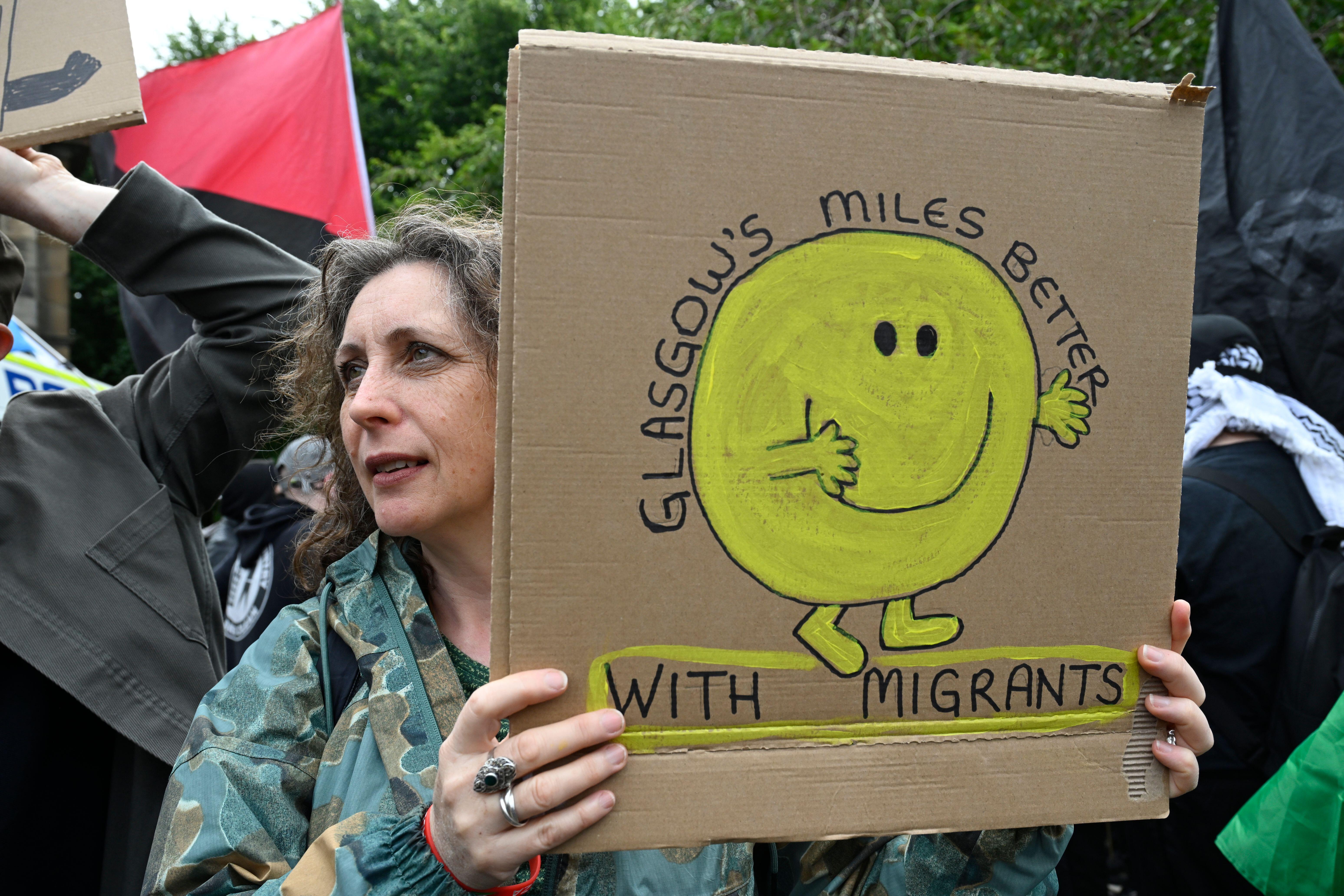 A woman holds a homemade placard during a demonstration earlier this year | Alamy
There has been huge progress in the two decades since, the homicide rate falling 66 per cent between 2005-10 and 2020-25. While the level of overall level crime sits above the national average, it has remained largely static over the past few years. And yet anyone who has recently spent time in Glasgow city centre will know it is not looking its best. The issue has been compounded by a series of devastating fires which have left ugly gap sites on Sauchiehall Street and Union Street, like missing teeth in the face Glasgow shows the world. A slew of social media videos showing violence, drug taking and anti-social behaviour has helped convince many that parts of the city centre are unsafe, particularly after dark. It’s a problem that other largely safe UK cities such as London and Birmingham have also experienced.
Much of the online commentary that has gone alongside those videos has attempted to link these incidents to immigration and the increasing numbers of young men arriving in the city in the past few years, a cohort Reform refers to as “fighting-age males”.
Last month ahead of the Commonwealth Games, Kerr posted his own video. Billed as a walk around Glasgow’s “lawless” city centre, it featured groups of non-white males, their faces blurred, hanging about next to the Clyde and St Enoch Centre. Kerr said he had personally witnessed a drug deal as well as drug taking and “four migrants staring at a young girl” during a 30-minute period. Reform also seized on a BBC Disclosure documentary, Welcome to Glasgow, shown earlier this month, which focused on a dispersal zone introduced by Police Scotland earlier this year to tackle crime and anti-social behaviour.
According to police, the dispersal zone is working. Since its roll out, more than 1,500 notices have been handed out, excluding the recipient from the relevant part of the city centre for 24 hours. But others have raised concerns, notably the Children and Young People’s Centre for Justice (CYCJ), part of the University of Strathclyde, which warned of the unintended consequences of banning young people from the relative safety of the city centre.
What’s clear, however, is that the introduction of the dispersal zone hasn’t shifted the idea that parts of the city centre are now a “no-go zone”. Indeed, if anything, it may have helped entrench that notion.
This summer, as MSPs began their long recess period, some of the tensions experienced in the city centre spilled out into other parts of Glasgow, such as Cranhill where a large police presence was deployed early in July after locals surrounded a block of flats where one of two men involved in an alleged rape and an alleged assault was believed to be living. Later the same week, hundreds gathered outside a property in Castlemilk where a sex offender was thought to be living. Police said the latter incident was a case of mistaken identity as they warned of disinformation being spread online. The Scottish Police Federation, which represents rank and file officers, said both incidents had been “orchestrated”.
Whoever is responsible for stoking up hatred online, and many of the accounts are likely based outside of the UK, they are nevertheless managing to exploit real-world grievances about housing and the misguided notion that refugees are given priority.
Reform’s political opponents accuse the party of muddying the waters, seeking to link housing issues and the scrapping of the local connection rule with rising tensions in parts of Glasgow. Language which divides people into ‘locals’ and ‘strangers’ certainly seems designed to pit Glaswegians against one another. It has also led to some fiery exchanges at Holyrood in the first few weeks of this parliamentary session.
The housing problems faced by many Scottish councils, but particularly Glasgow, are both complex and years in the making. But changes made to who can claim housing and where, while well-intentioned, may indeed have contributed to wider issues within the system. If those issues have been hard to identify, then the solutions will prove even more difficult to come by.
Holyrood Newsletters
Holyrood provides comprehensive coverage of Scottish politics, offering award-winning reporting and analysis: Subscribe