Local Knowledge: Having a deep understanding of island life informs vital decisions about policy and investment
When Angus Campbell took on his new role as chair in November last year, Highlands and Islands Enterprise (HIE) was marking its 60th anniversary. It’s recognised as an institution synonymous with positive regional development across some of the nation’s most geographically challenged areas. For Campbell, the organisation’s longevity provides the basis for continuing success.
“I’m genuinely excited about the role,” he says. “That’s why I went for the position. HIE and community development in the islands are well known but there’s still a huge opportunity to make a bigger and better difference.”
Coming from an island background himself and living on the Isle of Lewis, Campbell is keenly aware of the lived realities that lie behind policy decisions.
“I think I’ve something to add in terms of how we land all this and make it work in practice,” he explains. “It’s about bringing in new elements but making sure they work for communities and places as well.”
That grounding matters. Before this role, Campbell spent 18 years as a councillor in the Western Isles, including 14 years as leader. His political motivation was deeply personal: “My interest has always been in the socio-economic side of things but I came into politics first to make sure my children had better opportunities: to live and work at a good level in the islands. However, that applies just as much to rural areas right across the Highlands and Islands.”
While many of the region’s challenges persist, Campbell argues they have evolved rather than disappeared, noting: “Young people are more inclined now to want to stay in the Highlands and Islands because they see the value of the place and what it offers for their lives. But making that happen is still as challenging as ever.”
He believes creating jobs, while incredibly important, is in itself not enough. He says: “You need good quality jobs, well-paid, satisfying work, but you also need structure in terms of housing, transport connections, digital connectivity and access to culture and leisure. Young people are more discerning today. They don’t want to feel disadvantaged simply because of where they live.”
Campbell believes connectivity – physical and digital – remains central to progressing economic activity and points to his eight years chairing the Ferries Community Board as a marker of the importance he consistently puts on working links for both businesses and social activity.
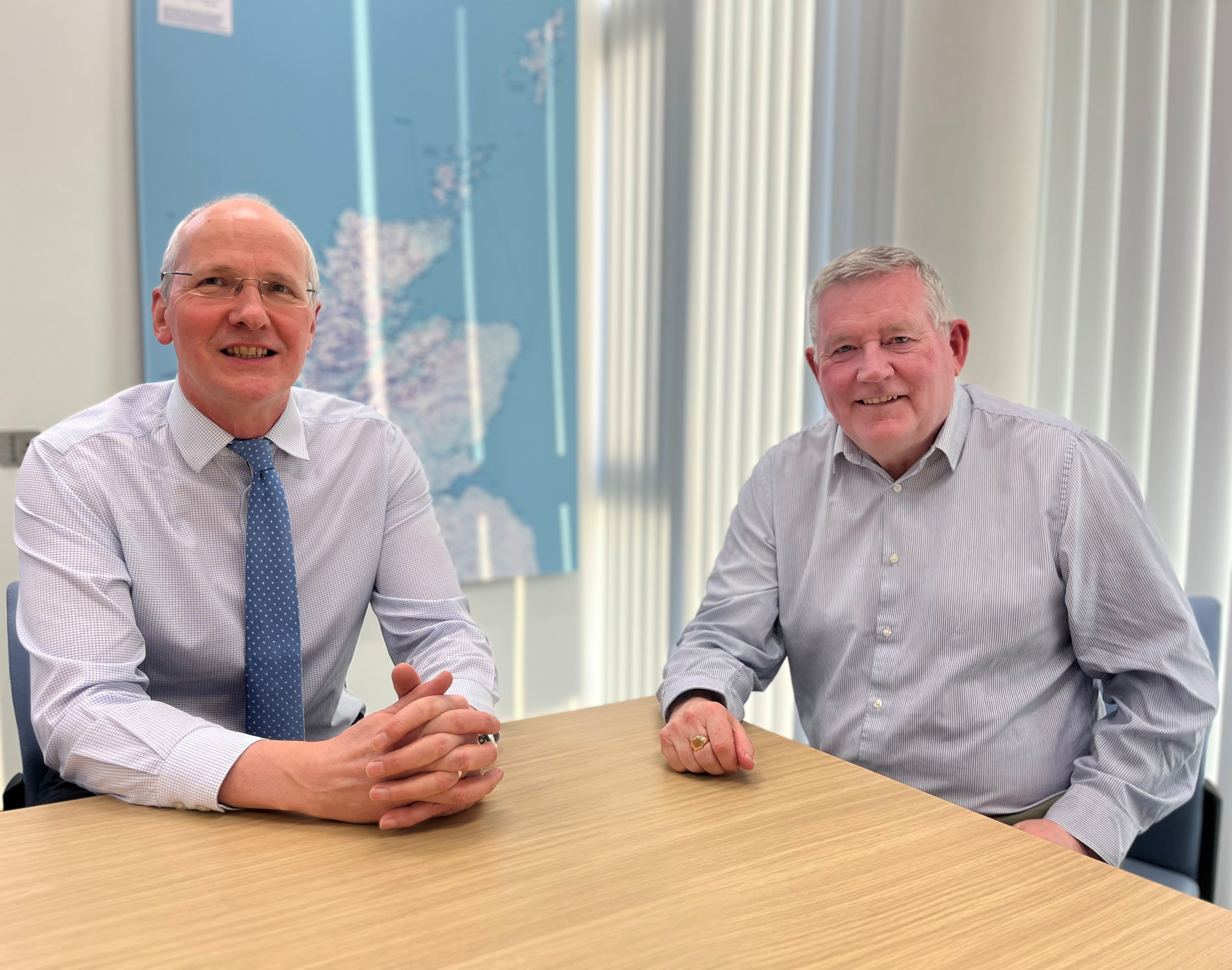 Stuart Black, chief executive of HIE (left) and Angus Campbell, chair of HIE (right) | Photo credit: Mairi Gillies
“People want to live island lives,” he says, “but they also want to have the same opportunity to participate in the cultural and sporting events available to others, travel easily and feel connected to the rest of the country. The whole package has to be right.”
Since the Higlands and Islands Development Board (HIDB) was established in 1965, the region’s population has risen from 381,000 to 470,000, a 23 per cent increase compared to under 6 per cent for Scotland as a whole. Its contribution to the country’s economy has more than quadrupled from less than 2 per cent to 8.5 per cent GVA (gross value added).
That growth has been driven by the success of HIE and its partners in supporting economic expansion and diversification. Where once the Highlands and Islands economy was characterised by a narrow range of primary industries, including farming, fishing and forestry, it is now home to thriving businesses in sectors as diverse as food and drink, tourism, creative industries, life sciences and space.
Looking ahead, too, the scale of opportunity across the region is exceptional. Research published last year by Ekosgen for HIE and the Highlands and Islands Regional Economic Partnership identified more than 250 planned development projects with a combined investment value of £100bn and the potential to deliver more than 18,000 operational jobs by 2040.
For Stuart Black, chief executive of HIE, even after 60 years balancing economic and social development remains fundamental to the organisation’s mission – while recognising for a rural area to be successful it doesn’t need only vibrant businesses but also recreational places and community facilities – often provided by third sector organisations rather than councils or the private sector.
“It’s equally important that the more geographically challenged parts benefit from the activities,” says Black, “and we’re not spending all of our budget in and around more accessible centres, such as Inverness, but across the region.
“One of our key strengths is having people based all across the Highlands and Islands and in 12 regional offices. For example, we’ve teams in Shetland, Orkney, the Hebrides and Lochgilphead, who are incredibly well connected.
“Being in the community helps with our understanding of what’s happening in different areas and how local economies work.”
He cites projects ranging from Tiree to Fair Isle, including the Fair Isle Bird Observatory, as examples of HIE reaching places “no other agency would get to”.
A lack of housing is another critical pressure point in attracting and retaining people in the region and is particularly troubling for Black.
“In the sixties there were lots of empty houses but not now. House prices are also very high and that makes it more challenging for young people to stay in their communities because often they’re competing with second homeowners or people who come into the area post-Covid and are able to work remotely – which is a good thing but it does make the housing market even hotter than it was before.”
Much of HIE’s local knowledge is being applied to the energy transition. While international players are involved in offshore wind and renewables, Black stresses many of the region’s most transformational projects are driven by locally rooted and small to medium sized companies.
The Highlands and Islands economy is home to thriving businesses in sectors as diverse as food and drink, tourism, creative industries, life sciences and space
He points to the redevelopment of Kishorn Port in Wester Ross, led by Ferguson Transport and Leiths (Scotland) Ltd: “It’s already one of Europe’s biggest dry docks but they’re adding a football pitch-sized new facility and several hectares of laydown space. These are major investments being driven by companies with local roots.”
Similar models are emerging in Lerwick, Wick and Cromarty Firth, where trust ports and local boards are leading major developments. Black notes: “Our knowledge on the ground working with these local companies is really important.”
Campbell stresses such inward investment matters but adds: “So, too, is making sure local companies and supply chains benefit. That’s how you land these projects properly.”
Despite public scepticism about the slow pace of offshore wind delivery, Black remains confident about its positive impact.
“Pretty much every sizeable harbour in our region is investing now for the future and that’s all about confidence. There have been delays – often due to global decisions and market pressures – but port investment is happening. We’re planning for the next boom in offshore renewables while onshore work on the transmission network is already happening, so we can see infrastructure being put in place to service energy projects.”
Both emphasise engagement with businesses and communities must be meaningful: HIE works closely with hundreds of businesses and organisations, holds board meetings across the region and runs in-person and online engagement sessions.
That emphasis on listening has tangible outcomes, such as the Islands Business Resilience Fund, developed in response to ferry disruption affecting tourism and supply chains.
“We fed back to ministers on the serious impact this was having,” Black says. “The provision of the resilience fund is a clear example of feedback leading to action.”
Another element of HIE’s work is supporting the role of Gaelic in entrepreneurship and economic development. In 2022 the government’s Economic and Social Opportunities for Gaelic report noted there should be increased activity in key business sectors, including the creative industries, culture, heritage, tourism, sport, food and drink as the drivers of social Gaelic use and economic outputs.
Campbell says: “Gaelic is a hugely important economic driver. We’d like to see it used more not just as a social language but a working language.”
After six decades of progress, HIE’s work is formally measured against 20 annual targets, including job creation and retention, investment leverage, wages and productivity. Over the past decade it has supported the creation or retention of roughly 1,000 jobs annually.
Recent investments include Sumitomo’s £350m subsea cable manufacturing plant at Port of Nigg, Arnish in Stornoway, Dales Voe in Shetland, and Kishorn Port. It’s also made strategic investments to enable growth, including a range of small flexible business units in rural locations, the Manufacturing Innovation Centre Moray and a new £8.1m laboratory and office building at European Marine Science Park in Argyll, while progressing development at Inverness Campus.
It’s evident, then, that HIE continues to have a crucial role in attracting additional funding for regional initiatives with the return on investment coming in the form of economic activity and tax revenue from job creation. After 60 years its mission remains steadfast: enabling people not just to live and work in the Highlands and Islands but thrive here. The challenges may have changed shape over decades but the principle endures: place, people and opportunity must move forward together.
This article is sponsored by Highland and Island Enterprises (HIE).
www.hie.co.uk
Holyrood Newsletters
Holyrood provides comprehensive coverage of Scottish politics, offering award-winning reporting and analysis: Subscribe