Economic drivers
Scotland possesses some of the most abundant natural resources in Europe, alongside a skilled workforce and a long-established heritage of innovation. Against this backdrop, the opportunity for continuous economic improvement is genuinely huge.
Nowhere is this more evident than in the Highlands and Islands, viewed increasingly as pivotal to Scotland’s future. From green energy and life sciences to aquaculture, tourism, and food and drink, its diverse range of industries are a focal point of investment interest.
The end result is a region fast gaining a reputation as a powerhouse not only for the UK’s energy needs but the national economy as a whole.
“Research has identified more than 250 planned development projects with a combined investment value of £100bn around the region,” says Stuart Black, chief executive of Highlands and Island Enterprise (HIE).
“A lot of this investment is already underway, particularly around energy transmission infrastructure, led by SSE Networks. In Stornoway, for example, SSEN Transmission investment is taking shape in £7.2m funding to support the upgrade to Arnish Road, improving access to a vital enterprise park.
“That’s also partly funded by ourselves, as well as the Port [a critical maritime and industrial hub], so it reflects excellent and productive partnership activity. In addition, SSEN will be putting in a new substation and subsea cable to the mainland, and there are a lot of new and upgraded power lines being built on the mainland.
“So, although we’re seeing some evidence of offshore wind projects being affected by market and current geo-political conditions, the onshore grid infrastructure is happening at pace.
“SSEN is quoting a figure of £33bn investment in its transmission infrastructure. Obviously, some of this activity is in Aberdeenshire and down the east coast but a lot of the investment is taking place in the Highlands and Islands: we’re talking about almost 1,000 jobs in Shetland and the Outer Hebrides to build this framework. On the back of that we’ll see further renewable developments, particularly in offshore wind.”
Black points out HIE had an extremely successful 2025/26, with its own investment drive and efforts to attract additional funding to the region.
“Our starting budget from the Scottish Government was £53m but we actually ended up spending £104m. We almost doubled our budget and by far the bulk of that extra money was for offshore wind investment projects, such as the £350m Sumitomo Electric Power cable factory at Port of Nigg.”
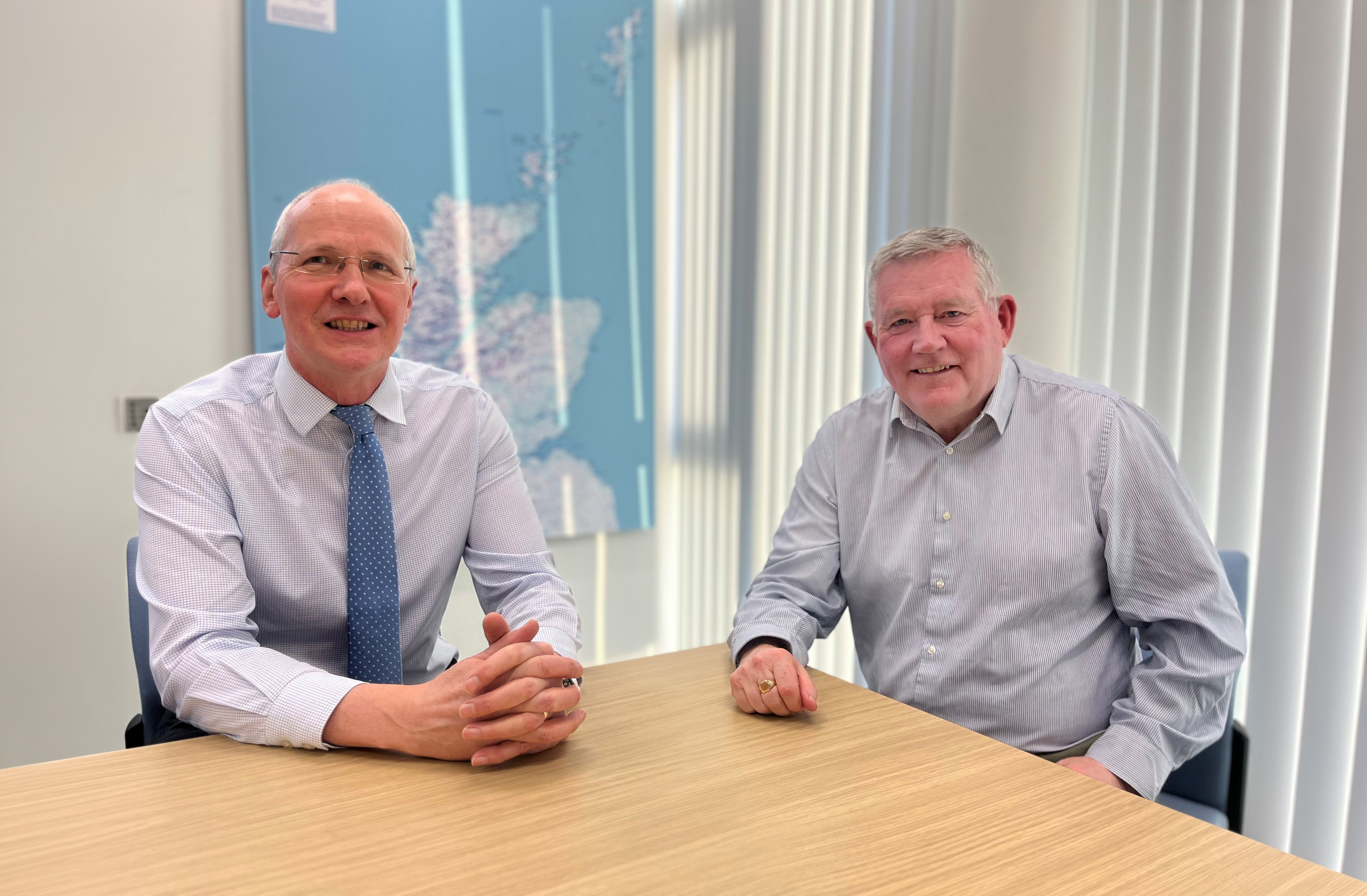 Stuart Black, chief executive of HIE (left) and Angus Campbell, chair of HIE (right) Credit: Mairi Gillies
HIE also approved over £24m Scottish Government funding for Kishorn Port to enhance its capacity and capabilities, with an expanded dry dock and land reclamation enabling the manufacture of floating offshore wind foundations.
“There is huge investment happening at Kishorn,” says Black, “and that’s creating a lot of employment on the construction side and could lead to between 500 and 1,000 jobs in a very rural part of Wester Ross.
“The enabling infrastructure is happening and that’s a key point. We’re confident the power infrastructure will follow, including pumped storage hydroelectricity along the Great Glen, offshore wind around the coasts, as well as more onshore wind capacity as existing farms are repowered.”
These judicious and targeted capital injections by HIE form a major part of the Scottish Government’s commitment to channel up to £500m over five years into the offshore wind supply chain and port infrastructure. If realised, there’s no doubt they will constitute one of the largest economic transformations in modern Scottish history. However, the scale of opportunity also exposes the existential challenges that come with it.
Angus Campbell, chair of HIE, notes: “The government has said quite clearly that the economy is going to be the primary driver in the next few years, which highlights the huge opportunity for what the Highlands and Islands can deliver. We see figures of 70 to 80 per cent of this activity being in the Highlands and Islands.
“However, that scale of opportunity also means we have to work hard in making sure the supply chain benefits land properly – and that they work around improved housing, childcare and transport links so our communities can prosper.
“It’s about embedding the wider supply chain and getting the best benefits out of it for all of the Highlands and Islands and, indeed, the whole of Scotland. That is driving a lot of what we’re doing.”
For decades economic policy in Scotland has often struggled to reconcile national ambition with regional capacity, with a main obstacle being adequate levels of housing to support employment. It’s an issue that resonates with Black.
“A major challenge in many of our rural locations is affordable housing, especially homes for young people starting out on their careers. It’s why we’ve been asked to engage in the establishment of a new housing agency the government is setting up.”
In a bid to stem rural to urban migration HIE is also proactively looking for companies to take on young people and apprentices.
“We need young people in the community. We need a balanced population but in some parts of the region we’re facing quite significant migration by young people, even though more and more are showing a desire to be in the region if the enabling infrastructure is in place. So we’re trying to encourage companies and the bigger investors to come in and provide opportunities.”
Campbell notes a good transport system is vital for tourism and the wider economy and that businesses need to be able to get their products to market, adding: “People, particularly the elderly, also need to be able to go about their daily life: attend health appointments, see their families, do whatever they have to do – that’s a critical part of it as well.”
When it comes to the power of enabling change, both Black and Campbell welcome the direction now being taken by the Scottish Government.
“First Minister John Swinney’s recent speech to the CBI suggested a strong focus on the economy,” says Black. “We’ve always felt that should be the case because when you consider some of the government’s priorities, such as tackling child poverty, the best way of achieving this is by giving people opportunities for high-quality jobs and employment. We need to generate revenue.
“We’ve undertaken studies that show for every pound HIE puts in generally, this generates at least £3 back for the taxpayer. So there’s a strong multiplier effect on what we do. The £100m we spent last year is the highest annual figure we’ve invested for over a decade and shows this area is seeing the benefits of additional government infrastructure spend, particularly for offshore wind.
“However, we really want to use that infrastructure to grow the economy, create more high-quality jobs and also have that power Scotland. The Highlands and Islands is a real asset for the rest of the country. We are actually providing the energy that’s needed for the electrification of the economy, for data centres, for all of the new industrial activities that are going to be powered through renewable energy.”
The appointment of Stephen Flynn as Cabinet Secretary for Economy, Tourism and Transport has also been welcomed, as these sectors are so intricately linked in the region: “You need a successful transport system to have a thriving economy so bringing them together in one portfolio is helpful for us.”
… for every pound HIE puts in generally, this
generates at least £3 back for the taxpayer
Alongside many examples of approved HIE investments to boost infrastructure, there are projects directly benefiting local economies and creating community resilience. As Campbell underlines: “It’s important to remember we need a balanced economy here. So we need to make the community businesses grow as well: to be part of and complement what’s happening.”
One example is in Oban where HIE has completed a second building – the £8m Camas House – of laboratory and office space at the European Marine Science Park. The first building – Malin House – is already home to 13 businesses and around 70 employees.
“We recently visited Ocean Ecology there,” says Black, “who do laboratory testing of areas where offshore wind farms are going to be. The company was full of young people under 30, many of whom were from the local area. That’s what we want more of: knowledge-based, well-paid technical jobs – not just basic entry level jobs – in our area.”
As well as applying innovation in developing nationally significant sectors, HIE is streamlining its own operations as part of the public service reform agenda.
Black says: “We’ve been looking at how we can be more efficient and looking at our processes for many years. More than 90 per cent of our activity is digital activity in terms of interaction with the customer.
“In the last financial year, we generated around £2.8m of savings through different initiatives. So we’re very active in public service reform in terms of processes, sharing premises and collaborating with other agencies.
“We keep an eye on the output for our customers and our communities. It’s relatively easy to go salami slicing here, there and everywhere, but if you’re losing purpose and the reason you’re there as an organisation, you’re doing more damage to the economy. We’re making sure we get a bit more out of what we have and getting more for the end user.”
HIE’s sustained public and private investment, alongside policy stability, aims to boost investor confidence and empower business and communities. Such economic transformation rooted in value creation and shared prosperity is not an easy transition – however, it is a necessary one. If the Highlands and Islands can get it right, the rewards will extend far beyond the region.
According to Black and Campbell, the opportunity is there – the challenge right now is to seize it.
“There is a new landscape out there,” says Campbell, “and we have set ourselves the task of getting known in that environment and creating an awareness of what we can achieve to help promote the direction of travel for government. It all takes investment, time and directly addressing the issues. However, there is a fantastic story to tell for the Highlands and Islands in terms of where we are . . . and what new opportunities lie ahead.”
In association with Highland and Islands Enterprise.
www.hie.co.uk
Holyrood Newsletters
Holyrood provides comprehensive coverage of Scottish politics, offering award-winning reporting and analysis: Subscribe