Scott Arthur: I can understand why people feel left behind
Scott Arthur did not at first appreciate the magnitude of what he’d achieved when the Rare Cancers Bill passed into law.
As a first-time MP, it all seemed “entirely normal” that he should enter parliament and get some legislation onto the statute books. “This is what you do: you enter the [private members’ bill] ballot, you get selected, you draft a bill and it gets passed into legislation,” he says.
It wasn’t until he tried his luck with the ballot again just before summer recess that he realised “just how exceptional it was”. “I was kicked out at the first stage – that is normal.” Indeed, there are MPs who have been in the Commons for decades and never once topped the ballot. And even of those that do, few see their proposals become law.
“I do feel lucky,” Arthur tells me from his office in Fountainbridge, almost half a year on from the bill’s royal assent. “But it’s also not been about me – it’s about the staff in the office and all the charities and the wider campaign that made it happen.”
We thought that maybe if the tumour was different or he was different, perhaps there would be a different outcome
The Labour MP won Holyrood’s Scottish MP of the Year accolade at this summer’s Showcasing Scotland event for his work on the legislation. Accepting the award, he was equally humble, pointing out the real measure of success will be if this law saves lives. He hopes, he said, to be able to come back in 10 years and talk about the tangible change he played a part in delivering.
The legislation aims to incentivise research and investment into treatments for rare types of cancer – those where fewer than six in 100,000 people are diagnosed per year – and it will improve access to drug treatments across the UK.
It will also create a strategy for research and establish a national database to better connect patients to clinical trials – though these elements only apply to England as they are devolved.
But Arthur says his team has been engaged with the Scottish Government on the matter, with ministers hoping that “most of this can be done without the need for legislation” to improve cancer care here too.
Arthur’s name was drawn from the private members’ bill ballot in September 2024, just two months after winning his Edinburgh South West seat. His inbox, he says, was immediately flooded with proposals. “There was a lot of uncertainty about which campaign to work with,” he recalls.
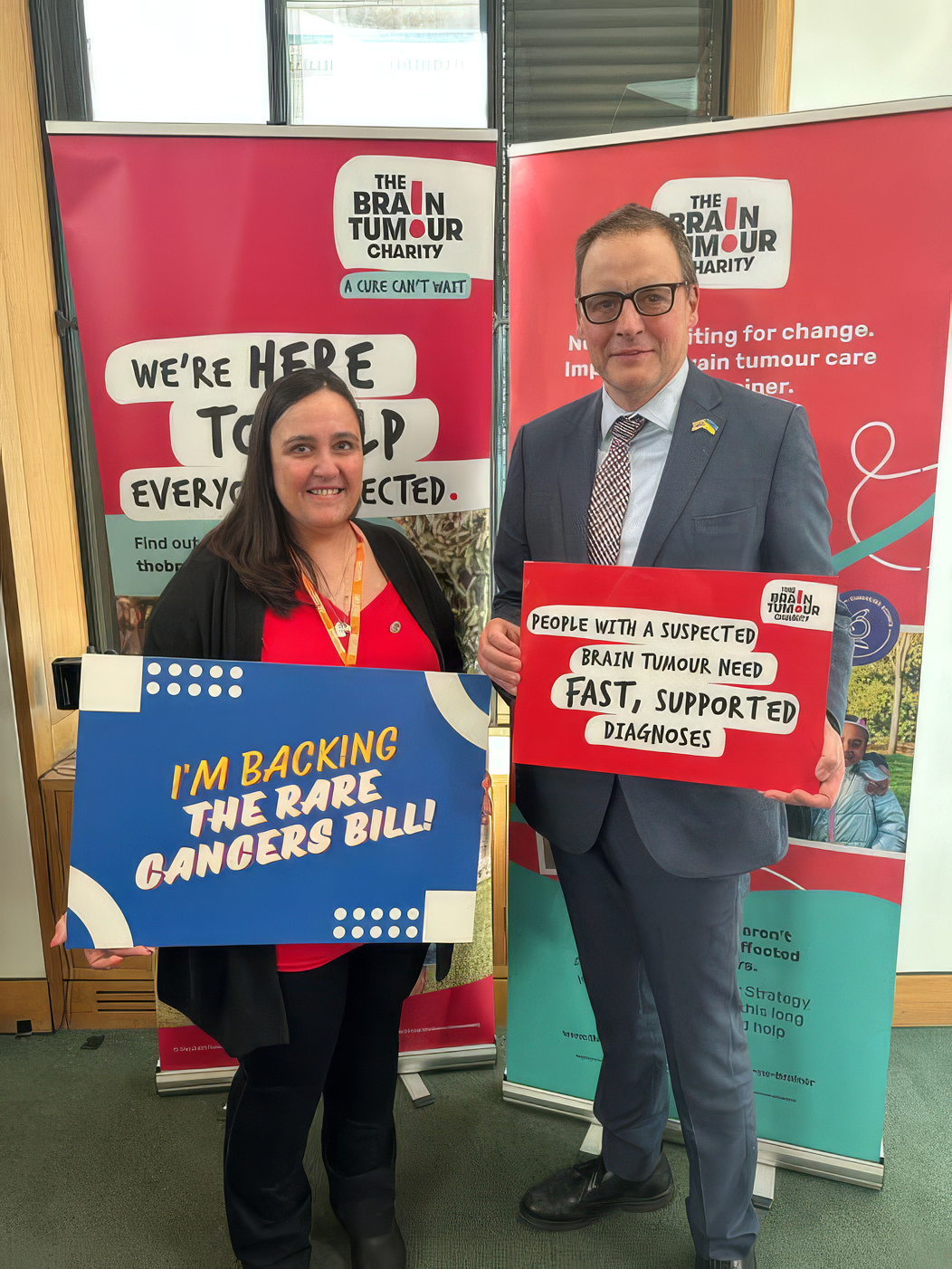 Arthur meeting campaigner Oriana
Until, that is, he received one email in particular. It was from a woman called Oriana, who told him about losing her father to glioblastoma. Arthur recognised the name of the cancer. “I asked my wife, ‘was this what your dad died of?’ And when she said yes, it felt like the burden in making the decision about what I was going to do the private member’s bill on had been taken off my shoulders.”
Ivor Hutchison, Arthur’s father-in-law, died in May 2018. He’d started to experience difficulties with speaking in late 2017 and the family were at first concerned it was an early sign of dementia. But an MRI scan revealed the cause was an incurable and untreatable brain tumour.
The family managed to have a relatively normal Christmas, but at the turn of the year Ivor really began struggling with his mobility. Eventually he was admitted to the Adamson Hospital in Cupar. He died surrounded by his wife and daughters.
At first, Arthur thought Ivor had just been “unlucky”. “We thought that maybe if the tumour was different or he was different, perhaps there would be a different outcome,” he says. It wasn’t until he met other campaigners – and in particular fellow Labour MP Siobhain McDonagh, whose sister and Labour grandee Margaret died from glioblastoma in 2023 – that he realised the experience was commonplace for that type of cancer.
“Ultimately [this legislation] doesn’t change the outcome for my father-in-law, of course, but hopefully in the future it does change things in a good way [for others],” Arthur says. His wife Audrey visited London to see the bill pass in the Lords, and their children – Ivor’s grandchildren – followed it closely too.
***
Despite this early success, the past two years have been a difficult time to be a Labour MP. The wheels came off almost immediately and it’s fair to say things have not gone to plan.
“I don’t quite understand why we have to be so public about all our disagreements. It drives me crazy,” Arthur says. Still, he welcomes the relatively smooth transition from Keir Starmer to Andy Burnham. And he remains optimistic that this new government will start to deliver.
Arthur is a true believer in the Labour project. He initially joined the party straight out of school but didn’t stick around after, he admits, finding local meetings “incredibly dull”. But like much of this generation of Scottish politicians, his interest was reignited by the independence referendum. He threw himself into the local Better Together campaign, which he says was a “real eye-opener”.
Fate is powerful. I don’t think I’ve ever planned anything really in my career
“Going around Edinburgh, knocking on people’s doors and them opening their doors and you’d see inside their lives – you could see that quite a lot of people were really, really struggling. And if you remember back then, back in 2014, there was a lot of talk about inequality and how we had to fight this, and the difference between the richest and the poorest was so stark.
“So, at the end of that I rejoined the Labour Party, because I thought they were best placed to do something about it. I didn’t know that when I joined in late 2014 that it was just going to be election defeat after election defeat, and to get further and further away from power each time! But it still felt the right thing to do.”
He stood to be a councillor in 2017 and was elected to represent the Colinton and Fairmilehead ward. Labour worked alongside the SNP as a minority administration for five years and then, after the 2022 election, managed to pull off an impressive coup – taking control with just a fifth of the city’s councillors. “I say to people superficially that the only reason we held on was because everybody else hated each other more than they hated us,” Arthur laughs. “There’s maybe more nuance than that.”
What his time on the council did teach him was the value of cross-party working. “To get anything across the line, you needed two other parties to agree with you… Almost every time, that made the decision better,” he says.
Despite the fact he relished his time on the council, and he’s enjoying being an MP, Arthur says that his political career has been a bit of an accident. He didn’t expect to be elected in 2017 because the ward he was standing in previously had two Conservatives and one SNP member. And like much of the party in 2024, he didn’t predict the tidal wave that would sweep away the SNP’s dominance – particularly when his rival, Joanna Cherry, was well known. But he describes his career before elected politics in a similar fashion. “Fate is powerful. I don’t think I’ve ever planned anything really in my career, but it’s worked out,” he muses.
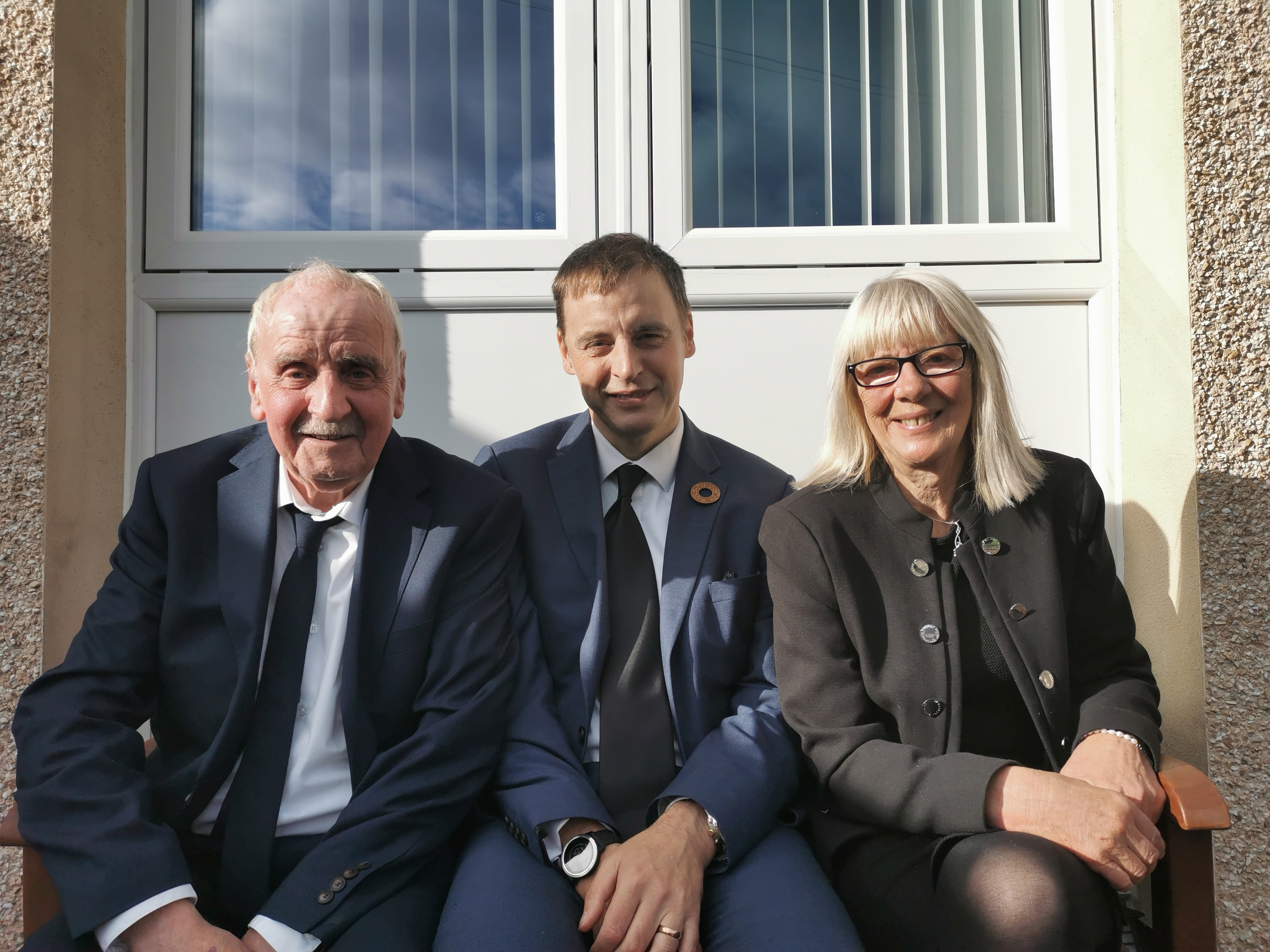 Arthur with with dad Rodger and mum Sheila
Until being elected, Arthur was a lecturer at Heriot-Watt University and a chartered civil engineer. That wasn’t always his future – and certainly not the one his dad, Rodger, had seen for him.
Arthur grew up on a council estate in Kirkcaldy, an area hugely impacted by the deindustrialisation of the 80s. He was a teenager when the miners’ strike took place, and he recalls the struggle faced by many of his peers whose fathers worked at the collieries. Rodger was not employed there, but Arthur recalls him being “really critical” of the government.
When it came time to choose his own path, Arthur was unsure. His dad had expected him to pick up a trade, and he did interview for a job at the Rosyth dockyard. But the future of the yard was uncertain and so instead Arthur decided to go to university – the first in his family to do so. Rodger didn’t understand the decision, and Arthur admits he can “still feel a little bit hurt” when he thinks about how his dad reacted at the time.
What made Arthur’s upbringing even more unusual was that his dad was the primary parent. His mum, Sheila, left the family home when he was in P3. This was shortly after his youngest brother Marc was born and, reflecting now, he suspects postnatal depression was a factor. “A number of years went past before I saw my mum” after that, he says, when limited contact was re-established.
He lived for some time after it, but he never recovered consciousness
I ask how growing up in a single-parent, all-male household affected his worldview. “When I left home, I realised there’s different rules about the toilet seat,” he quips, before more seriously saying that his dad looking after him and his two brothers “was normal”. He saw his aunts regularly, and he was particularly close with his Aunt Ella, his dad’s twin. She would come round on Thursday evenings, he recalls. “We’d watch Top of the Pops and Tomorrow’s World and the Kenny Everett show. And she would always bring crisps, sweets and juice. And my Aunt Irene, she would normally come on a Sunday, and she would do a bit of a tidy-up of the house.”
His relationship with his mum improved when he became an adult, and he’s on good terms with both his parents now. “I see my dad probably more than I do my mum, even though the relationships are quite different between the two of them,” he says.
Perhaps what brought them that bit closer was the death of Marc, who was killed aged 12. He died from smoke inhalation after being caught up in a building fire. “He lived for some time after it, but he never recovered consciousness. That was really difficult for my family, really difficult.”
He’s mentioned his brother’s death in passing to the press over the years, but it’s never something he’s dwelled on. Indeed, when I ask what happened his answer is straightforward and factual, rather than emotional. He suspects he felt the impact less because by then he had already moved out of the family home. But it naturally “really changed my dad and my mum”, he says, particularly because the circumstances around the building fire remain unresolved to this day. He suspects one of his brothers’ friends started it, but “no one was ever found guilty of anything”.
But he does carry the loss with him every day. His most treasured possession, he says, was a ring given to him by his dad not long after Marc’s death. “I wear that as my wedding ring.”
***
For Arthur, having the member’s bill also helped him find his footing in the world of parliamentary politics. Between that and his place on the transport committee, he had a clear focus, he says. “I’d just be floating around a little bit more, particularly since in parliament – as long as you’re not causing trouble – you’re pretty much left to your own devices. It has been good having those two things that have given me something a bit more longitudinal to think about.”
So what comes next? Arthur says he is likely to continue campaigning for better cancer care and research, while also focusing on youth employability. Much of his casework centres on this, he says, along with related issues such as anti-social behaviour and school truancy.
“The problem is a lot of the things that come up are things like neighbourhood disputes, anti-social behaviour, homelessness and overcrowding. Not only are they largely devolved issues, they’re also largely intractable issues which are difficult to solve within a few weeks. It takes long-term interventions to solve them.”
We failed, I think, on the values stuff. We were too negative
That, he says, makes building connections with the community he represents “difficult” because people become “quite cynical about why I am doing this”. Accusations that he’s on the “Westminster gravy train” and doesn’t care about local issues are made more often than he’d like. “I can understand why people do feel a bit left behind,” he says, and that’s why his team has spent a good bit of time thinking about engaging with harder-to-reach communities.
This is a problem faced by politicians across the country. Mistrust runs deep, exacerbated by the fact that many of the public don’t feel the change that was promised in 2024 has been delivered by this Labour government.
Arthur says this distrust has been a long time in the making. “The financial crash, Brexit, Covid – these are all once-in-a-lifetime economic impacts, yet we’ve had them all in the space of two decades. A lot of people who graduated around the time of the financial crash or whose kids graduated at that time, they just don’t feel like they’ve had a chance. And I don’t think Keir [Starmer] was ever going to pick that up in two years... He never promised it was going to happen, but those expectations were high. People voted for us because of change, of course, but also because they were angry with the previous government. They stayed angry about the situation the country found itself in. It’s really, really challenging.”
That anger and the challenge Labour faces as a result became apparent in the recent Holyrood election, which saw the Scottish Labour bloc reduced again.
Arthur says the woes of his party is partly down to messaging. The campaign was “far too negative” and overly focused on “stopping the SNP”, whereas the SNP managed to tap into people’s values – even when the public don’t really believe they will deliver.
He points to the food price cap as an example. “The incredible thing about that pledge was that people didn’t actually think it was going to be delivered… But I think it was a values thing. The SNP communicated that they understood prices were too high in supermarkets, and they had an aspiration to do something about it. What they outlined was either not going to happen or people largely thought it wouldn’t, but they got the values right. We failed, I think, on the values stuff. We were too negative.”
Looking ahead to the next general election – which he still believes will be in 2029, despite calls for Andy Burnham to go earlier – he hopes it won’t be a contest fought on “negative politics”. But, he says, he is concerned it could end up being cast as an election to stop a Reform UK government.
“People in Scotland might vote for Labour to stop Reform becoming a government in the UK, but I’d rather they were voting for our manifesto rather than just stopping Reform.”
Holyrood Newsletters
Holyrood provides comprehensive coverage of Scottish politics, offering award-winning reporting and analysis: Subscribe