Inside Anas Sarwar's last stand
Perplexed was probably the most common reaction to Anas Sarwar’s decision to call for Keir Starmer to go.
Just three months out from the Holyrood election, it was a bold move for a Scottish leader to admit his UK leader has made “too many mistakes” and become a “distraction”.
The scandal surrounding the appointment of Lord Mandelson as the UK’s ambassador to the United States was already weighing heavily on Starmer. The departure of his chief of staff, Morgan McSweeney, the day before meant the PM started the week on already shaky ground – with some even questioning whether he’d last the day.
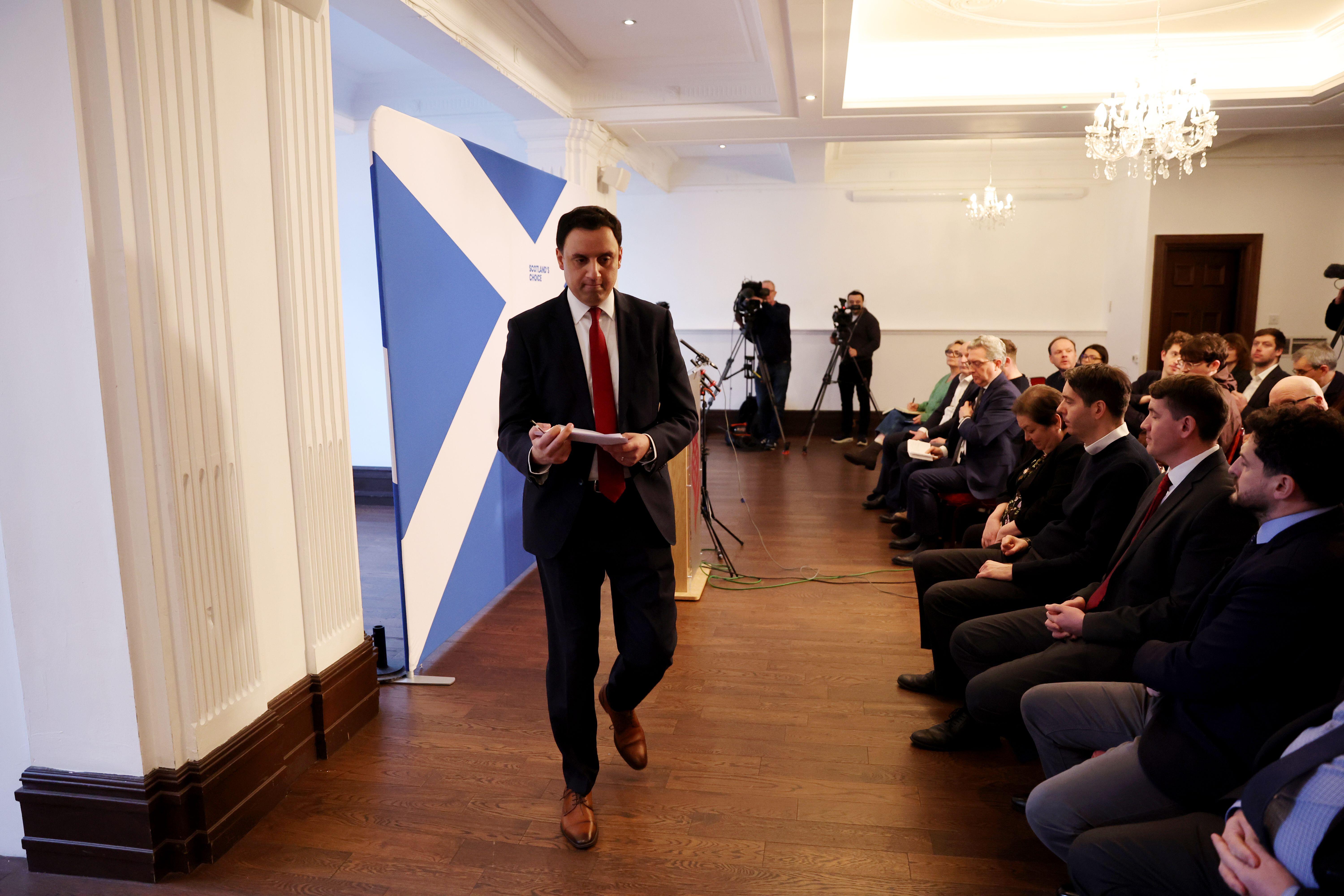
The storm clouds darkened when Sarwar called journalists to Glasgow’s Trades Hall for a hastily arranged press conference. There was a suggestion that Welsh first minister Eluned Morgan planned to follow his lead in calling for Starmer to go. Starmer’s Cabinet had remained ominously quiet for most of the morning and rumours about resignations were flying.
By the end of Sarwar’s speech, never mind by the end of the day, Starmer was in a much stronger position
Then, at 2:28PM – just two minutes before Sarwar’s press conference was due to begin – Deputy Prime Minister David Lammy became the first to break cover. “Keir Starmer won a massive mandate 18 months ago,” he wrote in a post on X. “We should let nothing distract us from our mission to change Britain and we support the prime minister in doing that.”
As Sarwar began his press conference, housing secretary Steve Reed issued his own similarly supportive statement. Within an hour, this would be followed by every member of the UK Cabinet and several other key Labour players – including health secretary Wes Streeting, former deputy prime minister Angela Rayner and energy secretary Ed Miliband, all of whom are thought to be possible successors should Starmer be ousted.
The rumoured resignation call from Morgan never surfaced from Wales, while two of Labour’s best-known mayors – London’s Sadiq Khan and Manchester’s Andy Burnham – also rowed in behind the prime minister.
By the end of Sarwar’s speech, never mind by the end of the day, Starmer was in a much stronger position than where he started. The pressure had not completely dissipated but nor was his removal imminent. He had secured a reprieve at least until the Gorton and Denton by-election taking place this week (and perhaps even until after May’s elections).
In contrast, the Scottish Labour leader appeared isolated. Just a handful of his MSPs – Jackie Baillie, Neil Bibby, Mark Griffin and Davy Russell – had attended the conference in support while others remained silent. Of Scottish MPs who spoke out, most of them reacted poorly. One dubbed the move “treacherous” and another accused Sarwar of being “opportunistic”. “I’m sorry and deeply disappointed that Anas is wrong here,” said former Scottish Secretary Ian Murray.
This was my decision and my decision alone
On the surface, the day seemed to have gone very badly. Had a coordinated coup against Starmer been abandoned at the last minute and left Sarwar out on a limb? Had Sarwar incorrectly read the room and jumped the gun? Had he been deliberately misled into making the announcement to force others’ hands, essentially being used as a sacrificial lamb to shore up support for Starmer? All of these suggestions were made that Monday afternoon as the world of politics attempted to make sense of the news. Meanwhile, Sarwar himself was privately telling some commentators that this was about him simply “being honest” and he no longer wanted to say in private what he would not say in public.
“I can understand why Westminster politicians and Westminster journalists want to view this about what this means for Westminster,” Sarwar would say to a huddle of journalists in the Scottish Parliament two days later. “I only care about what this means for Scotland, what it means for the people of Scotland, and what it means for the choice the people of Scotland have to make in a few months’ time.”
Sarwar has maintained throughout that he was not involved in any wider plot. The calls he’d made to various Cabinet members – including Streeting – over the weekend were not to coordinate an attack. “This was my decision and my decision alone… The people of Scotland deserve to know what my standards are, what I’m willing to accept, if I’m willing to call out failure wherever I see it, and what I would do different were I elected first minister.”
The chief aim of his call for Starmer to resign was never really about that resignation. Instead, it had rather more to do with putting himself into a better position to fight his upcoming election battle against the SNP.
Sources close to the Scottish Labour leader admit there has been a real frustration with the operation at Number 10 for several months. Speaking to voters on the doorstep, the party is repeatedly being faced with the belief that a vote for them in May is a vote for Starmer. The message that this is a devolved election about a devolved government is not cutting through, and so Sarwar had come to the conclusion that Starmer was the single biggest barrier to Bute House – perhaps even persuaded by the disingenuous SNP campaign trailer that drove past Westminster advertising a new slogan about sacking Starmer.
 Credit: Alamy
It’s a dramatic change of circumstances to where Labour was in July 2024. The close personal relationship between the two men was seen as a major selling point, and the idea that Scottish voters could not just “send a message” but “send a government” to Westminster had real weight. Winning the keys to Bute House in 2026, while no means in the bag, at least felt realistic for the first time in well over a decade.
But that close relationship between the Scottish and UK party turned sour almost immediately after that general election victory. By the end of 2024, Scottish Labour’s support had plummeted thanks to unpopular decisions by the UK Government. Throughout 2025, party strategists had been optimistic that it could turn things around in the run-up to May 2026. As they saw it, all they needed to do was make this vote about the SNP’s near two decades in government – and there was a lot to criticise.
In practice, convincing the electorate to treat this as a referendum on the Scottish Government and not the UK Government has proven difficult. As things stand, the SNP is polling 20 points ahead of the nearest rival. The latest projections have even put Labour third behind an insurgent Reform UK.
The need to put some clear water between Scottish Labour – which has long struggled with the “branch office” label – and the UK Government came to a head when the row over Mandelson overshadowed what should have been a major win for Sarwar over Glasgow’s Queen Elizabeth University Hospital.
At worst, it changes nothing about the party’s fortunes in May
At the end of January, Sarwar discovered what he believed would be the smoking gun to uncover the truth behind several patient deaths at the nation’s largest hospital. It’s an issue he has been campaigning on for the last eight years and is close to his heart. During a session of First Minister’s Questions, Sarwar revealed the existence of a minute of a meeting between the health board and a Scottish Government official. It said the health board felt “political pressure” to open the hospital and that “no consideration was given to delaying the opening…despite the issues being faced with completion and operation”. It appeared to directly contradict Scottish ministers’ claims that there had been no pressure to open too soon.
The atmosphere among Scottish Labour MSPs and staff that day was jubilant. They finally had Swinney on the ropes, on the issue that could turn the election.
But mere days later, Labour was engulfed once more by the Mandelson scandal. The Labour grandee quit the party and Starmer faced further questions on what he knew and when about Mandelson’s friendship with convicted paedophile Jeffrey Epstein. A police investigation was also launched following allegations of misconduct in public office relating to the ex-minister passing sensitive government information to Epstein. The hospital scandal was blown out the water.
Insiders say this was the final straw for Sarwar, who had already been expressing concern privately that Starmer would cost him the election. It was time to go public.
The move is a big gamble – but as one of Sarwar’s senior team told Holyrood last week, “politics is a gamble”. The calculation is that this puts him on the side of the voters he desperately needs to court over the coming three months. At worst, it changes nothing about the party’s fortunes in May.
Starmer’s unpopularity will remain a problem for Sarwar and his intervention may be just that bit too late
This appears to have now been recognised by Scottish Labour MPs. Following a meeting of the Scottish PLP, chair Richard Baker put out a statement confirming that while the group was still behind Starmer, it was “fully committed to electing a Scottish Labour Government in Holyrood and Anas Sarwar as our first minister”.
Even Downing Street seemed to come around to Sarwar’s reasoning, with a readout from Cabinet stating: “The prime minister said that the whole of the Labour Party wants Anas Sarwar to come first minister and will fight for a Labour government in Scotland.”
As for Sarwar’s own frontbench, the reaction has been pretty sanguine. The feeling on the whole is that their leader has made the best of a difficult circumstance, when there was no obvious right choice. Disavowing their own UK leader is not where the party would want to be with three months to go, but staying silent risked their own political futures. One frontbencher told me he’s “not uncomfortable” with the move, nor is he “relaxed” about what it means come May. Another, when asked if the rift between the PM and Sarwar would make it difficult to stay focused on domestic issues, breezily said that “dramas come and go”.
There is also an acknowledgement that creating some distance from Downing Street defangs a major attack line from the SNP, who can no longer cast Sarwar as the mouthpiece for an unpopular UK government. Starmer had become the face of the SNP’s campaign, with Westminster leader Stephen Flynn earlier this month standing with billboards suggesting the PM could be “gone in 100 days” if the SNP wins. And while Flynn has since called for Starmer to resign over the Mandelson affair, it is telling that Swinney had not made any such statements – because the anti-Starmer vote is what his party is courting.
The Mandelson affair could also yet have a Scottish perspective which could become uncomfortable for the first minister. Senior civil servant Gregor Irwin worked for Mandelson’s company, Global Counsel, as its chief economist prior to his appointment as Director-General for the Economy at the Scottish Government. And while the Scottish Government has said Irwin’s contact with the disgraced peer was “solely in a professional capacity” and there are “no ongoing links”, that hasn’t stopped questions being raised – particularly given the first minister’s recent meeting with President Trump, accompanied by Mandelson, with whom John Swinney stayed with while on the trip to the States. Swinney later said during an exchange at FMQs that he “chose” to stay there to save money for the Scottish taxpayer.
Labour is now anticipating the SNP will focus its fire on the party’s turmoil, trying to use the split as evidence it is not fit to enter government. But this is more difficult ground for the SNP, given its own turmoil in recent years. Sarwar is expected to start making more hay from the ongoing secrecy around ministers’ bust-up with former first minister Alex Salmond, the party’s decision to protect former MP Patrick Grady despite sexual misconduct allegations, and the upcoming embezzlement trial of former chief executive Peter Murrell (though how much the party will be able to say on this has been limited, given the preliminary hearing has been delayed until after the election).
Still, Starmer’s unpopularity with the Scottish electorate will remain a problem for Sarwar and his intervention may be just that bit too late to turn the tide. While polling by Norstat for The Sunday Times found over half of voters believed Sarwar had made the right call (compared to 26 per cent who felt it was the wrong decision), that same poll found little change in voting intention.
Voters may agree with Sarwar’s diagnosis of the problem, but they are not yet convinced about him as first minister. The tightrope he now walks is being critical enough of UK government blunders while also defending Labour policies. That might prove too difficult an argument to make in the run-up to 7 May. But whether or not he has been too late in putting distance between UK and Scottish Labour, he has undeniably reframed some of the election campaign’s arguments and pitched himself as standing up for Scotland.
Holyrood Newsletters
Holyrood provides comprehensive coverage of Scottish politics, offering award-winning reporting and analysis: Subscribe