Fred MacAulay: Michelle Mone lived a stone's throw away and I was the one throwing them
It’s been an eventful year for Fred MacAulay – after a freak accident involving a motorised golf trolley which almost killed him, he then got diagnosed with prostate cancer. For someone who has spent his career making others laugh, there’s certainly been plenty of dark material to draw on. But MacAulay remains upbeat, preparing to head out on a stand-up tour in the new year.
Things could have turned out differently, however, had it not been for a quick-thinking golf partner who just happened to be a surgeon. MacAulay was playing 18 holes with friends in April when his electric trolley hit a tree stump, causing it to stop abruptly and deliver a blow to the stomach, shearing off a Meckel’s diverticulum, a pouch in the small intestine which is the result of a birth defect most people will never know they have.
“I took a blow to the stomach and didn’t think anything of it,” says MacAulay. “But the artery that was supplying my bowel just pumped blood into my stomach. So I filled up with blood and became very unwell. Fortunately, one of my playing partners was a consultant surgeon and he phoned 999. The bowel had been starved of blood, so they had to cut a bit of it away and re-section it. I was pretty ill. What I would say to anyone who’s been given a cancer diagnosis is that it helps if you’ve had a near-death experience two months before.”
In July, MacAulay revealed he has prostate cancer, a disease which both his father and older brother were previously diagnosed with. The cancer has been caught at a very early stage, and the 68-year-old is currently undergoing nothing more than “surveillance”, which involves quarterly blood tests and occasional MRI scans. While he didn’t take part, MacAulay attended former Olympian Chris Hoy’s Tour de 4 cycle event in Glasgow earlier this year, which raised money for cancer research. Hoy has been less fortunate with the disease, being diagnosed at stage four and told he has only a few years to live.
MacAulay is an advocate for improved screening, particularly among men like himself and Hoy who have a family history. However, last month the UK National Screening Committee ruled out screening men except those with a genetic mutation that raises the risk, a decision Hoy said he was “disappointed and saddened” by. The charity Prostate Scotland said it was “deeply disappointed”.
“I am very fortunate we’ve caught [the cancer] very early because of MRI scanning at my own expense over the years since my brother was diagnosed,” says MacAulay. “So I’m on a thing called ‘active surveillance’ which means quarterly blood tests for PSA [prostate-specific antigen] and MRIs every six months just to see how the cancer develops. That is so that you can carry on with life without getting treatment or an operation. It could be a year, it could be two to five, it could be five to 10, it just depends how quickly the cancer is growing.
“[A screening programme] has to come, whether it’s through MRI or developing something else. The simple fact is more men get diagnosed late in Scotland with stage four than in England and Wales. That has to be the old Scottish reluctance to go and see the doctor – I can’t think what else it could be. I’ve got three kids – my boys are 38 and 35. No later than when they turn 40, I’ll be getting them in for an MRI and paying for it myself.”
MacAulay first appeared at the Edinburgh Fringe in 1989 as part of the Scottish collective Funny Farm. That year, the Perrier Comedy Award was given to Simon Fanshawe, a founder of Stonewall who is currently rector of the University of Edinburgh. A fixture on the comedy circuit and our TV screens since the 1990s, MacAulay’s brand of gentle humour has passed the test of time, unlike many of his early contemporaries who have gone out of fashion as tastes have changed.
He thinks Scottish comedy is in “a good place” with a younger generation of stand-ups continuing to command large audiences across the world. But has comedy become safer, with comedians less willing to upset people lest they be cancelled?
“It has changed – maybe less in clubs than it has changed on TV or bigger venues. I still think you might find people pushing the boundary a bit in the clubs. It seems to me that it’s been venues that have created the news in that respect – people getting removed from the schedules like [outspoken stand-up] Jerry Sadowitz.
 MacAulay's former neighbour, Michelle Mone, whose company PPEMedpro has been wound up while the UK Government pursues it for £122m | Alamy
“Cancelling and wokeness is certainly a thing of the last five-plus years. At The Stand, [former SNP MP] Joanna Cherry had a show cancelled and then re-instated and I think that came from the staff. That’s very much a 21st century phenomenon, that the staff can determine who comes along. Maybe people are just more politically sensitive or politically aware…
“I doubt very much that if you go back over 30-odd years you’ll find very much stuff that Fred MacAulay did that would be deemed offensive, [but] I’ve probably got one or two bits that might not have sat comfortably now. There’s an expression that still scares the pants off producers in television – ‘it was of its time’. I remember [former Scottish Conservatives leader and now baroness] Annabel Goldie pulled me up for something I did 25 years ago. I think it was sexist, and I remember seeing her at the next event and asked if we were cool. ‘Indeed we are not,’ she said.
“I have never written something and thought ‘I’ll try that and see how it runs’. I maybe self-censor a wee bit. That’s just me. I’ve got a good pal [fellow comedian] Mark Nelson – he’s happy to give it a run out and I’ve sent some things to him in the past and said it’s not for me, but if it fits, have it.”
Comedy writer and fellow Scot Armando Iannucci has resisted calls to bring back The Thick of It, the beloved sitcom which ran for four seasons in the 2000s and which starred Peter Capaldi as potty-mouthed spin doctor Malcolm Tucker, saying that modern politics has moved beyond satire. MacAulay doesn’t necessarily agree, although is keen to add that he “bows reverentially” to Iannucci’s genius.
Never an overtly political comedian, MacAulay describes his own politics of being “of the left”. His late father, a former police officer, had always voted Labour but MacAulay himself actually joined the party during Boris Johnson’s time in Downing Street. He admits to voting Labour at every election except in the 1980s when, living in Hillhead in Glasgow’s west end, he voted for Social Democratic Party (SDP) founder Roy Jenkins, one of the ‘Gang of Four’ who broke from the Labour Party while it was under the leadership of Michael Foot. After voting Labour at the last general election MacAulay – along with many more like him – has been seriously underwhelmed by Prime Minister Keir Starmer.
“I’m disappointed really, but I’m old enough to know they weren’t dealt a good set of cards. They tried to make the best of a bad job. Maybe it’s because my background was in accountancy and finance before getting into comedy, but I don’t know why they thought growth could be achieved by lumbering another cost [through National Insurance increases] onto businesses. The only way businesses can expand is through retained profits and if you’re taking that away from them, you’re not going to get growth.
“I think Starmer is a decent guy, but he has this demeanour, a sort of look of ‘oh no, what’s coming next?’”
I ask if the Labour leader could take lessons from a comedian about how to loosen up, perhaps deliver a punchline.
“I don’t think he wants to take lessons from stand-up comedians,” MacAulay says. “He wants to take lessons from politicians. That’s a criticism that’s been laid at his doorstep, that he’s still a lawyer rather than a politician.”
With a Scottish election on the horizon, SNP leader John Swinney has put securing another independence referendum front and centre of his campaign. Swinney believes that if his party secures a Holyrood majority in next May’s vote, that will give him an electoral mandate for the constitutional question to be put – just as it did when his predecessor Alex Salmond won a historic majority in 2011. But MacAulay isn’t so sure and reckons there won’t be another referendum any time soon.
“I hated 2014,” he says. “I hated the division, the divisiveness of it all; I didn’t like it all. To date, no one has made the financial case [for independence] to my satisfaction. In 2014, I had the most successful Fringe show I ever did. I was in the ballroom at the Assembly Rooms, and it sold out every night, my ‘Frederendum’ show. There was the big White Paper but there was also an eight-page thing that came through everybody’s door. Inside each one there was a Domino’s Pizza flier and people kept that, and the pamphlet was thrown away.
“Having said I didn’t like the divisiveness – I had a lunch with the late [chef] Andrew Fairlie, who was very much a ‘Yes’, [former SNP MP] Tommy Sheppard, who was a colleague at The Stand, and David Eustace, who is photographer pal, and the journalist Stephen Jardine. It was just the five of us and we had a good long lunch in the run-up [to the vote]. My feeling then was that regardless of the outcome, life would go on and we’d all still be friends. But five middle-aged blokes are not representative of the people of Scotland.”
MacAulay’s right to say that he’s not representative of too many other Scots. His long-running success has made him comfortably well-off, with a house in Thorntonhall, an affluent village near East Kilbride, where he once counted disgraced businesswoman and Tory peer Michelle Mone among his near neighbours. “She lived just a stone’s throw away and I know that as an absolute fact because it was me that was throwing them,” he jokes. In October, a company linked to Mone and her husband Doug Barrowman was ordered to repay £122m for supplying defective PPE during the Covid pandemic. The firm, PPE Medro, entered administration the day before the judgment and failed to meet the two-week deadline for paying back the money. In the weeks after the High Court ruling it emerged Mone had recently bought a £10m condo in an exclusive community near Miami dubbed “billionaire’s island”.
MacAulay says if he was prime minister for the day, he would “speed the law up” to catch up faster with those who transgress.
“Here we are coming into six years into Covid, and the PPE scandal continues. PPE Medro have been told to hand the money back – you’ve got to admire them in terms of timing that they managed to secure hundreds of millions of orders just five days before the company was incorporated and they managed to go into administration 24 hours before they were told to give the money back. It just reeks.
“Something that used to rankle with me was that [Mone] was alleged to be this multimillionaire and that the company was hugely successful, but I don’t think anyone looked into the accounts of the company – it was smoke and mirrors. She’s been found out in that respect.”
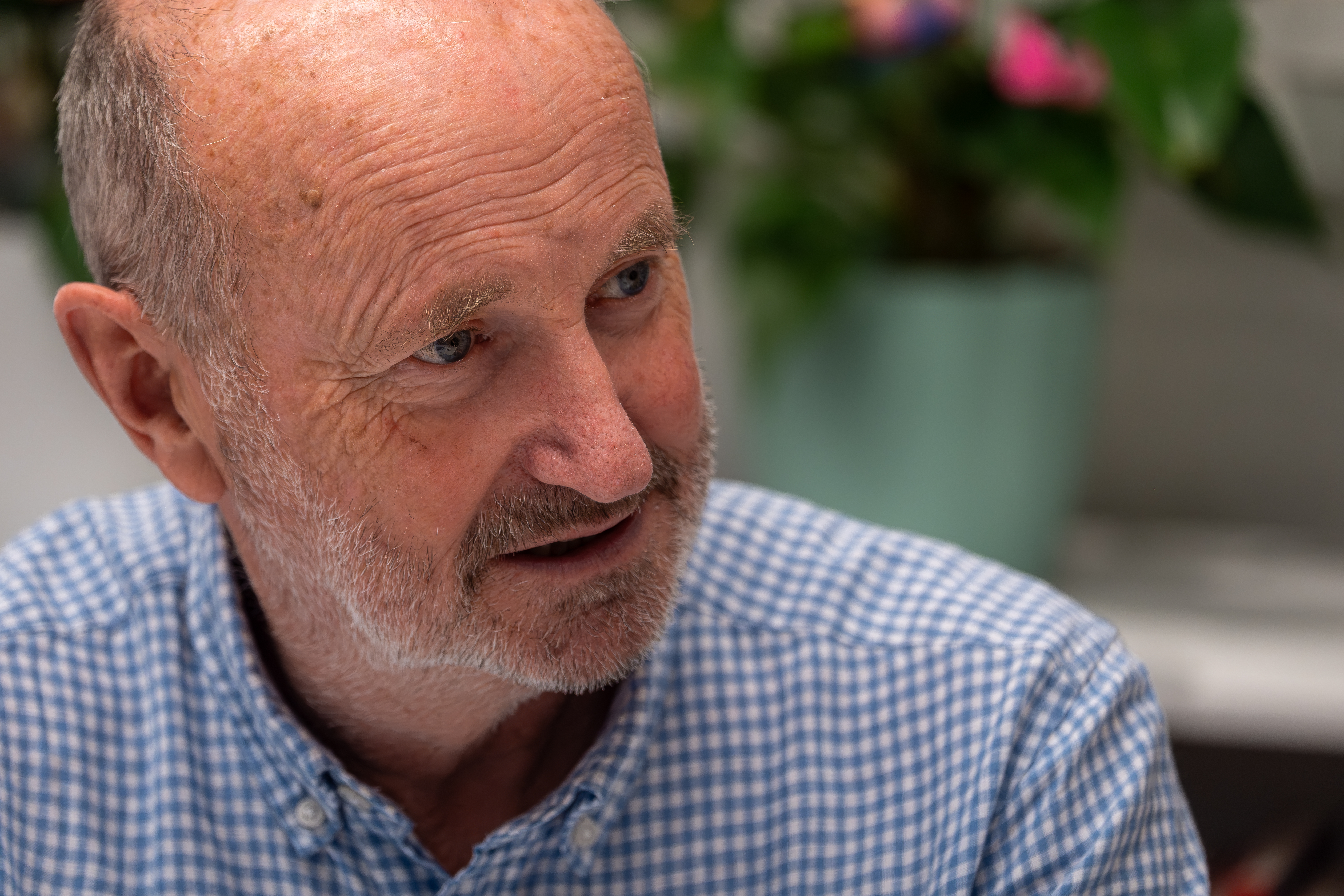 Fred MacAulay photographed for Holyrood by David Anderson
Born in 1956, Fred MacAulay grew up in Perthshire before studying accountancy at the University of Dundee. He began in comedy relatively late in life, first performing at the Fringe in his early 30s before becoming a full-time comedian in the early 1990s. During a career which made him a household name in Scotland, he appeared on shows including Mock the Week, QI, and Radio 4’s Just a Minute, as well as hosting a short-lived chat show with Ally McCoist. He also hosted BBC Scotland’s morning show from 1997 to 2015 and says the decision to drop him from it “still rankles” a decade on.
The broadcaster has not had its challenges to seek recently, not least in the controversy over a Panorama documentary which doctored a clip of Donald Trump. Despite an apology from the BBC, the US president has pledged to sue. There have been problems too in Scotland, where the corporation has recently been criticised for pulling the plug on radio shows presented by the likes of Billy Sloan, Roddy Hart, Iain Anderson and Nastasha Raskin Sharp. Arguably its best-known presenter, Kaye Adams, is still suspended amid allegations of bullying.
“Kaye used to do the show before mine and I would see her in the crossover,” MacAulay says. “I don’t know the circumstances of her removal… but I don’t know how it will be resolved. I think it might be the end [for her], maybe something else will come along – but it won’t be me, I can tell you that. I’m 70 next year I’m not getting up at six in the morning every weekday. I couldn’t do a daily show.”
And yet despite his age and recent health problems, MacAulay is planning to go out on tour again, beginning with a “work in progress” show at the Glasgow Comedy Festival in March. While he’s never been short of work, MacAulay didn’t receive an invite to the Riyadh Comedy Festival in Saudia Arabia, a country whose leaders have not previously been famous for having a sense of humour. Taking place over a fortnight in September and October, the festival attracted some big-name US stand-ups such as Louis CK, Dave Chappell and Bill Burr but also British comedians including Jimmy Carr, Jack Whitehall and Omad Djalili, who said he agreed to perform in an effort to contribute to “positive change” in the socially conservative country. English stand-up Stewart Lee described those taking part as “evil, amoral, grifting bastards”.
“I was surprised at the UK comics that went,” says MacAulay. “Omad Djalili, my golfing pal Jimeoin… the gag is that I have principles, 20,000 of them and they’re a pound each. Nobody’s going to ask me to go and do Riyadh. I have played Iraq, though, for the troops in September 2003. We had to suspend an outdoor gig as two Chinook helicopters brought back casualties from a firefight. Riyadh would be a tough one to justify but Saudi money is everywhere, it’s all over football and golf.”
The man who once joked about being the voice of Scotland’s bowel screening advertising campaign has clearly had his own health issues these past 12 months, but remains positive about touring. Unlike other older comedians whose material has become horribly dated or who have found themselves falling out of fashion, MacAulay continues to find an audience as well as having a generation of younger comedians who cite him as a formative influence. As long as he’s able, he plans to continue doing stand-up.
“I had two significant health issues this year which have changed my diary but the tour I was going to be doing in September/October, we’ve managed shift all the dates to September/October next year, so I will definitely be doing stand-up next year.”
I ask him if he isn’t tempted to retire, to spend more time with his friends on the golf course, near-death experiences notwithstanding.
“It’s an old cliché, but I don’t think comedians wind down or retire,” he says. “Not until the laughter stops.”
Holyrood Newsletters
Holyrood provides comprehensive coverage of Scottish politics, offering award-winning reporting and analysis: Subscribe