Fertile ground: How Scotland's baby capital is bucking the trends
There is no sign at the East Renfrewshire boundary declaring “welcome to the baby capital of Scotland”, but maybe there should be. After all, the fertility rate here is higher than anywhere else in the country.
The average number of children for women in the area is 1.63, according to National Records of Scotland (NRS). If that doesn’t sound like much, it compares to a record low for the country as a whole. Fewer than 45,070 live births were registered last year – almost 700 down on 2024 and the lowest annual total since records began.
The total fertility rate for the nation – the average number of children a woman will have – now stands at 1.23, a level the United Nations considers “ultra low” and which is a considerable distance from the 2.1 required for a population to be self-replacing. For 11 years running more of us have died than been born.
It’s one of the arguments often cited in support of immigration – that more incomers are needed to make up for the shortfall in births. But if the trend continues, current migration levels won’t be enough to stabilise the population.
On the main road in Giffnock, East Renfrewshire’s administrative and coffee shop centre, there is little sign of that demographic challenge. The lunchtime noise from the local primary school carries down towards the shops as prams are pushed on either side of the street.
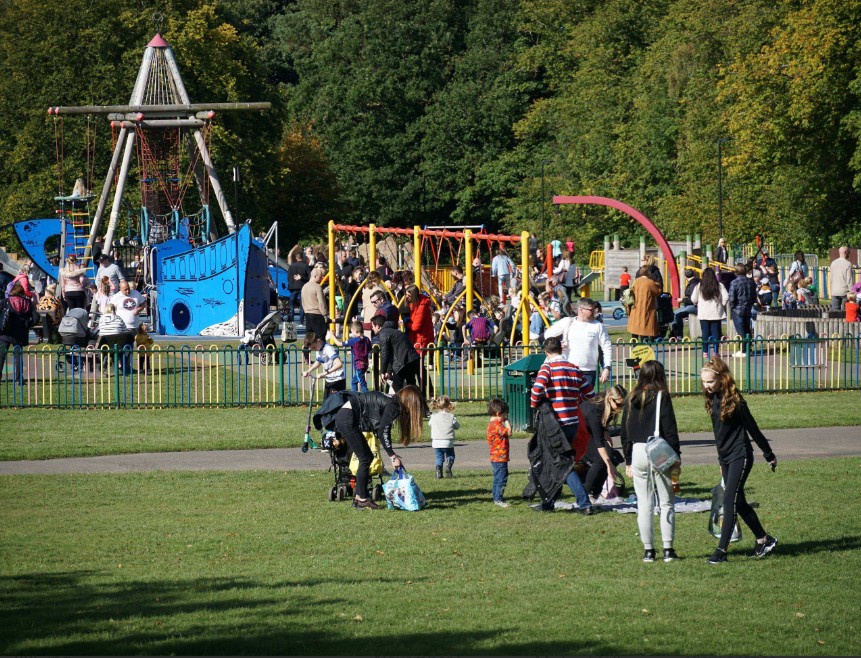 Families in Rouken Glen Park | Alamy
“We’re doing our bit to plug the gap,” one mum jokes of the area’s parents. Her pregnancy bump is visible as she walks her youngest child to sleep in a padded pushchair. This will be her third baby, and possibly not her last. She and her husband both come from big families, she explains, and would love to have a fourth. Not everyone understands the drive. “I’m a lawyer, and at work people are like, ‘what are you thinking?’”, she says.
Social norms have changed so much that that is probably a fair question. Total fertility rates for Scotland haven’t been above 2.1 since 1973, and in our biggest cities they have dipped to around 1.0. In Edinburgh, the figure bottoms out at 0.93.
“Family size is the lowest it has ever been,” says Esther Roughsedge, NRS head of demographic statistics. “In 1971 it was 2.5 children.
“Total fertility in Scotland is now the lowest in the UK, and it has been since the 1980s.”
What’s more difficult, she says, is not to pinpoint what is happening, but to understand the drivers behind it.
****
A decline in births isn’t just a Scottish problem. Data reveals lower fertility rates across much of the industrialised world.
The level for England and Wales is down at 1.39, while European Commission body Eurostat puts the EU’s figure at 1.34 live births per woman. Across the bloc, figures range from a high of 1.72 in Bulgaria to a low of 1.01 in Malta – one of several southern European nations where traditional associations with larger families seem now to be out of date.
The latest World Population Prospects report from the UN states that one in four people lives in a country where the population has already peaked. One in 10 lives in a nation which will hit its peak by 2054. At 2.3 live births, the world’s women have one child fewer on average than was the case in 1990 and fertility levels are under the 2.1 threshold in more than half of all countries and areas. By 2080, the UN predicts there will be more people aged 65 and over than 18 and under.
it is a problem when you think of low fertility as a symptom of a society that is not working well
NRS projections suggest that Scotland’s population will grow by only 0.3 per cent by mid-2033 and will then fall year-on-year. By the middle of 2049, it’s expected that the national headcount will have declined by 1.3 per cent from the 5.55m recorded in mid-2024.
Still, Dr Francesca Fiori, a social policy specialist at the University of Strathclyde, says the fertility rate is somewhere near a taboo subject. “Any time you talk about low fertility, people are a little worried,” she says. “The idea is that you are going to tell women they have to have more children, which is not where I’m coming from.
“I don’t like to frame it as a problem, as ‘we don’t have enough taxpayers’. But it is a problem when you think of low fertility as a symptom of a society that is not working well, a society that’s failing young people, failing women. So yes, it is a problem.”
A member of the Scottish Government’s Population and Migration Expert Advisory Group, Fiori remembers her surprise when she arrived in the UK from Italy, where population hit a record low in the mid-90s, to discover that “nobody seemed to worry about” declining births.
“Italy has been the precursor,” says the mother of two, and where traditional drivers like religion and parental expectation had once sustained a culture in which childlessness was a comparative rarity, that has now changed.
She’s been probing the reasons behind Scotland’s shift and recently surveyed 1,700 people, both with and without kids, about their attitudes to having children. She found that, overall, most childless men and women intended on having a baby in the future, and while close to 60 per cent of fathers said the same, the number for mothers was just over 40 per cent. Those who did not want to have a child cited “lifestyle preferences” as the predominant reason – something that was stronger for women than for men. For parents who wanted another child, work, childcare and money were cited as major factors in why they had not yet done so. Focus groups in Glasgow led to yet further insights.
 Dr Francesca Fiori, University of Strathclyde | Contributed
“The reasons why people are having fewer children are mostly two-fold,” Fiori says. “One is changing preferences and the second is obstacles. If it’s preferences, then that’s not really a space for us to intervene as researchers or governments or policymakers – although we also have to inspect where those preferences come from and what is driving them.
“When we did focus groups, we heard from women who define themselves as childless by choice. When they started talking, it wasn’t really a choice – they were talking about the patriarchy, and how men don’t do their share.”
In the Scottish Government’s 2023 Gender Equality Index, a greater share of “caring responsibilities” was blamed for holding women back in the labour market, while “housework and cooking” and “non-developmental childcare” took up more of women’s time than men’s, with each driving inequality. When it came to money, women were more likely to avoid going out than men, saying they could not afford to spend on themselves. “Everyone in Scotland has a role in reducing and removing the social and economic barriers that result from different expectations and treatment of men and women,” the index said. While a national Equality Strategy for Women and Girls has been promised it has not yet been delivered, though officials say this is at an “advanced stage” and could be released by the end of the year.
Fiori suggests that Nordic-style “generous family policy packages” including flexible working, wraparound childcare and enhanced parental leave pay could provide redress. The Scottish Government’s own findings pinpoint the “low rate” of statutory maternity and paternity pay in the UK – a reserved matter – as “especially problematic” for families. In Finland, maternity pay amounts to 84.8 per cent per cent of average full-time earnings, with paternity pay at 66 per cent. This rises to 100 per cent for both categories in Slovenia, while in the UK the rate for mothers is 31.1 per cent, and 20.4 per cent for fathers.
Fiori suggests bringing in a “use it or lose it” system of shared parental leave to encourage more fathers to take a greater share of childcare. The UK’s transferable system has been criticised for its complexity, and a 2023 evaluation by the UK Government found that just one per cent of eligible mothers and five per cent of fathers used it. Uptake and awareness was particularly low amongst lower-income families.
“Sometimes we have to push for a change,” says Fiori. “We have failed women. We gave them the illusion that they can get high education, get a career, be the successful earner, but then we left them without providing the other side. We force on them the choice of whether they want to have children or a career. Combining the two is incredibly difficult. You can only do it if you’ve got the money, if you’ve got a supportive partner or if you’ve got family nearby – if one of those three is lacking then it becomes very difficult for women. Something has to give.”
****
NRS fertility data runs back to 1855, when the industrial revolution was pushing rail lines across the Highlands and Clyde-built ships into the Atlantic, and when compulsory civil registration was introduced.
The system replaced parish registers and followed lobbying from doctors who wanted better information on birth rates, death rates and the causes of death, and from lawyers who needed more reliable records for legal purposes. There were almost 93,350 births that year, and the figure rose to a peak of 135,550 in 1920.
Now, more than a century later, the latest data shows the largest group of women who gave birth last year – 37 per cent – were aged 30-34, and there were more infants born outside of marriage than within it. Overall, the poorest quintile of the Scottish Index of Multiple Deprivation had a higher total fertility level than the wealthiest. But by council area, leafy East Renfrewshire topped the table.
Its results can partly be explained by geography and partly by economics, Roughsedge says. The area borders Glasgow and offers larger properties than the city, plus gardens and proximity to jobs and leisure, and indeed other areas surrounding cities – East Dunbartonshire, Midlothian, Aberdeenshire – also have higher fertility rates than their urban neighbours. “It’s how we move around in different parts of our lives,” she says. “People move out of the main cities to the areas around where it’s often a bit cheaper to buy a bigger place, but still in commuting distance to jobs in the city.” Homes here aren’t a snip, though. The median price for a residential property here in 2025-26 was, according to NRS, £303,000 – the highest in Scotland and far above the national figure of £198,000.
Owen O’Donnell, leader of East Renfrewshire Council, believes his area is drawing people in because life there is just so good. “We perform very, very highly,” he says of local services. “I think size matters in this: we are an optimal size. I often say it’s our superpower because we are small enough that we can get our arms around the whole community and understand what’s going on and work out what are the issues and strategic actions that can improve things.”
It’s not just rhetoric – the latest Local Government Benchmarking Framework marked the area top in Scotland in 16 categories. For education, the council is ranked at number one across 11 indicators, including the percentage of high school pupils who achieve five or more National Five awards. At primary level, more children achieve expected literacy and numeracy levels than anywhere else, and league tables place three of the local secondaries in the country’s top five state schools.
We have been described as the Florida of Scotland: we have a very high young population and a very high older population
So popular are the secondaries St Ninians, Mearns Castle and Williamwood that the council once faced an annual bun fight for places, with requests entered by families living outwith catchment areas. In some cases, families fudged registration details to get their children in. That doesn’t happen anymore, says O’Donnell, because now “people know that they can’t get in”.
“Our schools are at very high capacity; most are well in excess of 90 per cent so the chances of getting placement requests met are very low. The number of requests have declined because people say ‘what’s the point?’”
He’s certain that schools are the number one draw for parents and prospective parents, and he’s an example of that himself. A Glasgow native, he spent years in London and chose East Ren on his return as the best place to raise his three children. Friends did the same, he says.
Out on the street, one mother of three – a doctor – says that she did similar, setting up a family home in Giffnock after marriage. “It was for the schools, but now we’re here there’s more than that. There’s a nice sense of community and lots of clubs, which is great for friendships.”
“It’s a very safe place to live,” says another, whose children are now in their 20s, “but my kids were desperate to move out when they were old enough because there’s nothing here for them.”
Indeed, the region may be home to many young families, but it struggles to hold onto its children as they grow and rates of those aged 15-29 are, in O’Donnell’s words, “very low”. “We have been described as the Florida of Scotland: we have a very high young population and a very high older population, and not so many in the middle,” he says.
We are walking into a demographic crisis
Age is also a major factor in the fertility story, with more people choosing to postpone parenthood until they are into their 30s. En masse, that choice means population gains are also delayed, and that parents have fewer children than they would have had if they had started earlier. “Those children that you might have had when you were 25 might not arrive just because of biology,” Fiori says.
This, too, is an international issue, and the UN has suggested that governments could consider making IVF “more affordable and widely accessible” as a result.
But this is far from its central recommendation. “While each country’s approach varies based on its unique cultural, economic and social context, the central principle remains consistent: supporting families and maintaining a holistic and inclusive approach to sexual and reproductive health and rights is key to addressing some of the reasons why individuals and couples might be hesitant to have children in a modern society,” it said.
According to Fiori, this could come down to more than work, money and inequality between the sexes, with evidence emerging of linkages to climate anxiety, fear of war, and even local service cuts. “Concerns about the future are certainly playing a role but they are not the only factor because there’s always financial constraints,” she says, arguing that these factors also apply to immigrants settling in Scotland.
While the Scottish Government has described inward migration as “increasingly important” in mitigating population changes, projections suggest that even “positive” rates in the near future will not offset the overall population decline without what it calls “a change in policy approach” to bring more movers in.
Though newly arrived families can provide a temporary boost in fertility levels, they are unlikely to do much for the birth rate in the longer term, Fiori argues, because research shows a “convergence” with the norms of the societies in which they settle, something which takes root as early as the second generation. “They are highly educated, they are working, they are having fewer children than you think they are,” she says.
In East Renfrewshire, this is something O’Donnell has noticed too. “They fall into the same choices”, he says.
“This is a global challenge and all sorts of governments have tried various incentives. We are walking into a demographic crisis and we haven’t woken up to it yet.
“We are well short of replacement level, and I don’t think the Scottish Government or East Renfrewshire is going to have any luck in solving it.”
Holyrood Newsletters
Holyrood provides comprehensive coverage of Scottish politics, offering award-winning reporting and analysis: Subscribe