Between a lock and a hard place: Swinney misleads from the front over pensions
Delivered against a backdrop featuring the words ‘Hope Again’, Andy Burnham’s first speech to the Labour Party conference as prime minister was an attempt to articulate a positive vision of Britain’s future, to transcend party politics and avoid mentioning his political opponents by name – except one.
“On the day my dad died, the Scottish first minister said I would be the last prime minister of the United Kingdom,” Burnham told delegates. “I quote that not to seek sympathy nor to criticise John Swinney, I don’t think he knew the news at the time… I relay it because I want you to know how it made me feel – utterly determined to prove him wrong.”
Burnham fought back tears as he spoke of his father Roy, who died from Alzheimer’s shortly after his son became prime minister. He had previously told a podcast of how staff at his father’s care home had positioned Roy in front of a TV on the day his son entered 10 Downing Street, with only a momentary flicker of recognition suggesting he understood the significance of the events unfolding on screen.
Using his dad’s belief in social justice and his own story of social mobility, the prime minister made his case for the continued future of the United Kingdom. But while much has been written about the prospect of a second Scottish independence referendum since Burnham came to power amid his rhetoric about “rewiring Britain”, it was his comments on care – not the constitution – which triggered Swinney.
Burnham’s big idea, inspired by his dad’s experience, is to reform social care in England, a herculean task that every one of his predecessors has baulked at since the publication of the landmark Dilnot Commission report in 2011. While the Institute for Fiscal Studies (IFS) has suggested that taxes will ultimately need to rise to pay for reform, the prime minister’s other major policy announcement was to “adjust” the pensions ‘triple lock’. Burnham presented it as a quid pro quo for pensioners – making the pension system more sustainable in return for care which is free at the point of use.
Perhaps remembering the political capital that was made out of Keir Starmer and Rachel Reeves’ calamitous decision to scrap the winter fuel allowance for millions of pensioners (a decision which was later reversed) Swinney and the SNP have come out fighting over the triple lock, putting the party on the same side of the debate as the Tories and Reform. But this is not a repeat of the winter fuel allowance debacle and Swinney has found himself misrepresenting the UK Government’s position as he attempts to score political points.
“Pensions are under attack from a Westminster Labour government,” he said at First Minister’s Questions the same week as Burnham’s speech. “It demonstrates that what the people of Scotland were told in 2014 [during the referendum campaign] was a lot of absolute rubbish. We’ve been taken out of the European Union; we’re now going to lose our pensions…”
That last comment led to the first minister being accused of misleading parliament. With opposition MSPs clamouring for an investigation, he initially doubled down on his comments before later highlighting the issue to the independent advisers on the ministerial code. The code, which Swinney strengthened in 2024, says that any minister who “knowingly misleads” parliament will be expected to offer their resignation, although it would ultimately be up to the first minister himself to decide whether any breach had taken place. If nothing else, the episode shows that Swinney, who rightly calls out Reform UK’s use of disinformation, it not above peddling his own.
“I don’t think it’s fair for John Swinney to say this is cutting Scottish pensions to pay for English social care,” says David Phillips of the Institute for Fiscal Studies (IFS), a think tank which receives funding from the UK Government.
“That suggests this is a transfer from Scotland to England – that’s a fundamental misrepresentation of the Scottish fiscal framework. If what happens is that money saved from reforming the triple lock is used to fund higher social care spending in England, that generates a Barnett consequential for the Scottish Government which it can then choose how to spend.”
First introduced by the coalition government in 2011, the triple lock is a commitment that the state pension will rise in line with earnings growth, inflation or 2.5 per cent – whichever is highest. The mechanism has meant the state pension has risen by an average of 4.1 per cent a year over the past decade and a half. Since the 1990s, pensioners have gone from among the poorest in society to among the better off, with their levels of disposable income increasing by more than non-pensioners. From 2030, Labour wants to remove the earnings growth component of the triple lock so that pensions track salaries over time without being subject to sudden spikes, a move Downing Street says will save £15bn a year by the end of the 2030s, rising to £50bn by 2050.
But Swinney and his ministers have characterised that as a raid on pensions and have sought to link the issue to the constitution, despite the question of what happens to pensions in an independent Scotland long being a problematic one for the SNP. It is claimed that under changes to the triple lock, Scotland’s pensioners could receive £4bn less in payments by 2050, the equivalent of £2,000 per person in real terms. The only way to protect those pensions is to vote for Scottish independence, Swinney says, despite continuing to be hazy on how that particular benefit would be paid for in the event of Scotland leaving the UK. Last year, the SNP government stopped publishing its Building a New Scotland series of papers before setting out its proposals for post-independence pensions.
“What we are seeing is Andy Burnham mimicking Keir Starmer by coming into his premiership and, at the first opportunity, taking a swing at pensioners and the most vulnerable in our society,” says SNP MP Lara Bird, the party’s social security spokesperson at Westminster.
Bird says pensions in Scotland are now “uncertain and vulnerable to quite significant changes” to pay for a policy which has no impact in Scotland. Health and social care are fully devolved issues.
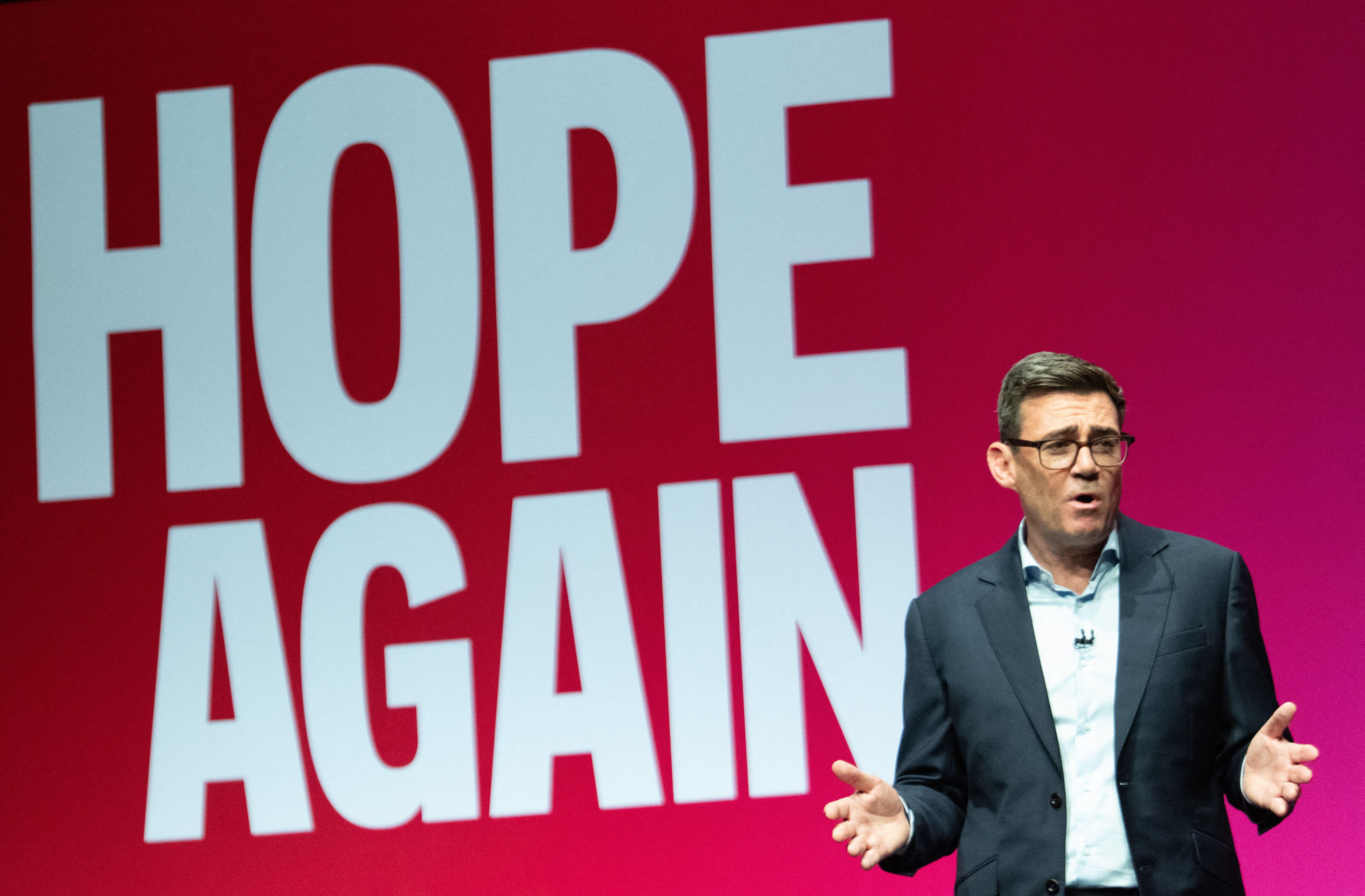 Burnham delivers his speech at the Labour Party Conference | Alamy
“Andy Burnham is proving through this process that his priority will always be people south of the border,” she adds.
According to the IFS, the social care changes outlined by Burnham could cost around £9bn-10bn a year, meaning an extra £1bn for Scotland under the Barnett formula. That is money the Scottish Government could use as it sees fit, including making top-up payments to pensioners, although those in most need already receive Pension Credit, a weekly means-tested benefit.
“In the short term, [the UK Government] will need to be looking at more than changes to the triple lock, such as tax rises or spending cuts,” says Phillips. “It’s too early to say exactly, but in today’s prices, I think Scotland could be getting [an extra] £900m-£1bn a year. But if it’s funded through cuts elsewhere [in English services] some of that could be offset. Let’s say all of this is paid for by cuts in England, then they’re not spending any more in total so why should Scotland get any more? Only when total spending goes up England should Scotland get any more under the Barnett Formula.”
While Swinney and Burnham may not see eye to eye on how to pay for it, both are agreed on the need to reform social care. In some ways, Scotland has a headstart, having introduced free personal care for those aged 65 and over nearly a quarter of a century ago under the then Lib-Lab Scottish Executive. Delivered by local councils, it means anyone assessed as needing it can receive help in their own home with everyday tasks such as washing, eating and taking medication. The policy was extended to cover all adults in 2019 following a successful campaign by the family of former Dundee United footballer Frank Kopel who died in 2014 after being diagnosed with dementia at just 59.
But the Scottish system is far from perfect. Indeed, the Health and Social Care Alliance, a membership organisation, says the sector is at “breaking point”.
“It’s really important that people understand that free personal and nursing care doesn’t mean that it’s automatically provided,” says Sara Redmond, the Alliance’s chief officer.
“Rationing happens in England and Scotland and the way in which that’s done is by assessing the level of need against eligibility criteria. [Free personal care] doesn’t mean that people have access to the care and support they need… we’re far from that vision in Scotland.”
Redmond says there’s also no real understanding of the level of unmet demand in Scotland, something the Scottish Government had previously said it would address.
It’s now more than five years since the publication of an independent review of adult social care in Scotland led by Derek Feeley. A former chief executive of NHS Scotland, Feeley told this magazine in 2022 it was impossible for many to access social care until “some sort of crisis” had occurred and even then, the assessment process continued to be “challenging”.
But the Scottish Government’s attempt to fix those issues – through the National Care Service Bill – faltered and ultimately collapsed amid a lack of detail over how the plans would be funded and complaints from local councils that what was envisaged amounted to a “power grab”.
It’s not just in Scotland where attempts to address social care have failed. Before the last election, the Conservative government scrapped plans for a Health and Social Care Levy due to the cost-of-living crisis. And yet as Burnham alluded to in his conference speech, the challenges of social care threaten to overwhelm the NHS itself, with thousands of patients stuck unnecessarily in hospital because there’s no care package in place to look after them in their own homes.
Burnham’s plan for a national care service lacks detail and – just like free personal care in Scotland – it won’t meet the exorbitant costs of residential accommodation and the problem of people having to sell their homes to pay for it. But in simultaneously addressing both care and the triple lock, he’s showing a willingness to address the big issues his immediate predecessors have shied away from away. A YouGov poll which found 48 per cent of respondents supported changing the triple lock compared to 28 per cent who didn’t, suggests he may well have the public on his side.
The SNP’s response to the proposals has been deeply unserious. In an unattributed blog posted on the party’s website entitled The Great Scottish Pensions Robbery, the party described changes to the triple lock as the “political equivalent of a burglar stealing your TV, selling it to your neighbour, and then handing you a bill”.
“Strip away the political spin and grandiose title, and the reality is as absurd as it is outrageously unfair: Scottish pensioners – who already have access to free personal care under an SNP-run Scottish Government – are about to have their triple lock snatched away to pay for English pensioners to get the very same thing,” it said.
The party goes into its autumn conference looking desperately short of ideas and with its focus on the managed decline of public sector reform. That reform includes a proposed reorganisation of local authorities which could have significant implications for the way social care is delivered.
The first minister knows that picking a fight with Westminster over pensions will help divert attention from both his government’s record and his failure to progress the case for independence. Less than six months on from a historic fifth election win, it remains to be seen whether distraction and delay is all he’s got.
Holyrood Newsletters
Holyrood provides comprehensive coverage of Scottish politics, offering award-winning reporting and analysis: Subscribe