Aileen Campbell: I was never meant to be a politician – I just cared about people
There’s something entirely wholesome about Aileen Campbell that her time in the bear pit of elected Scottish politics through the tumultuous years of 2007 to 2021 – ten of those in government – hasn’t managed to taint. She has a warmth, a sunny outlook and a particular couthieness that along with her frequent lapses into Scots language, only add to the impression that she could be an ideal poster girl for all that is good about growing up in rural Scottland.
And indeed, as the daughter of a Perthshire tenant farmer, there is a touch of the fresh-faced milkmaid about her. But her niceness and willingness to please should not be confused with naivety or being too soft. She is tough, has survived the rough and tumble of politics, navigated her way through some of the most complex and controversial legislation to do with family life, has seen how brutal politics can be, but also left it on her own terms and with no regrets about doing so.
But back to the start. When she was elected in 2007, Campbell, at just 26 and a few weeks shy of her 27th birthday, was the youngest ever MSP and although she admits that she had to persuade others to take her seriously because of her youth, her hallmark became one of working collaboratively with others, unafraid to admit that she did not have all the answers, and always willing to listen. Under Alex Salmond as first minister, she entered government just four years on from her “surprise” election – she had actually gone home to bed on the night of the count having failed to be elected in the safe Labour seat of Clydesdale and it wasn’t until she got a call the next morning that she discovered she had been subsequently elected on the South of Scotland list. That one seat majority making the difference between Salmond declaring the SNP would form the next government, and not.
A succession of junior ministerial roles followed. Firstly, for local government and planning, then as minister for children and young people, and minister for public health and sport, before she was finally promoted to the Cabinet by Nicola Sturgeon in 2018 as the Cabinet Secretary for Communities and Local Government.
In 2020 after the undeniable trauma of dealing with vulnerable communities during Covid, she announced she would be standing down at the 2021 election, saying she wanted to spend more time with her own family. You got the impression that she was also just scunnered with politics. Her announcement followed that of fellow SNP MSP Gail Ross, who revealed she was also quitting politics to “watch my son grow up”.
Those announcements from two bright, young women brought much speculation about whether the so-called family-friendly Scottish Parliament was as family friendly as it claimed to be. Campbell was not the first government minister to have children while in office, but she was the first to take her full maternity leave when she was pregnant with her second child and then, when her boys were five and nine, she knew it was time to put them first. “I had missed out on enough on their childhood,” she says.
My upbringing has guided everything I have done since
It was as children’s minister though that Campbell really came into her fore – the role appeared a perfect fit for her – and she steered through one of the most ambitious pieces of legislation the Scottish Parliament had ever passed. The Children and Young People (Scotland) Bill elevated the status of children and young people in Scotland and embedded many new rights for them into law. But more importantly, it moved the dial on listening to children and baking their views into any process that might affect them. It laid the groundwork for what would later become The Promise, pushing the needs of children taken into the care of state further up the policy agenda and while Campbell wears her own achievements lightly, she stresses it was a team effort with an estimated 2,400 people consulted and involved in shaping the bill.
“We want Scotland to be the best place in the world to grow up in,” she proclaimed as she passed the wide-reaching legislation through parliament, embedding the provision of children’s rights into Scottish law. Adoption, care, school dinners and health visiting were just some of the many provisions covered as well as the more controversial aspects like the so-called policy for a ‘named person’, which helped to explain why the stage three amendments and the eventual passing of the bill took just over five and a half hours. And as the mammoth session ended at just after 8.30pm on 19 February 2014, Campbell left the Chamber and went on to meet some of the care leavers who had been cheering in the gallery as the bill passed. She was presented with a newly framed photograph showing her with some of those that had helped inform the bill, and they included Duncan Dunlop, then chief executive of Who Cares? Scotland, and Alex-Cole Hamilton, then of Aberlour, the children’s charity, who are now both Lib Dem MSPs having come into elected politics following a journey as children’s rights campaigners while Campbell, on the other hand, took the same journey but in reverse. Campbell had one simple guiding principle: to make Scotland the best place in the world for a child to grow up in.
Children and childhood matter to Campbell and that passion to give every child access to a positive start in life is clearly rooted in her own background. She grew up in rural Perthshire and went to a primary school with only 16 pupils. Everyone knew each other and community rallied around. It sounds idyllic. “It was,” she says. “My dad was a tenant farmer; my mum managed to stay at home and bring us up. So, my sister and I had both parents around us. Looking back on it now, that’s just so lucky.” Collace Primary School grew to 30 pupils by the time she left. “It was a lovely school, a beautiful school too. It’s the school that my dad went to and my grandparents went to as well, so it means a lot to me,” she says.
“We didn’t have much money or material things growing up, and that has profoundly shaped the policies I’ve cared about – things like the Scottish Child Payment and tackling rural poverty – but what we did have was rich in other ways. It was a very Perthshire childhood: berries in the summer, tatties in the autumn, and helping out on the farm in between, sometimes enthusiastically and sometimes not! What that gave me was a work ethic and a sense of getting on with things, which I saw every day in my parents, and has never left me.
“We also had animals everywhere – pigs, goats, hens, dogs – and a kind of freedom that feels rarer now. I was always on my bike, always outside. I was what people then called a ‘tomboy’ – never still, never far from some adventure.
“More than anything, my childhood gave me a sense of belonging. To a place, a community, and my family, and has guided everything I have done since.”
Campbell’s first son was just five months old when Alex Salmond asked her to join his ministerial team as minister for local government and planning. She describes the experience as “nerve wracking” and “tough” and a “huge learning curve” but within six months after a reshuffle she took over the role of minister for children and young people and says it was there that she really felt she had found her place and sense of purpose. She says that she found Salmond “extremely supportive and interested in the subject” but also “formidable, because he could pick up on any subject so quickly and understand the numbers and the detail with apparent ease” which meant that “as a minister you also had to be on top of your brief”. She says that Nicola Sturgeon, who brought Campbell into the Cabinet, “had a steely sense of what she wanted to achieve and how to get there.”
“I feel like we were able to advance the idea of the child payment, and I feel very proud of that, and Nicola was very receptive to it – and you might remember that at that point we had the poverty adviser Naomi Eisenstadt, who was basically saying to myself and later to Shirley-Anne Somerville that to shift the curve on poverty we needed to get money into people’s pockets using the powers that we had and that would be the biggest single thing that we could do. That argument landed well with Nicola.
“Nicola was supportive and could be challenging as well, but you know, for both individuals, Alex and Nicola, they didn’t get to the top of their game without demanding the highest standards from the people around them.”
I ask Campbell how she felt about the toxicity that played out in session six of the parliament and the way things began to unravel in terms of Salmond and Sturgeon and the revelations about Peter Murrell.
She sighs. “You know, I think I was quite glad to not be in the thick of it in that last parliamentary session. In terms of my party, I think it’s desperately upsetting and personally difficult to look at where we are now and seeing things as they play out. It’s regretful. I do find it difficult. I find it difficult because I think that Alex played a huge historic part and role in the SNP’s history. He’s played a huge historic role in Scotland’s history and story as well, and some of that is forgotten about, or not as celebrated, and I suppose it’s difficult in the circumstances to find the right way to do it. But yes, on a personal level, I find what’s happened to my party difficult to unpack.
We had animals everywhere – pigs, goats, hens, dogs – and a kind of freedom that feels rarer now
“There’s lots of things that can be true at one time, and I think I am immensely proud of what I did in my portfolio while Alex was first minister, and very privileged that he asked me to be part of his government, and to do so at a time when we went through the referendum, those were massively positive times. I felt the referendum was a positive experience, of a kind of real awakening of people’s political views and thoughts and ideas and knowledge and ability to want to know more. What I found on the doorstep were people who would disagree agreeably and people who were empowered and equipped with knowledge I’d never experienced in any campaign ever. So that in itself is a positive, and the chance to consider what we might want to achieve in Scotland was exciting, and independence for me still remains an exciting idea. So those are good memories that I choose to focus on. I also choose to focus on my experience in Cabinet and about the things that we achieved and the things that we delivered in the face of an enormous challenge with a global pandemic, which I wouldn’t wish on anyone. But in terms of my party and the things you mention, I just feel desperately sad.
“I have no regrets about leaving politics. None whatsoever. I was never meant to be a politician – I just cared about people, worked hard and tried to do my best. I’m proud of many things I did and achieved in politics, particularly given the background I came from, but it was the right time to step away, to be more present for my family, and to reshape my life.
“I also felt that it wasn’t becoming the wholly positive experience that maybe I had wanted it to be. The parliament was becoming really quite tribal and that ability to work across parties that I enjoyed was less clear. I found that challenging.
“I also feel that for me and in terms of a policy aspiration, I think the issue of community empowerment can go further. Quite often during the pandemic I would engage with, for instance, island authorities, and feel like people in those island communities were best placed to know how to run their own affairs, and I think in terms of independence, for those that want that, there’s probably a bigger, braver, conversation that could be had around giving communities more agency and it’s not just about shifting and lifting power from London to Edinburgh. And I suppose that I feel that debate wasn’t able to get the air that maybe it needed. I think it’s a shame because what we needed during the pandemic were alive, awakened, motivated, communities, because they were part of the response to the pandemic to keep folk connected and safe, and looked after. So, I feel that’s a narrative that never maybe got to where it needed to be, and I think that’s regrettable.
“I don’t miss the intensity or the harshness of politics. I do miss the people – the colleagues, the communities, the organisations. And I still care deeply about the big questions, particularly around how we empower communities and move decision-making closer to people. That part of me hasn’t gone anywhere.”
It’s now five years since Campbell took over the helm at Scottish Women’s Football – the governing body of women’s football in Scotland – and it feels like a role that was made for her, pulling in all her ministerial experiences across children and young people, sport and communities. She is also working on the next strategy for women’s football and is part of the home nations bid lobbying to bring the 2035 Fifa Women’s World Cup to the UK which would see games played across 16 host cities in England, Wales, Scotland and Northern Ireland.
I ask her what role sport and specifically football has played in her own life.
“Growing up, village life was everything and sport was directly and indirectly woven through many aspects of our family and community life. My dad played at amateur level for our local village football team in Kinrossie and later helped run the club. Both my parents were involved in the village hall, which really was the beating heart of our community.
“That hall held everything: youth club nights run by my mum and other brilliant women, games of snooker and darts, football and badminton, and all the shows and pantos we put on. Sport sat comfortably alongside laughter, creativity and community. My mum would never have described herself as sporty, but she gave everything a go and loved cheering on Scottish athletes – Tom McKean, Liz McColgan, Yvonne Murray.
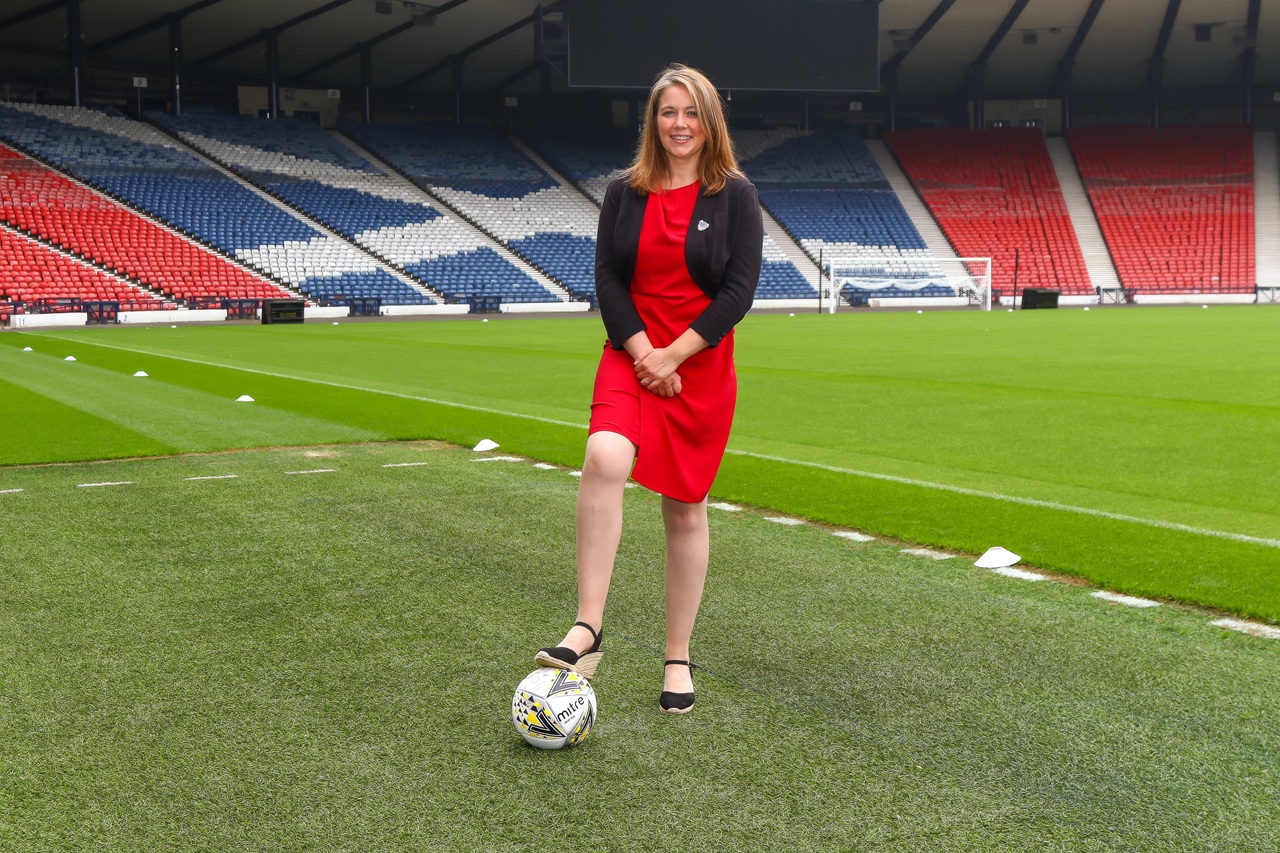
“I found my way into karate through the youth club and somehow managed to win a gold medal for my kata – something I’m still quietly proud of.
“The village hall wasn’t just a building – it was where life happened. It even became the place I chose for my wedding reception, because it held so many memories.
“And when it comes to football itself, well, there weren’t enough boys for a team at our wee primary school, so we all just played together. It had never occurred to me that it might not be ‘for me’. And then, one day, I learned it wasn’t. I turned up to football coaching with a friend and was told, flatly, “football isn’t for girls – go and join the netball.” I remember the sting of it even now. It wasn’t just the disappointment; it was the shock – realising for the first time that something I loved could be taken away because of who I was. I was angry. I’m still angry, if I’m honest. And I’ve carried that with me in a useful way – because no girl should ever be made to feel that something she loves is off limits because of who she is. I’ve been lucky in my roles since to help push against that – to make sport feel open and possible for every child. That coach didn’t last long, thankfully, my dad stepped in instead and gave us back our place on the pitch.
“Primary school gave me such a free, joyful experience of sport, but secondary school felt like a different world entirely. Suddenly, being into football made me stand out, and not in a good way. What I found hardest was that the criticism often came from other girls. At an age when not everyone has the confidence to stand out, it’s hard to keep holding onto the things that make you different. So, quietly, I stepped away.
“I didn’t stop loving football. I still watched it, still talked about it with my dad, still went to games, but I wasn’t part of it any more. While the boys in my class went together, I went with my dad. There’s a loneliness when something you love isn’t something you feel you can share with your peers. That’s why visibility matters so much. When girls can see women playing, coaching, commentating – when they see that the game belongs to them too – it chips away at that sense of exclusion. And the growth of local teams means girls can see women playing in their own communities, for the love of it. These women are role models who are real, reachable, and powerful. That’s why this job is so important.”
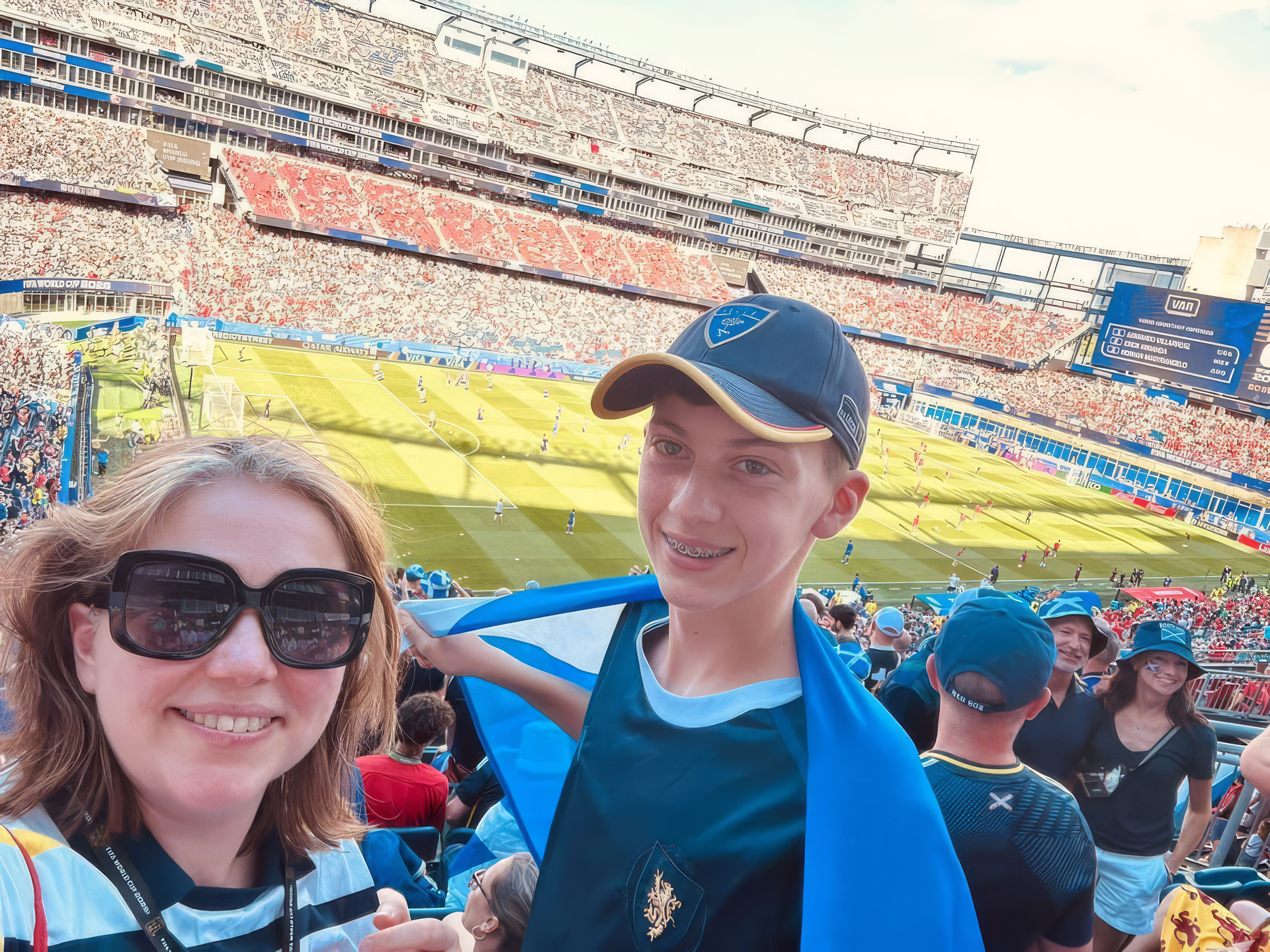
Given we are in the midst of a Summer of Sport designed to make sport more accessible and inclusive, and Campbell and her family are just back themselves from the US having watched Scotland play in the World Cup, I ask her how we get more young people playing sport rather than just watching it.
I have no regrets about leaving politics. None whatsoever – I was never meant to be a politician – I just cared about people
“There’s no single answer, but there are some clear priorities. First, we need to support the volunteers who are the backbone of sport. They’re not just coaches – they’re mentors and role models who provide a steady presence in a young person’s life. Volunteering in sport is often a lot more than helping out on a pitch or a field, so we need to equip our volunteers with all the support and guidance they need to be confident to perform these crucial roles to the very best of their abilities, which offers unquantifiable benefits for young people’s lives and not just their sports. Second, affordability matters – access to facilities, transport costs, etc. – these can all be barriers. If we want sport to remain open to all, we have to tackle those head-on. And finally, we need to listen, especially to teenage girls. Ask and engage with them, learn what would keep them active, respond to it and do everything possible to deliver. If we get that right, we’re not just creating healthier individuals, we’re building lifelong habits.
“Sport is part of the rhythm of my family life. It brings structure to our weeks, and it brings shared purpose, conversation and connection. I love watching my boys play football and be part of and contribute to their teams. Our lives often revolve around lifts to training, matches, and activities. They both play for our local team, Symington Tinto, and my husband helps coach the younger one’s side. There’s such a sense of community around it.
“My eldest has had a particularly tough time. After breaking his leg three times in 18 months, there was a moment when we genuinely thought his sporting days might be over. Our fears weren’t only about sport or football itself, but more about the impact the breaks would have on his social life since so much of his recreational time revolved around being at the park with his pals. Thankfully he’s overcome it all. It would’ve been entirely understandable if he’d walked away, but he didn’t. He’s shown a quiet, stubborn resilience that has been incredible to witness. Watching him step back onto the pitch and slowly rebuilding confidence has been incredibly emotional. When he received the ‘most improved player award’ at the end of the season – with all his teammates, their parents and coaches making him feel so appreciated, as much as a person as a player – I felt so happy and proud of him and what he’s overcome.
“My youngest brings pure joy to it – his team plays with such energy and fun, and it’s infectious. He’s now trying athletics and enjoys golf too, and I feel lucky that we live somewhere that all of these opportunities are on our doorstep, made possible by volunteers who give so much of themselves.
“As a family, football remains a shared love. Supporting St Johnstone – as probably the only Saints fans in the area – makes match days feel even more ‘ours’. It has become a family ritual that has created its own unique family bond.”
Over the course of an hour or so sitting in the boardroom at St Johnstone Football Club at McDiarmid Park in Perth, where she also sits on the board of directors, the conversation between us moves from the day-to-day realities of juggling ministerial life with family to the bigger question of how we ensure every child is afforded equal opportunity. There are moments of pride, some candid admissions about the limits of government, a repeated insistence that prevention must sit at the heart of public policy and absolutely no regrets expressed about exiting elected politics. I ask her whether she looks back on her own childhood and contrasts that with whether childhood is just much more difficult these days.
“I do think young people are navigating a more complex world with the pressures of social media and the pace of societal and technological change. Children today also have opportunities previous generations could barely imagine but the pressures are different and, for many families, they are relentless,” she says. She points to the cost of living, insecure housing, mental health pressures and the digital world as forces that can compound one another.
“Parents are doing their best in very difficult circumstances. The danger is that we talk about ‘parenting’ as though it happens in a vacuum. It does not. If a family is worried about rent, heating, childcare costs or getting a child assessed for additional support, that stress goes everywhere.”
Sport is part of the rhythm of my family life. It brings structure to our weeks, and it brings shared purpose
As a former minister, Campbell is careful not to present government as the answer to everything. Personally, it wasn’t for her, and she has no desire to return. Her approach while there was to work collaboratively outside government to try to effect change and she says that communities, charities, schools and extended families all matter. But she also recognises that government sets the conditions in which support either flourishes or frays. “If we wait until families are in crisis, we have already failed too many children.” And when it comes to the efficacy of the much lauded Promise to support looked after children, she clearly feels frustrated that on too many measures, children who have come into the care of the state, continue to fail.
Given she has suggested that she left unfinished business, I ask her what would be at the top of her political to do list if she could turn the clock back.
“I think what we did get right was to start with the earliest years because if you get that right, then we give children the strongest foundations. But I would not stop there. Children need proper support through adolescence too, because those years can be just as decisive.”
She says that there should be better joined-up services, more reliable family support, stronger mental health provision, and a renewed focus on children who are least likely to be heard. “The children who most need the system are often the children who find it hardest to navigate. That should worry us.”
Campbell returns repeatedly to a theme of always making sure that a child has someone in their corner, batting for them. “Sometimes that is a parent. Sometimes it is a teacher, a social worker, a youth worker, a grandparent, a neighbour. Public policy should make it easier for those people to stand beside a child, not harder. Every child needs that one person who stays, who listens, who doesn’t give up on them. I had that in my parents. We didn’t have much money – my dad was a tenant farmer, my mum worked multiple jobs – but we had stability, love, and a deep connection to our community. And my mum embodied that idea of ‘being there’ for young people. In her café, she welcomed local kids in, gave them a place to gather, to talk, to just be. She offered advice, laughter, and sometimes a firm word when it was needed.
“I remember one young lad, struggling, called her from London just to say he’d arrived. At the time, she was surprised at why he would phone her but looking back, I understand – it was probably the closest thing he had to home and someone who cared.
“That’s the role we should all aspire to play. Because when systems fail, it often comes down to something simple: a child not being seen, not being heard. If we truly want to be the best place to grow up, we have to build a culture where every child feels they belong – where they are known, cared for, and never alone.”
Holyrood Newsletters
Holyrood provides comprehensive coverage of Scottish politics, offering award-winning reporting and analysis: Subscribe