Money 'not being spent in the right places' to tackle child poverty
Attending a weekly teatime club with her kids changed Denise Donlon’s life. For many years the mum-of-two had suffered from severe anxiety, bad enough that some days she struggled to get out the door. But as her children – one daughter and one son – were getting older, they were wanting to do more.
She found out about a new Tuesday group through her kids’ school. A little intimidated, Donlon missed the first session but managed to get to the following week’s meeting. “Everybody was lovely,” she recalls.
Two years on and Donlon has come a long way. She now chairs the Tuesday group, a parent-led club which plans activities and shares a meal together each week. She’s also a community leader, having taken part in a leadership programme with a focus on shared experience and finding solutions based on local community values.
“You were really talking about the challenges that you face and how you see yourself, how you can change. It had a really big impact on me. From there, things progressed – it helped me on the journey because I haven’t stopped volunteering since. Coming back, you were energised, you were thinking of the things that you could do, and you knew you weren’t alone,” Donlon says.
She’s now heavily involved in a local women’s group, chairs her parent teacher association, and sits on the Make It Happen Fund panel for north east Dundee, which delivers cash directly to community groups.
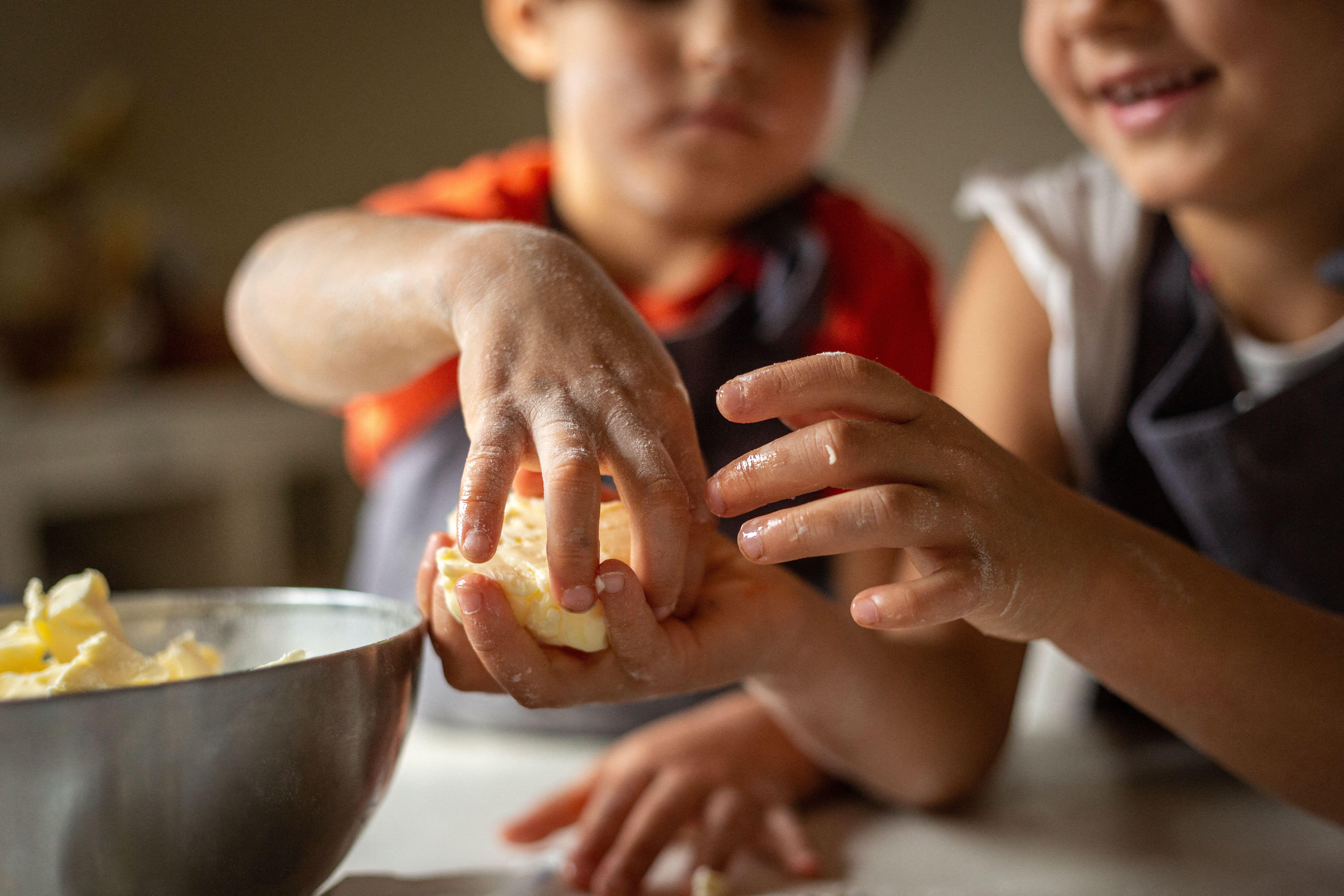 A teatime club encouraged Donlon to start volunteering | Alamy
This fund was established by What Matters To You (WM2U), a project delivered by the Hunter Foundation and BBC Children in Need in Dundee and Clackmannanshire. WM2U’s ambition was to hand power over to local communities and tackle problems by letting them decide what they needed.
It works, Donlon says, because it means that when someone comes to a community group for the first time, there is “somebody on the other side of the door who is going to be there for you, who’s been in the same predicament as you”. That can then open up a whole world of other support. And more importantly, she says, it gives people a sense of being able to help themselves.
“I get involved in lots of things and I’m not afraid now,” she says. “It’s because I’ve built up that confidence. If you can listen to what people on the ground are saying and take notice, that is a big step. If you can change somebody’s life that fraction, it does major things for them. It gives them hope. It gives them a sense of achievement, even. And it gives them a bit of self-worth, knowing that somebody listened to them and somebody helped them.”
And as confidence grows, communities feel better equipped to raise other concerns with institutions – what Donlon refers to as the “domino effect”. She says: “You can come into the community centre, and you can get help with housing. Then there might be someone there from the police that you might be able to speak to [about another problem]. And there’s someone there from the NHS. All that kind of stuff – it’s a big deal.”
How will we know people’s lives are better? We ask them
The Hunter Foundation, the philanthropic organisation set up by businessman Tom Hunter, is keen to push Scottish and local government to adopt this more local model of support. It believes that community-led initiatives do far more to help tackle persistent problems like child poverty because it means the response is designed with and around the people it supports and then builds people’s confidence that systems are in place to help them.
Lynn Hendry, who has worked for the Hunter Foundation for the last 20 years, is critical of the government’s over-reliance on data to tell them whether anti-poverty measures are working. That’s because lifting people out of poverty is about more than the number in their bank accounts, but about improving wellbeing on the whole.
“How will we know people’s lives are better? We ask them. Numerical targets are part of it; I completely accept that. Are people financially better-off? But being financially better-off doesn’t always equate to better whole person outcomes or whole family outcomes because there’s still systemic barriers and systemic issues that affect people who are experiencing poverty.”
She continues: “The worry for me about those absolute measures is we think it’s job done. We’ve moved X number of people out [of poverty], that has achieved it. But actually, it’s much more nuanced than that. When you speak to people in communities, they will express that really clearly. It’s not just about money; it’s about hope, aspiration, purpose, social connections, all of those things.”
Dave Hawkey, a senior research fellow at think tank IPPR Scotland, makes a similar point. He says the problems that stem from child poverty in Scotland are more to do with inequality. “Inequality is important because it is psychologically harmful to grow up in a society where you know that you’re being left behind,” he says. He encourages policymakers to answer the question: “Why are we worried about poverty and what does it mean?”
How do we prevent families moving into poverty in the first place?
That feeling of insecurity is not helped by the way the UK’s welfare system is set up. Hawkey explains: “Having a minimum wage job and receiving Universal Credit puts household income very close to the poverty line. But people’s circumstances are different – people’s housing costs might be higher… which then means that when families are receiving benefits, you do get some of them below the poverty line and some of them above.”
The introduction of the Scottish Child Payment has made a difference to overall child poverty rates – estimates suggest it has cut it by between four and five percentage points – but what that means in practice is that often families just below the poverty line are pushed just above it. That also means a sudden change in circumstance (such as losing a job) or an unexpected bill can push families back in poverty.
What is really needed is action to improve the resilience of households to be able to weather such changes. That then becomes more about prevention of poverty.
Hendry says that while the welfare system, including the Scottish Child Payment, is “an effective measure in the immediate term”, it does not address “systemic issues that cause poverty in the first place”. “What we would really be interested in is the wider debate around prevention as opposed to mitigation. How do we prevent families moving into poverty in the first place and how do we sustain families on a positive trajectory out of poverty?”
 The cost of transport can prohibit access to services | Alamy
This message was the headline of a report published by NHS Highland last month. Highlighting the link between poverty and poor health, the health board’s director of public health Jennifer Davies called for “urgent whole-system action”. Speaking to Holyrood, Davies explains: “The call to action for me is that we have to work at every level of society if we want to make the structural changes that are needed from a primary prevention perspective.”
While she acknowledges the important role of social security, she argues long-term action is needed “so that people aren’t in a position where they’re having to rely on a welfare state” all the time.
That requires national government setting targets and policy objectives but then allowing local communities to deliver the solutions based on their own needs. “For it to be impactful, it has to be grounded in what we understand about the local area. I would argue that the people who know best are the people who are in the local area,” she says.
Her report highlights issues relating to housing, childcare, and transport as major areas where collective action is needed. These same policy areas are those raised time and again by anti-poverty campaigners.
John Dickie, director of Child Poverty Action Group (CPAG) Scotland, says this session of parliament must move to reduce childcare costs and improve availability, reduce the cost of housing (including ensuring new affordable housing is “family-sized”), and push employers to implement working practices that are “family friendly”.
I feel that we’re not really getting to the nub of things with tackling child poverty, because we just say all those things are too expensive
But, he says, this must also be done alongside uplifting the Scottish Child Payment. Doubling it would lift an estimated 30,000 children out of poverty, and while not enough in itself to hit the 2030 target to have fewer than one in ten children in poverty, that’s still a “really important and very real reduction”.
Ministers are planning to increase the payment for children under one in 2027-28, but there is seemingly little appetite to increase it for other families. Partly the issue is financial. The Scottish Fiscal Commission forecasts the payment will cost £518m by the end of the decade, while at the same time the auditor general has warned of a £4.7bn gap in the government’s budget.
But Dickie says politicians must put child poverty at the heart of all decisions. “If the statutory requirement to reduce child poverty, supported by all the parties, has any meaning it needs to be backed up by budget decisions, tax and spending decisions. It’s perfectly sustainable if the resources are made available through the budget process. It’s no more or less sustainable than investing in our health service or our schools or public services more generally.”
A similar point is made by the chief executive of children’s charity Aberlour, Justina Murray, who says she’s made a “personal commitment” to call people out any time anyone says there’s not enough money. For her, the answer lies in public service reform.
“There’s actually plenty of money, but it’s not being spent in the right places. At the end of this month, it’s going to be 15 years since the Christie Commission, which is pretty depressing. We’re still repeating the same behaviours, this kind of crisis intervention, not being able to shift spending… I feel that we’re not really getting to the nub of things with tackling child poverty, because we just say all those things are too expensive. But children living in temporary accommodation is expensive. Children being accommodated by the state is eye-wateringly expensive. If we can prevent all these things…”
That is quite a frustration, this disconnect with what’s really going on in communities
But in the immediate term, the focus will remain on getting more cash in people’s pockets. The Scottish Government’s latest child poverty plan, published in March, highlights three strands of work: increasing income through earnings, increasing income through social security, and reducing the cost of living.
While this approach has been broadly welcomed, CPAG, Aberlour and a raft of other charities joined the Joseph Rowntree Foundation (JRF) in calling for ministers to “radically re-write” the plan. Legal advice obtained by the JRF suggested ministers could be at risk of breaking the law because the strategy fails to set out how the 2030 target will be met.
Murray hopes ministers will now show “a bit of humility” and “accept that the new plan is not good enough”. She also says the parliament must take a “more active interest” and push for “concrete measures” from government, because at the moment it feels like government is “losing sight of the actual outcomes for people”.
“It does feel like the Scottish Government is removed,” she adds. “It’s not just about having a couple of people with lived experience on a panel, it’s actually getting right alongside people, as the third sector does every day, to really understand their issues and respond to what matters to them, rather than what a minister can announce or report to parliament. That is quite a frustration, this disconnect with what’s really going on in communities.”
That same point is echoed by Donlon back in Dundee. “We all want change,” she says. “You can’t keep going back and having the same conversations all the time because it doesn’t work. Obviously, it’s not working because people are in a worse state now than they were before.”
Holyrood Newsletters
Holyrood provides comprehensive coverage of Scottish politics, offering award-winning reporting and analysis: Subscribe