Pulling the purse strings: The women enduring economic abuse from their partners
was walking away thinking ‘how am I going to manage, where am I going to go,’” says Sarah (not her real name) of her decision to leave a long relationship that had become increasingly emotionally abusive. “I was in pieces, I was scared.”
She left with nothing to her name, or rather less than nothing, saddled with thousands of pounds of debt that had been accrued by her partner.
“Money-wise, he controlled everything,” she says, with everyone in the family having to get his permission to buy anything. He, however, would treat himself whenever he felt like it. “It was like that for so long… I never had anything in my purse.”
Sarah was being subjected to what is defined as economic abuse, a type of domestic abuse whereby a perpetrator controls the financial resources, such as money as well as, say, food and transport of a victim – the vast majority of whom are women – and keeps them trapped in a relationship they want to escape.
Economic abuse is now gaining greater recognition as a standalone issue, recognised within the Domestic Abuse (Scotland) Act 2018 as part of coercive and controlling behaviour, with many new initiatives targeting the problem.
And while women have obviously made huge progress towards economic equality, deeply entrenched gender stereotypes around men being the breadwinner and therefore controlling the household purse strings can move at a rather more glacial pace.
Compounding the difficulty is that, shockingly, it is only recently that women have been allowed to have full, individual control of their own finances, and the crucial freedom that comes in tandem with this. It’s just over 50 years since women in the UK were first able to open a bank account, apply for a mortgage or get a credit card without a man’s signature, thanks to the implementation of the 1975 Sex Discrimination Act. But fast forward to today and women suffering economic abuse still find themselves in the nightmare of being deprived of basic financial freedoms.
Conservative MSP Pam Gosal says it is something those in her West Scotland constituency frequently turn to her for help with. “They’re very scared to leave because of the financial side that holds them back…A lot of domestic abuse perpetrators hold that control.”
Gosal, also deputy chair of her party at Holyrood, adds that victims often don’t know what’s in their name financially, whether that be assets they could lose or liabilities they could be left with, because of an abuser. “You don’t know anything because you never, ever controlled the finances in a relationship. I’ve seen it myself.”
Queen Camilla hosted a special reception at Clarence House in December dedicated to highlighting and tackling economic abuse. Surviving Economic Abuse (SEA), the only charity in the UK dedicated to raising awareness of economic abuse and transforming responses to it, has found that about one in six women experienced the problem in the previous 12 months. Victims were left with an average individual debt of more than £20,000.
Debt charity StepChange has published a major report on coerced debt showing that three per cent of UK adults, equivalent to 1.6 million people, had experienced this in the previous 12 months. And almost a third of this group were found to be experiencing problem debt, compared to just six per cent of UK adults.
The organisation said the problem “causes and compounds harm to victims, including the burden of dealing with debt, diminished financial resilience, low confidence in their ability to manage their money and in their financial future, and poor wellbeing”.
That chimes with the experiences of Sarah, who found that in the wake of leaving an economically abusive relationship, “there’s so much to deal with, and you can’t cope with it all yourself – it’s overwhelming, because you don’t know where to start”.
StepChange also points out that the issue traverses every single section of society. “It can happen to anyone – that the really scary part,” says Genevieve Richardson, senior public policy advocate at the charity. Indeed, a woman having deep financial resources can also make her a target, with one striking finding of the report that interviewees often reported that perpetrators of coerced debt “took advantage of a strong economic position, or one that was perceived to be strong”.
Further enabling economic abuse’s ability to harm is the lack of understanding of it as a concept. StepChange found that nearly a third of survey respondents from across the UK had never even heard the term, and even fewer were familiar with coerced debt. That “wasn’t a surprise – but it is really worrying,” says Richardson.
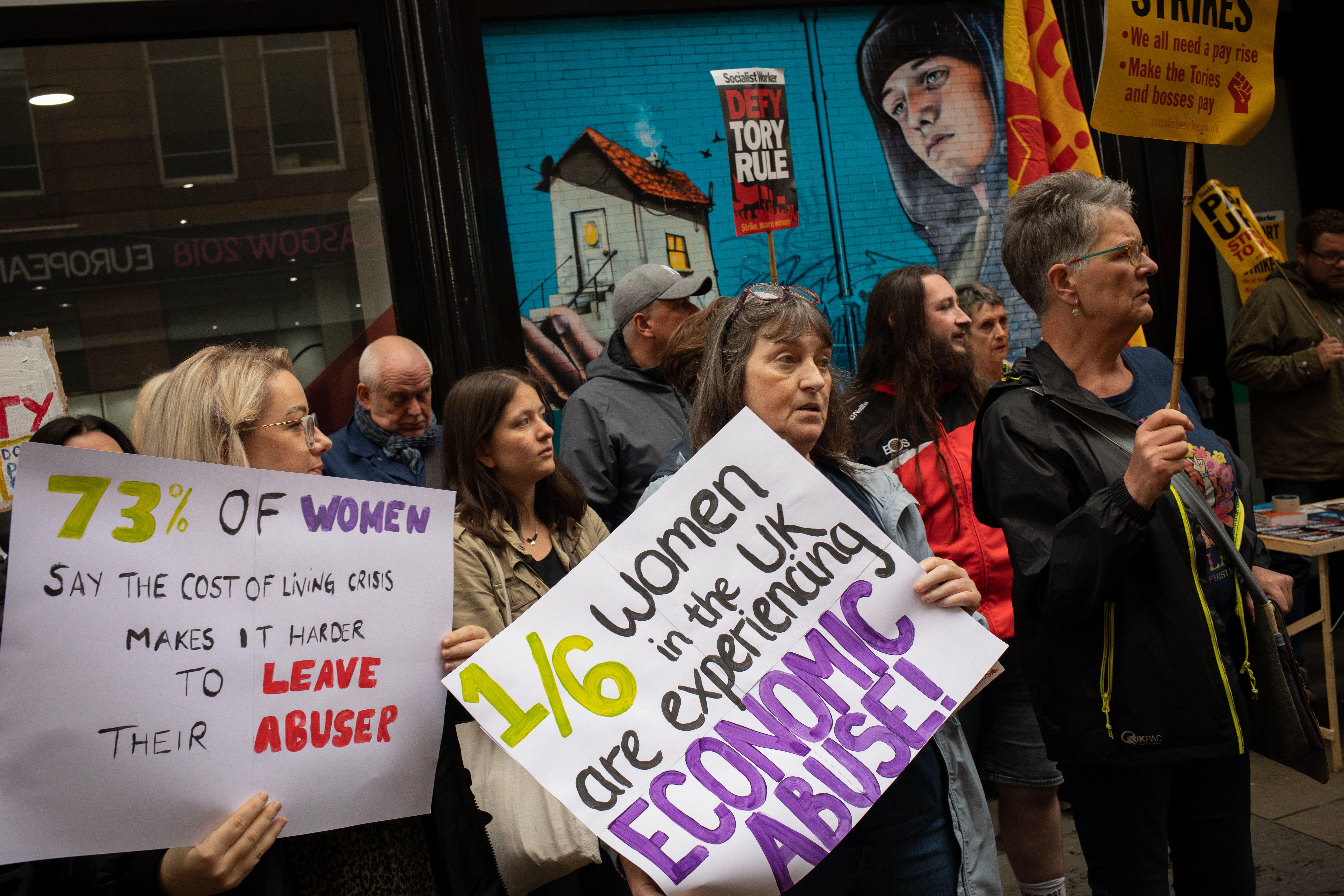
It delays and hampers seeking relevant help for a problem already clouded and worsened by shame and fear. Data from SEA revealed that nearly 60 per cent of victims who had heard of economic abuse reached out for help, compared to about four in 10 who had not.
Richardson cites one case of a woman calling StepChange for help with problem debt, and it was only when speaking to an adviser that she realised she was suffering economic abuse. The public policy advocate adds that support from certain agencies who come into contact with women suffering such abuse can be patchy, with a lack of understanding of the needs of victims.
That is something Sarah has experienced first-hand, for example when she phoned one organisation about a bill she owed and explained her personal circumstances. “I wasn’t running away from paying it, but I didn’t have the funds to pay it at the time. However, the person I spoke to just said, ‘it’s not our problem who pays for it, we just need to get the bill paid’.”
Such experiences were sadly not uncommon for her. “You were up against so many barriers that you felt like people weren’t listening. It can feel like people don’t care, they just want paid – and it shouldn’t be like that.”
She was put in touch with West Lothian Women’s Aid and helped by a pilot scheme currently being undertaken by Scottish Women’s Aid, using specialist, trauma-informed debt advisers from Citizens Advice. Those behind the project say it “removes many of the barriers women face when seeking help with debt and financial hardship and recognises the deep and lasting impact of economic abuse, including coerced debt”.
Citizens Advice West Lothian contacted large organisations on Sarah’s behalf, but she also felt it has dealt with her “the right way… the pressure’s still there, but my adviser lifts the load”.
She adds: “You don’t feel like you’re in it on your own… It gave me the guidance and help that I needed to get through to where I am today.”
Another recently launched initiative is what is billed as Scotland’s first confidential helpline for victims of economic abuse. The Purple Phone helpline is part of a new economic abuse pilot project supported by Scottish Government funding. It was launched by Financially Included, which is led by Greater Easterhouse Money Advice Project in collaboration with Glasgow Violence Against Women Partnership, and focuses on improving the provision of money advice across gender-based violence sectors.
In terms of the broader state-backed addressing of the problem north of the border, SNP MSP Collette Stevenson recently received a reply to her request for an update on Scottish Government actions following the publication of her report The Financial Considerations When Leaving an Abusive Relationship. Equalities minister Kaukab Stewart stressed that the Scottish Government “is resolute in the belief that coercive control, including financial abuse, has no place in Scottish society”.
Relevant measures highlighted by Stewart include investment of £1.5m in a new national Fund to Leave, which recently opened for referrals, giving financial support to women fleeing an abusive relationship. It is expected to help up to 1,800 women and their children “transition to a more stable and independent future”.
It mirrors initiatives by the private sector such as high street lender TSB’s Flee Fund, which gives domestic abuse victims up to £500, which doesn’t need to be repaid, “to pay for essentials that make leaving possible”.
Richardson praises the increased prevalence of “banks, particularly the larger banks with more resources, having really innovative approaches to economic abuse”.
And last month, the Aberdeen Group Charitable Trust – the philanthropic arm of Edinburgh-headquartered investment giant Aberdeen – announced that it had extended its partnership with SEA, focusing on tackling responses to coerced debt. The trust has committed £180,000 to establish a standardised financial sector response to coerced debt.
Richardson welcomes the progress in tackling economic abuse, particularly in the last decade, but notes that there remain inconsistencies in how it is tackled. “I think we all need to take responsibility…We need to see the same approach and outcome from all areas.”
Gosal also calls for a more coordinated response as part of tackling the endemic scourge of domestic abuse, which she recently noted is “out of control” in West Dunbartonshire alone, with the number of women and children asking for help rising by about eight per cent year-on-year to more than 1,700.
That comes after Police Scotland in 2023/24 recorded 63,867 incidents of domestic abuse, a year-on-year increase of three per cent, while SEA found that 95 per cent of survivors of domestic abuse experience economic abuse.
And Gosal believes examining the root causes of women suffering financial exclusion is crucial. “I’d like to be in a society where we would be financially included, and we can only achieve that if we go right to the root of the problem and make sure that women have their full safety rights and they have a voice. If we don’t have that, we don’t build that foundation.”
She cites girls at high school already subject to being told what to wear by male peers. “That’s what these things start from, slowly.”
A project by the Scottish Women’s Budget Group (SWBG) threw into sharp relief financial disparity by gender. Focused on Aberdeen, it revealed that women’s average earnings coming in at £562.50 a week, well behind £621.30 a week for men.
Female respondents were also more likely to be economically inactive than their male peers, at 22.3 per cent compared to 15.3 per cent, often due to care responsibilities.
The latter is a key driver of economic inequality between men and women, says Heather Williams, training lead at SWBG. She notes that women in higher-paid employment suffer the long-term effects of the motherhood penalty as soon as they have children.
A new report from the University of Edinburgh, supported by wealth manager Evelyn Partners, calls for major action to address the current pension gap, which sees women end up with a “staggering” 75 per cent less in retirement wealth by age 60 than their male peers. The study cites figures from the Department for Work and Pensions showing that men hold a median amount of £75,000 in defined contribution pension wealth, the most common form of private pension provision, by age 59, compared to £19,000 for women.
Williams adds that career choices more broadly are driven by societal, gender-based norms and stereotypes, and the way in which services are delivered.
In terms of how Holyrood is tackling disparity between the sexes, she says: “There are lots of policies and there’s lots of recognition of the issues, but we would still be asking questions about how that’s driving budget decisions… How is that actually impacting on the way in which services are delivered?”
Returning to economic abuse specifically, Richardson stresses that there is help out there, and advises anyone suffering to, first and foremost, ensure their own safety.
She recommends contacting domestic abuse organisations; a debt advice specialist such as StepChange; their lender who may have targeted support to tackle economic abuse; and credit reference agencies who can put a notice of corrections on their file that explains what they’ve been through. The latter doesn’t change a person’s credit score but might help them when trying to secure credit in the future, she adds.
Richardson cites the ideal of the “no wrong door” approach, whereby anywhere a victim turns for help, “whether that’s the police, a hospital, debt advice, a domestic abuse organisation”, they will be directed through the right “door” or pathway to obtain suitable support.
Gosal describes the support she would like to see as a “golden thread” running through each and every relevant support system “so that the right decisions can be made”.
Richardson also stresses that “you want to make sure that victims are being believed, because so often they’re full of self-doubt and self-blame” – something echoed by Sarah.
“It’s so sad,” says Richardson, “because they’re in such often-violent situations and often very manipulative situations that it couldn’t possibly be their fault. It is so common – abusers use very smart tactics to exert pressure, but also to obscure information… It’s not that person’s fault, an abuser will always find a victim to abuse. But there is a future, and there is a lot that can be done to help.”
That advice is shared by Sarah. “There is help out there,” she stresses, highlighting that she sees how much progress she has made since the split from her partner. “At the time you just feel like you’re in this vicious circle, and you don’t know how to get out of it. It’s hard, but you do get out, gradually.”
*This article was supported by a bursary awarded by Women in Journalism Scotland
Holyrood Newsletters
Holyrood provides comprehensive coverage of Scottish politics, offering award-winning reporting and analysis: Subscribe