Malcolm Offord: I went into therapy to become a better version of myself
Glasgow in 1955 was a city slowly emerging from the darkness of the Second World War. Rationing had just ended, public health was poor, and the swathes of slum housing was a blight on a dismal urban vista.
Into this grim landscape, fresh from his visit to London the previous year – in which he was seen by an estimated one million people – burst Billy Graham, the charismatic US Evangelical preacher who arrived in Glasgow on his ‘All Scotland Crusade’ to a rockstar reception and eager converts seeking some hope.
The Billy Graham religious cavalcade was something the likes of which the Scottish public had never seen before. In an era before Elvis and The Beatles, Graham attracted a sea of adoring fans that led to claims of his popularity being “kind of the Protestant answer to the Pope”.
And on 13 April in Glasgow’s Kelvin Hall, among the 15,000 other people that had queued for hours in the rain to hear Graham preach, were two strangers whose lives were about to take a completely different course. Maurice Offord and Doreen Ogston were just two ordinary 20-somethings who became radicalised by hearing Graham that day and that set them off on a lifelong path of Evangelical Christianity, or as their son Malcolm Offord now describes it, of following “the Christian Taliban”.
Offord is a man who doesn’t mince his words and he inevitably splits opinion. At 62, the former City of London financier turned Reform UK political heavyweight is in a hurry and he operates with a clinical, almost brutal, urgency fueled by a raft of statistics that for him represent failed lives. To his critics, he is an aggressive, far-right political interloper who stirs up racial tensions; to his supporters, he is a refreshing blast of raw, unscripted ambition for Scotland in a parliament they see paralysed by mediocrity. He is also very wealthy and not afraid to show it, famously referring to his six houses, six boats and five cars during an election debate.
Offord’s time as an elected politician has so far been brief but regardless of how you view his politics, he’s made a splash. Having joined Reform less than a year ago, he now leads the party’s 16 MSPs – having already lost one to sit as an independent. His dissenters say he’s not a real politician and will soon get bored – they even say he looks bored. He says he was too busy in business to involve himself in politics until recently, although describes an early childhood memory of listening to Brian Redhead on the BBC conducting radio interviews with politicians that have clearly left a mark. He also sat on the advisory board of the right-wing think tank the Centre for Social Justice (CfSJ), which was set up by the Tory MP Iain Duncan Smith in the early 2000s. Duncan Smith famously had his ‘Easterhouse epiphany’ in 2002 where he witnessed poverty in the raw and was moved to establish the CfSJ and used it to help shape future UK welfare reforms. Offord says Duncan Smith was the first politician on the right who he had heard talk about poor people with “a degree of empathy”. Offord officially joined the Conservative Party in 2020, stood unsuccessfully in the 2021 Holyrood election, was made a peer later that year having donated almost £150,000 to the Tories, ostensibly for the CfSJ, and became a government minister first in the Scotland Office and then as a junior minister for exports. He defected to Reform in 2025, saying that the Scottish Conservatives had “given up on Scotland”, and he also resigned from the House of Lords. In May 2026 under his leadership, Reform UK in Scotland won 17 list seats in the Scottish Parliament, tying for second place as the main opposition with Scottish Labour. He tells me now he wants to spend the next five years preparing his party for government.
There is no doubting Offord’s ambition. But to understand the ideological framework of “Super-Mal”, which was his nickname in the City, one has to look past the front-row ministerial seats, the post-Brexit trade deals, the swagger, the wealth and the no-bullshit presentation. You have to go back to his strict, television-free, Evangelical crucible in Greenock on the River Clyde – and the long, imposing shadow of an upbringing he has spent a lifetime running away from, yet somehow has found himself running directly back towards.
And for a man that spends a lot of his time talking about immigrants and displays an apparent disregard for the plight of displaced people, Offord’s entry into the world was defined by his own family’s structural displacement. His mother hailed from an Aberdeenshire crofting family; her father was a dairyman who came south for work and ended up living and working around Glasgow. Offord’s father migrated from Portsmouth via Hong Kong, where his own father had been stationed before the war, and then ended up being posted back to the UK in Greenock where the family remained.
The SNP only wants to talk about a referendum, and the Conservative Party only wants to say no. In the meantime, everything else goes to shit.
Offord’s parents, Maurice and Doreen, were working-class professionals – a nurse and a building surveyor – whose lives were fundamentally reordered in 1955 when Graham brought his historic crusade to Glasgow’s Kelvin Hall and they were radically converted, transformed from casual, small-c Christians into passionate, uncompromising Evangelicals. They didn’t meet at the Kelvin Hall that day in 1955, but they left the meeting inspired enough to become involved in the church and later met at a group meeting. They married and immediately threw themselves, with an impressive dedication, into upskilling their qualifications to become religious missionaries destined for the Belgian Congo, with Offord’s father basing himself in Brussels for a year to learn to speak French and French construction techniques, and his mother travelling to Liverpool to study oriental medicine. But at the eleventh hour, and with their bags all packed, a telegram arrived. The Congolese War had erupted; the mission was cancelled. And with their hopes and dreams crushed, the couple settled permanently in Greenock, funnelling their thwarted missionary zeal entirely into conceiving and raising their six children under the strict mantle of their faith. It was a household defined by tight finances, rigorous educational expectations, and an absolute ‘no TV’ rule. Offord had read the whole works of Dickens by the time he was 16 because, as he says, “when there’s no TV, you have to do something to occupy yourself, don’t you?” The family attended church meetings five times a week – twice on a Sunday. And Offord says his parents became “sort of missionaries in their own town”. They ran a small church in the council estate of Larkfield and every Sunday the family would drive to the estate where they would do church outreach, handing out food parcels along with the word of God.
And while his quieter, deeply musical siblings adapted, Malcolm, the third eldest, stood out like a sore thumb. He was charismatic, hyper-sporty, and outwardly rebellious. He describes himself as “the odd-one out” and felt like he didn’t belong in the family. “I think everyone got on very happily, except when Malcolm was around because they just saw me as a disruptive force that was always getting into rows with our parents. I’m not going to say it was the easiest childhood because it wasn’t.” When I ask him if he loved his parents as a child or whether he felt loved, he asks me why I am asking that and I don’t get a direct answer. He says there was “tough love”.
When his father forced him to take violin lessons on Saturday mornings, intentionally blocking him from playing for the school rugby team, the friction became absolute. He was the perpetual source of arguments, the family anomaly. Offord describes his lifelong pursuit of secular wealth and high-stakes finance as a direct manifestation of Newton’s Third Law: an equal and opposite reaction to the crushing intensity of his upbringing.
“I resented every aspect of my childhood,” he tells me. “Totally resented it. Which is why I got out of Greenock as soon as I could. Which is no disrespect to Greenock because it was, and is, a great town. But for me, I had to get away, which is why even though I was given a place at Glasgow University or Edinburgh University, I went to Edinburgh.
“I felt overwhelmingly thwarted by the religious aspects of our family life, and I’ll give you an insight into this. When I went to Edinburgh University, I remember a film came out called Chariots of Fire, a David Puttnam film, about Eric Liddell and I remember watching that film and being in floods of tears because if I was going to be a Christian, that was the kind of Christian I would have wanted to be, you know: win things. Those two things should not be incompatible but that’s not the way I was brought up. You know, Eric Liddell played rugby for Scotland on the wing. He won Olympic gold medal. He was also a missionary. Why was he allowed a Christianity that allowed him to succeed in the world and to set an example, and I was not? My parents would say to us that you’re in this world, but not of this world. It was a life that was to be lived in a sort of exclusion zone. And other than going to school I just didn’t feel I could be myself, which is why my school was so important to me, because that was my escape. My parents believed that this was how we were meant to live our lives and if you wanted to be a Christian, you weren’t allowed to fulfil your potential. And their kind of Christianity was not that sort of Eric Liddell type of Christianity, and I’ve never really reconciled that.
“I think they saw ambition or wanting to win as a distraction from all of that. They were missionaries and they expected their children to live that life and be missionaries.”
If his home life was a pressure cooker, the local state schools – Ardgowan Primary and Greenock Academy– were Offord’s sanctuary. Under the school motto Hinc Vera Virtus (“Herein True Worth”), Offord was taught that education was a weapon to make the world better. And it is perhaps no small coincidence that the school has spawned other politicians including Annabel Goldie, Ross Finnie and Wendy Chamberlain. He also remembers meeting Ming Campbell during a school visit, who later became a great friend.
.jpg) Offord with Farage at a Reform event in Scotland | PA / Alamy
But it was a moment at Edinburgh University that permanently codified his overall approach to life. Coming from a non-monied background, Offord qualified for a full grant and – unsurprisingly, given the novelty of having money in his pocket – spent it all within his first month. The day the ATM rejected his card, reality hit. Working gruelling late nights in Edinburgh bars to make ends meet, he was forced to skip a coveted university rugby tour to Kenya simply because he had no cash.
At 20 years old, he looked himself in the eye and made a solemn, unyielding vow: “Never again am I ever going to be found without dosh in my pocket. I’m going to work however hard I have to work, and I’m going to make money. That was it.”
Pushed into studying law by a school rector eager, says Offord, to boast to the local Rotary Club about the number of his pupils going on to study medicine or law from the school, Offord hated the subject and describes it as “a deep regret” that he read it. When the university introduced a postgraduate “diploma year” that lifted the lid on just how miserable practising law would be, he pivoted instantly on career choice and looked south.
Arriving in the City of London in 1987, Offord stepped directly into the explosive aftermath of the financial ‘Big Bang’. Riding the wave of the Thatcher revolution and the deregulation of Nigel Lawson’s 1981 Companies Act, he found a booming market starved for talent.
Encountering the elite Oxbridge establishment for the first time, the state schoolboy from Greenock felt zero imposter syndrome. Instead, he saw a contest and one he was determined to win. “I realised, well, actually, I can run rings around you guys.” But it was also another source of resentment that coming from a state school in Scotland, no one had ever suggested to him that Oxbridge was an option.
“If someone had taken me to Cambridge or Oxford at 16 to see the dreamy spires, I think I would have bitten their hand off to go there. But it wasn’t ever put in front of me. So the first time I met this Oxbridge thing was in the City and I wasn’t going to let them beat me. And one of the things that was really interesting about going to London in ‘87 was that there were sort of three types in the City – this is all before the international people came in. There were the toffs, the English public school kids, then there were the English grammar school kids, really from Bradford Grammar, Manchester Grammar, and so on, really bright kids who did go to Oxford or Cambridge because they got put through the scholarship system, and then there were the Scots. And what I discovered was the Scots had a really big reputation in the City because it was assumed that you were well-educated, articulate, hard-working, and hungry.”
Offord goes on to describe his own distinct socio-historical theory regarding Scottish success in the City. He notes that while the English only opened university education widely in the late 19th century, Scotland had established widespread democratic access since the 1660s. This birthed the “grand tradition” where the sons of peasant farmers could read Latin by age 10, creating a class of professionals he explicitly labels PHDs: poor, hungry, and driven.
Combined with an inherent, scrupulous honesty embedded in the Scottish cultural DNA, Offord argues that the wealthy English elite quickly realised the Scots made the ultimate managerial class to run the British Empire – a tradition that rolled seamlessly into modern international banking. Thriving in this hyper-competitive, unscripted environment, his aggressive drive earned him a legendary City moniker: ‘Super-Mal’.
“I was known as ‘Super-Mal’ because I was ‘up ‘em and at ‘em’. I was just driven. I felt coming down as a Scot that I was part of something. And having talked to you about growing up always feeling like an outsider, that being in London, working in the City, was the first time I felt like I belonged. I went down to play rugby at London Scottish and that was full of all the guys that had come down from Scotland to work in London. There was a real esprit de corps about it, a real sense that we were on top of our game and we were doing very well down here.”
Much is made of how much money Offord may now be worth and there is no doubting it is multi-millions, yet, for all his material success the ghost of his upbringing never entirely faded. He says that because he was “force-fed faith” and “had done enough church by the time he was 16 to last a lifetime”, he is no longer “a practising Christian but has a Christian faith, if that makes sense”.
I resented every aspect of my childhood. Totally resented it. Which is why I got out of Greenock as soon as I could.
But old habits are hard to kill off and for decades Offord maintained a strict ritual of phoning his mother every Sunday at 9pm, timing the call to the exact moment she returned from church.
The conversations were a masterclass in ideological tension. His mother openly expressed deep disappointment in his corporate achievements, telling him he was abusing his God-given talents to amass personal wealth rather than using them to serve the less fortunate. The irony, of course, was when Offord was appointed as a government minister. Calling his now 91-year-old mother with the news that he was a minister [albeit one of government rather than religion which was her ultimate dream] she finally acknowledged his career with dry humour, noting that at least now he wasn’t being paid much and was actually doing a job designed to help people.
He laughs at the memory, but this deeply buried demand for public service explains his eventual, sudden entry into politics. Spurred into action by the SNP’s relentless drive for a second independence referendum, Offord joined the Conservative Party in 2020. He was rapidly elevated to the House of Lords and brought into the Scotland Office by Alister Jack, where he spearheaded a post-Brexit funding mechanism that bypassed Edinburgh to deliver Levelling Up capital directly to Scotland’s 32 local authorities – a job, he says, he loved because it was about improving and empowering communities.
 Malcolm Offord photographed for Holyrood by Robert Perry
Later, serving under Kemi Badenoch in the Department for Business and Trade, Offord secured sweeping global trade pacts. But his front-row seat also exposed a wider, systemic collapse. Watching three prime ministers cycle through Downing Street in three years, he concluded the Conservative Party had lost total control of energy, immigration, and fiscal growth. Influenced by Tory philosopher Danny Kruger, he defected to Reform UK.
“I’d never met Nigel Farage. I didn’t go to Reform for Nigel. I went to Reform first of all because I was deeply unhappy in the Conservative Party, and I felt that I was being dishonest. I had unpeeled the onion on energy and I was horrified by what I found, and yet I didn’t have my party behind me. I had knives in my back in the House of Lords on the front bench from my own party. And then second of all, the Scottish Conservative Party, I was deeply disappointed that when I tried to help with that, they didn’t want my help. And when I said ‘we need more policies and what does the Scottish Conservative Party want to do at the next election’, they said ‘we’ve only got one policy’, which was no to another referendum. And that’s when I worked out that they were in a codependent relationship with the SNP. The SNP only wants to talk about a referendum, and the Conservative Party only wants to say no. In the meantime, everything else goes to shit. And I said that we need to have a programme for government, and I then commissioned that piece of work called Wealthy Nation, Healthy Nation with a number of co-collaborators, which is basically a plan for how we make Scotland successful. I thought that was something that nationalists and unionists could coalesce around, that we can find common ground on. That’s when the Conservative Party turned around and said ‘Malcolm’s a closet nationalist’. That was the end for me.
“Of course I’m not a closet nationalist. I’m passionate about Scotland, and I care more about that than the constitution. We’ll deal with the constitution in time, but right now, it’s a sideshow to the fact that 900,000 adult Scots are not working, and that’s what we need to deal with.”
Offord is “obsessed” by numbers but two in particular – the two million Scots who did not vote in the last election who, he says, are “scunnered” by Holyrood and need to be shown that the Scottish Parliament can be a “force for good”. And secondly, the 900,000 Scots of adult working age who are not working. He believes passionately that at least half of those Scots not working and on benefits could be given “attention and some love” to be supported back into work while the other half who, he says, “are legitimately unable to work; the sick, the disabled and so on”, will always have a safety net to look after them.
Offord’s political worldview is entirely output-driven, entirely mathematical, and fundamentally hostile to what he terms the “performative” nature of modern governance. He openly admits to looking visibly bored and disengaged while sitting in the Holyrood chamber.
He lambasts a sclerotic institution that wastes infinite legislative hours debating vanity projects and international resolutions while ordinary citizens are unable to secure a GP appointment. He points to a recent economic debate where, out of 129 elected MSPs, only 30 bothered to show up – a failure he attributes to a terrifying vacuum of fiscal literacy and suffocating groupthink among mainstream politicians: “They’re not comfortable on that subject, and yet that’s a subject that people outside need us to care about.”
He plans to “broaden the appeal” of Reform to attract voters back in and to produce a 10-year prospectus for Scotland which is aggressively production-focused. He demands a return to tangible manufacturing, pointing to a past where Kilmarnock made Johnnie Walker and Greenock made ships. To achieve this, he advocates slashing energy costs and putting a “stop to sacrificing jobs on the altar of net zero”; demands the approval of both Rosebank and Jackdaw, and North Sea gas pulled from international markets and reserved for domestic use; lowering business rates and cutting corporate red tape; and reforming welfare which, he says, is a “rational trap” where intelligent people choose not to work because the state pays better than the market.
His economic framework directly shapes his controversial stance on immigration. Offord fiercely opposes importing foreign labour, such as medical professionals from Nigeria, arguing it drains growing economies of their own vital assets. Instead, he insists Scotland must train its own homegrown labour.
He says he is entirely comfortable with the use of language such as “strangers” to describe illegal immigrants because he says that is what they are and brands mainstream accusations of racism as a “lazy trope” used to avoid real debate, fiercely condemning middle-class politicians in affluent areas like Morningside for preaching open borders while dumping undocumented arrivals into working-class neighbourhoods where locals are forced to compete for second-class resources.
I ask him if he feels uncomfortable with the rhetoric espoused by his deputy, Thomas Kerr, who frequently refers to immigrants as “strangers” and which has led to accusations of racism in the chamber.
“No, I don’t feel uncomfortable at all, it’s what his vernacular is, he’s a working-class boy from the East End in Glasgow. I’m not. I’m not pretending to be. I see it very much as an economic thing. He sees it very much as a community thing. These are two lenses, which are different but complementary. I want our own people back to work before we give jobs to outsiders.
“They are strangers because basically somebody you don’t know has just arrived. I spent time with all these people, understanding where they came from, what they were doing, why they came here, and I didn’t meet any doctors or nurses or lawyers, or poor women with children. I just met a bunch of young, male individuals who were clearly economic refugees who’d come here because you get a better deal.”
Isn’t that okay?
“No, it’s not fair on the people here. Look, in the world that I have in my head, where we’ve got Scotland re-industrialised, we’ve got people back to work, we’ve got all the mental health issues sorted out because work is good for your mental health, where we have vibrant factories and communities, and people are working, we can then think about helping other people.”
I ask him if he worries about discipline in a parliamentary group made up of people largely elected for the first time who know very little about each other and will require more control and leadership.
“Yes, I agree, I do agree with that. And we have to learn fast to be politically savvy as well. I accept that criticism. I accept that challenge. I have to be more politically savvy, more politically aware. I have to increasingly think about every time we’re in the chamber, what are we trying to achieve here? And if we haven’t achieved that, what was the point? It’s a learning process but we are all up for that challenge.
“Everybody in the group of 16 has got their own area of expertise, and they speak with their own story and with their own authority, and so far that has worked very well because we’ve got a group of talented people. But as we go forward we have to broaden our appeal, and I think we have to get very much more on the front foot, especially on the economy and the idea that we’re ambitious for people, not for our own political careers. We want to help people. We want to help our own people. That, I think, is the message we’ve got to really drill in.
“The Conservative Party is a very scripted party. It’s very hierarchical and it’s for ambitious people who want to get on and who view that as a vehicle for self-promotion and for self-advancement, and it’s a career. I don’t think anyone in Reform is really in this for a career. Now that might change in the future, but the early Reformers are not
careerists.
“I would say the SNP is the same as the Conservatives and now full of careerists and that’s why you get the groupthink. And it was General Patton who said that if everyone’s thinking the same thing, then somebody isn’t thinking. The groupthink went on in the Conservative Party for 14 years, and there’s groupthink going on in the SNP now for 20 years, and that is about both longevity and also the entitlement of feeling that you are entitled to be in government.”
Offord demands his team throw away centralised scripts, master their briefs, and “feel it inside”. It is a punishing, unrelenting pace that few can match – a reality he flatly points to when discussing the high-profile defection of MSP Amanda Bland, whose subsequent accusations of institutional misogyny he dismisses as an untrue, deeply irresponsible “false flag”.
When asked what he has sacrificed to maintain this pace, Offord is startlingly candid. He points directly to his personal relationships. His political realignment has cost him dearly, resulting in the loss of long-term friends and close family members who cut ties over his allegiance to Reform. This leads us into a discission more generally about relationships.
He has been married once; the marriage ended in divorce, a reality he speaks of with profound sadness and the recurring theme of regret: “That is an area where I failed. I hate failing... it was entirely my fault.”
There is no doubt that Offord is much more comfortable talking about people as numbers. He does the arithmetic of politics talking about the numbers of people out of work, the number on benefits, the numbers coming in from other countries, and is verbose on all those theoretical equations that feed into his menu for change. On personal relationships, he is much more circumspect.
There are some interviews that are easy and straightforward to write, but with Offord there were too many points where he just didn’t want to expose who he was so we agreed to a part two over coffee at Gleneagles, where he is attending a Tom Hunter Foundation conference attended by Scotland’s most wealthy entrepreneurs. We start to get more personal. Because there is a deeper, quieter trauma compounding his current political sprint. Three-and-a-half years ago, his partner tragically passed away from cancer. It is a loss that left him bereft and led to him seeking professional therapy which, he says, has helped him come to learn to live with his grief but also come to terms with who he is. He says he is now a “better version of himself”. But it is complicated. His partner was, in fact, his first love: a girl from Greenock who he believes he should have married but says London “turned his head, he became arrogant” and he told her that he hadn’t moved to London to end up being with someone from his hometown. They split up, only meeting many years later when both were married to other people and with children. They divorced their spouses in what he describes as “very messy break-ups, full of guilt and uncertainty” and the resulting painful fallout meant Offord did not speak to his now grown-up children for five years. They are only now starting to heal that rift and he is sensitive about saying anything that could put that in jeopardy. But the pain he feels for both the end of his marriage and the premature death of his first love is tangible.
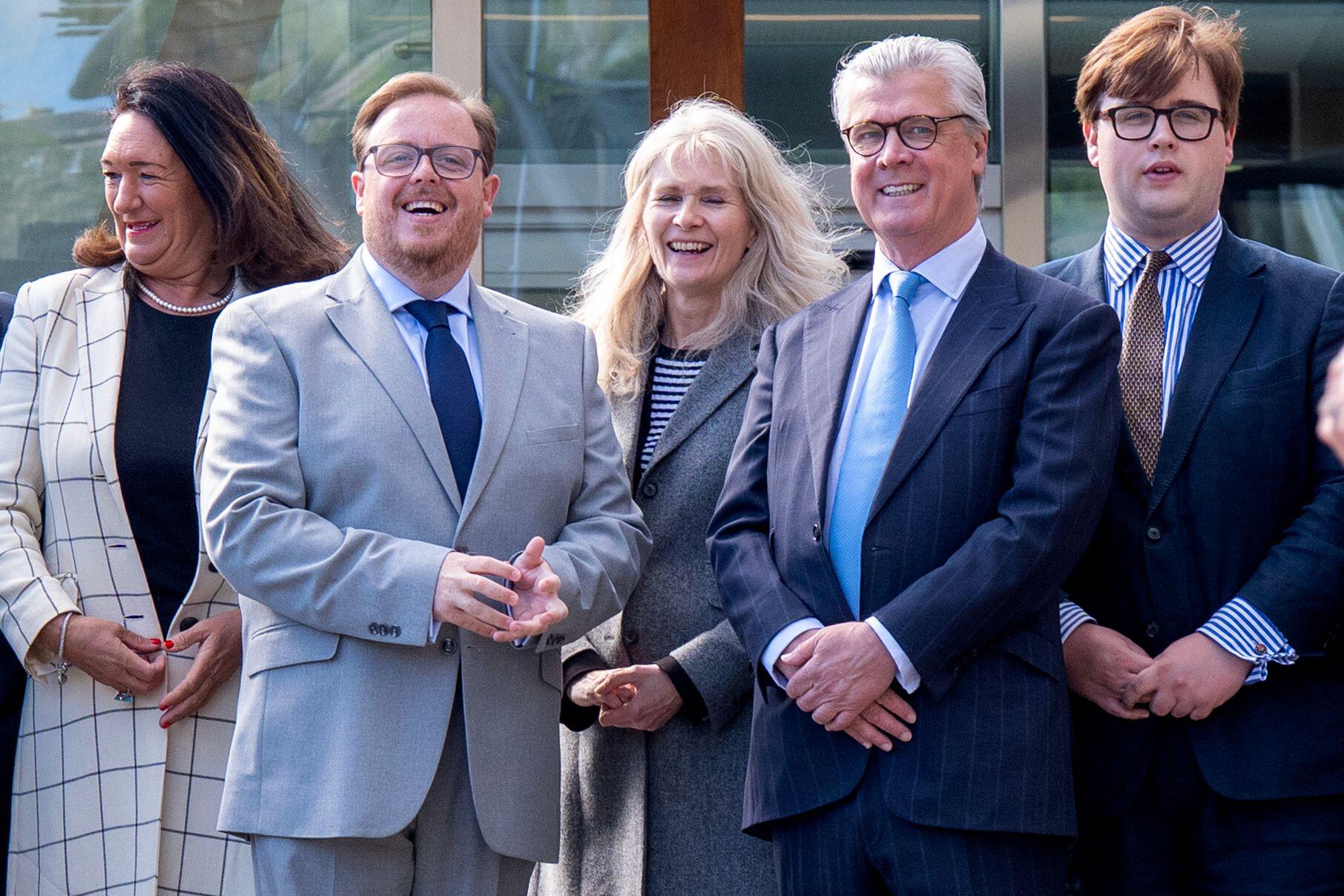 Offord with controversial deputy Thomas Kerr | Alamy
Now, entirely single, entirely untethered from domestic obstacles, and entirely driven by his own sense of moral duty to improve people’s lives, he is more driven than ever. This explains his corporate, almost detached response to his own recent health crisis. Diagnosed with prostate cancer following a routine screening, Offord experienced absolutely zero symptoms. Rather than treating it as a personal crisis, his corporate psychology immediately took over, framing the illness as a standard operational problem: “I’ve got a problem. How do you fix it? Just fix it. And let’s fix it fast.”
There’s a lot going on in the mind of Malcolm Offord and when I ask him if he is happy, he rejects the notion of personal contentment, famously quoting David Hockney’s line that he only “occasionally glimpses happiness”. To Offord, personal contentment is a dangerous trap that signals the death of hunger: “What does that just mean? Pottering in the garden all day long and being contented? No. Isn’t this life about duty and service?
“For all these reasons that we have discussed, I keep going. Yes, I’ve got scars on my back and I’m not a young kid. But I’m not in this for a career. I’m not in this for self-aggrandisement. I’m not in this for money. I need to make my mother happy, and I need to serve the people. Make of that what you will.”
And as for his 91-year-old mother still waiting in Greenock for her prodigal son to return to the church, Offord smiles at the psychological stalemate that keeps them both locked in time. “I can never let that happen,” he says of his return. “Which means she’ll never die.”
Holyrood Newsletters
Holyrood provides comprehensive coverage of Scottish politics, offering award-winning reporting and analysis: Subscribe