'I just ran out of lust for life because of my gambling addiction'
At her first Gamblers’ Anonymous (GA) meeting, Cat Cochrane recalls being unable to fully admit how much damage her addiction was doing to her mental health. She’d been given a set of questions GA uses to help people recognise they have a problem. The last one was about whether she had ever considered harming herself as a result of gambling.
“I couldn’t go there yet, even though I had,” Cochrane says. But the answers to the rest of the questions were enough to confirm what she deep down already knew – she was a compulsive gambler.
What started out as the occasional trip to the bookies to buy a ticket for the lottery turned into a regular habit. “Over time I was going in more often, putting on bets on sport, on horse racing, on football,” she says.
But it wasn’t until she discovered online gambling that the problem escalated. “All of a sudden you could open up an account whereby you could do everything that you did in the bookies, but do it from the comfort of your home,” she says.
Marketing tactics made things worse. Cochrane would receive emails encouraging her to try out the online casino, offering free spins and other rewards. “I fell for it. I ended up being on the roulette, playing blackjack, when I had no interest in doing that, but that’s what they do. Over time that just gets more and more, playing that, spending more money on that.”
I was manipulating money off my friends, my family, my partner
By 2018, Cochrane says her gambling habit had developed into a full-blown addiction. At the time she was working in a local newsroom and even managed to convince her editor at one point that she was writing a story about gambling so she could spend part of her working day at the casino.
Then when Covid came around, forcing everyone into lockdown, everything was exacerbated. “The three things that I always say that is a perfect storm for problem gambling is time, access and money. I had some savings that I put away for when I thought that I wanted to go freelance. I had loads of time on my hands because it was lockdown… And then I also had access – and access was having a casino in my pocket for 24 hours a day.
“Over that year and a half, it got really out of hand. I’d had a problem for a while, I knew that, but it got to the point where I was manipulating money off my friends, my family, my partner. I wasn’t paying bills. I’d get into a really bad state where I was staying up all night gambling and then sleeping all day. Me and my partner at the time, we were like ships in the night. My friends and everybody knew there was something going on, but I hid it quite well.”
It became all-consuming. She began to isolate herself, even from her partner, out of shame. Skipping meals became a common occurrence. Her mental health started deteriorating. “I definitely had times when I just didn’t want to go on. It was not like I wanted to die, but I just ran out of lust for life because of this addiction.”
Everything came to a head in September 2021, when Cochrane tried to go out for a meal to celebrate her partner’s birthday. She thought she had money in her account, only to realise she’d gambled it all away the night before. She was forced to come clean.
That was how she ended up at her first GA meeting – but it wasn’t enough help for her to quit. Six months later, she was still gambling. One morning in February 2022, she headed out to a casino and lost £500 in a matter of minutes. “That was a real rock bottom and I couldn’t tell anybody.”
She began looking for other support options that night but was stymied by the lack of services in Scotland. When she approached her GP, it was clear they didn’t know what to do and Cochrane was simply given the number of the national gambling helpline. There were private rehab options but those were unaffordable. Finally, she came across a women-only rehabilitation programme run by charity Gordon Moody – but it was in Birmingham.
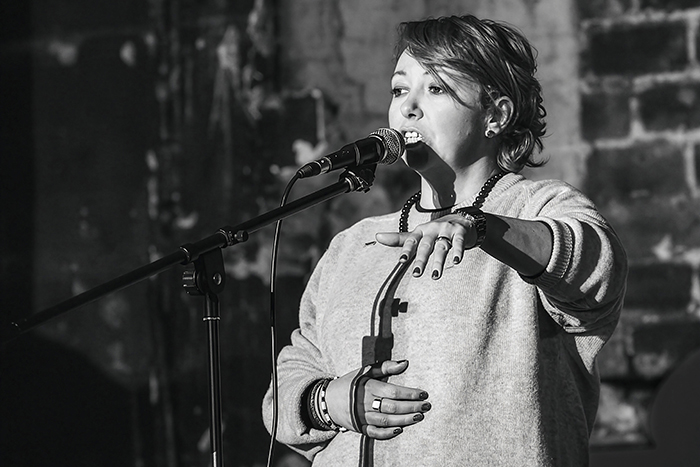
Performance poetry has been a major part of Cochrane's recover | Alasdair Watson
Thankfully she didn’t have dependents or barriers to going, and so she spent six weeks in early summer 2022 getting help. “It was the best thing that ever happened because I needed that to get away from Glasgow, to get away from everything, to just be like completely exposed, be with women who understood.”
Over the following two years, Cochrane would have the occasional slip up but would seek support from the women she met on that course. But in 2024 her relationship came to an end and she ended up losing her home – that caused a “major relapse”.
Services in Scotland were still few and far between, but she managed to find an
England-based support group which offered online sessions. This was also exclusively for women, but this time mixed those who had a gambling addiction with those impacted by others’ addictions. “I’d never been in any support groups with women who’d been affected by other people’s gambling, and that was a real eye-opener because I realised some of the things that I’d done to my family and to my ex-partner and all that. It was like a whole revelation, so this was another element to recovery for me.”
Shortly after, she was contacted by the Simon Community Scotland, a homelessness charity that wanted to set up a women’s gambling support service north of the border. This would become Aila, a website she helped co-design with other women. After that, Cochrane found herself increasingly approached to speak about her experience and advocate for improved gambling support in Scotland. This, she says, has helped her stay in recovery.
“Sometimes I wonder, can I still say that I’m addicted but I’m just on top of it? There’s a lot of women I’ve spoken to and they say, ‘I’m going to have this addiction forever, I need to be in recovery forever’. I’m still figuring that out.”
***
The lack of gambling support options in Scotland means Cochrane’s experience of not being able to get help is common. Existing services are provided by the third and voluntary sector with a limited geographic spread, and there is no provision at all within the NHS.
A healthcare needs assessment by Public Health Scotland looked into this issue last year, and it concluded there was a gap in provision. It proposed the creation of a Scottish Gambling Harms Service comprising two parts – a national clinic and local recovery networks. This service should be developed within three years, it recommended.
There is a lack of awareness of where support is and how to access it
The local recovery network element is similar to what is already in place in Glasgow. The council established the Glasgow Gambling Harms Group in 2020, bringing together council services, the third sector and health professionals to better coordinate services.
Councillor Laura Doherty, city convener for neighbourhood services, has been leading on this work. She explains that much of it has been about “building capacity into existing services” and encouraging multi-agency cooperation, given the harms caused by gambling can vary from person to person. The aim is to establish a ‘no wrong door’ approach where anyone can present to any service and be signposted to other support.
Doherty explains it’s about “trying to link in and equip people to ask the right questions, and also to know where the support is. Right now, what we’re seeing is there is a lack of awareness of where support is and how to access it.” That explains some of the barriers Cochrane faced. Docherty is hopeful that recently announced funding from the Scottish Government will help further build on the group’s success.
That cash came directly from the statutory gambling levy, which was introduced by the UK Government last year. A replacement for the previous voluntary levy, all gambling licence holders must contribute, and the proceeds are ringfenced for projects related to gambling harm. It represented the first major change to gambling regulation in 20 years.
The move reflects a slow change in recognising gambling as a public health issue, rather than a matter of individual responsibility. National Institute for Health and Care Excellence (Nice) guidelines were published last year, acknowledging it as a serious addiction.
Gambling largely doesn’t feature within people’s medical records because it’s just not talked about
Professor Heather Wardle, co-director of Gambling Research Glasgow, has been working to improve the evidence base on gambling harms for the last 20 years. She explains: “The gambling products that people are using are designed to encourage repetitive play often, particularly those fast-paced, continuous forms of gambling like online slot machines and online casino games, and therefore they can be addictive. And as with any addiction, it can impact people’s mental health.
“It impacts their wellbeing, it impacts people’s ability to do other things in their lives, it impacts their ability to take care of themselves. It can be all-consuming. It can really severely affect people’s mental health and wellbeing.”
In January, Wardle published a study highlighting a strong link between gambling and suicidal thoughts. It found that over a third of highly-engaged gamblers had considered taking their own life. And while these people are at the extreme, she also says that even those participating in low-risk gambling may experience “decrements to their mental health and wellbeing”.
But there are big gaps in data. Wardle says there is a “really well-established public health surveillance system” in place for other addictions like alcohol and drugs, yet the only information currently available on gambling is the Gambling Survey for Great Britain, which she leads. That information is based on self-reported behaviours of how people feel they are experiencing harms and therefore does not necessarily give the full picture.
There are also failures in recording gambling-related deaths. Charles Ritchie, who co-founded charity Gambling with Lives with his wife after the death of their son Jack, says that right now “nobody knows how many people die from gambling” each year. Estimates put the number anywhere between 250 and 650, but the charity is campaigning for all suicides where gambling is suspected to have contributed to be investigated.
Ritchie adds: “Gambling disorder needs to be recorded on death certificates alongside things like alcohol and the more established and well-known things… At the moment gambling largely doesn’t feature within people’s medical records because it’s just not talked about, or even if people do talk about it, it’s not recorded.”
Some successes have been made on this front in England, where a number of inquests have taken place and confirmed gambling as a contributing factor. This currently isn’t possible in Scotland due to barriers in the legal system, though the charity hopes to challenge this soon.
We’re still within a policy landscape that prioritises the leisure principle over the protection principle
The inquest in Jack’s case also led to a prevention of future deaths report, in which the coroner concluded the lack of understanding about gambling addiction and “significant gaps” in information, training and treatment had been a further factor in his death.
“The information available to the public on gambling is woeful,” Ritchie says. “Everybody knows the health risks of alcohol, of smoking, of drugs, et cetera, but basically that isn’t in the public domain [for gambling]… A six-year-old knows that smoking kills, but talk to people in the street, they’ve no idea about gambling and the mental health harms. People start gambling thinking it’s just another leisure activity, a bit of fun. What they don’t realise is that they’re engaging with something which is highly addictive.”
The fact that gambling regulation, a reserved matter, sits with the Department for Culture, Media and Sport rather than sitting in the health portfolio is perhaps a symptom of this.
And Wardle says the 2005 Gambling Act was based on the assumption that gambling is a “normal, recreational activity that should be encouraged”, only requiring light safeguards because just a small proportion of people were harmed by it. But evidence gathered over that last 20 years suggests this is not the case. “The harms are much wider. It’s not just the individual person who gambles, it’s also their friends, their relatives, their families, their communities are also experiencing harms. The harms are much more diverse,” Wardle says.
“But we’re still within a policy landscape that prioritises the leisure principle over the protection principle,” she adds. This point is particularly important when considering the fact that the gambling sector has a “disproportionate dependence on those who are harmed for industry profits”.
Ultimately, Wardle believes the UK Government must act on advertising and marketing, as well as introduce mandatory loss limits. But she also says the Scottish Government does not have to wait for UK ministers – there are actions that can be taken at devolved level.
On the treatment side, she says the lack of gambling support in Scotland presents an “opportunity to really design something that works”, using a whole raft of evidence from elsewhere. And on the public health side, Scottish ministers could launch an information campaign and limit advertising on publicly owned assets. She points to Bristol and Sheffield, which have both banned gambling adverts on public transport.
“So whilst [Scottish ministers] can’t control the overall policy, there are still opportunities that are within their gift to be able to think about, maybe we could implement these at a more local level,” she says.
Holyrood Newsletters
Holyrood provides comprehensive coverage of Scottish politics, offering award-winning reporting and analysis: Subscribe