Exclusive: Lord Ashcroft poll puts SNP ahead as Labour struggles before Holyrood vote
The SNP looks set to remain the largest party at Holyrood after May’s Scottish Parliament election, but with a reduced share of the vote and growing unease among voters over its record in government.
At Scottish Labour’s party conference last month, leader Anas Sarwar asked voters to “hold your nose” and back his party. But new polling released exclusively to Holyrood suggests voters are unwilling to make a change and are unconvinced by Sarwar’s arguments, despite believing Scotland’s governing party has performed poorly on key issues, including health, education and the economy.
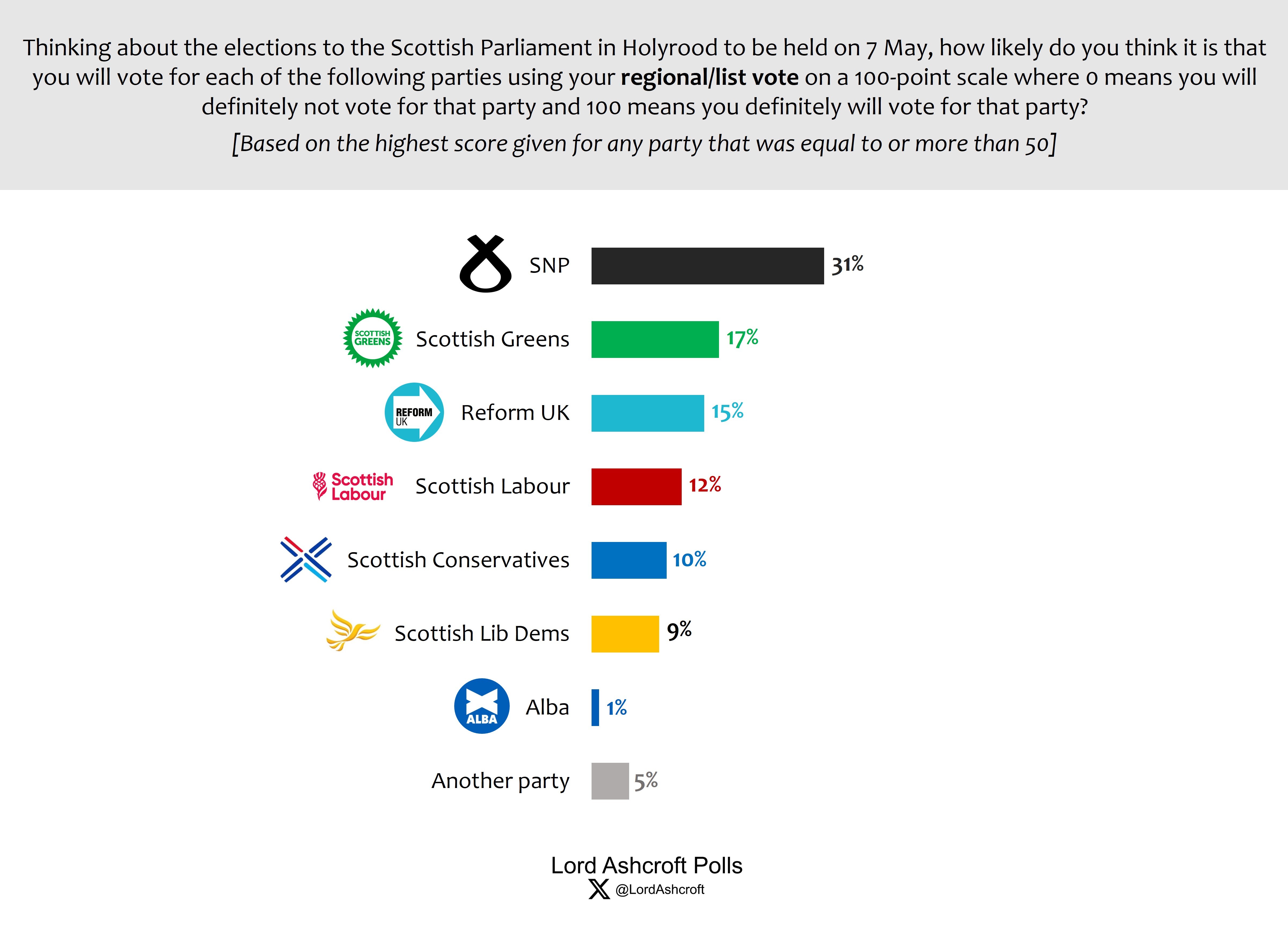
With less than two months until polling day, the survey of more than 2,100 people by Lord Ashcroft puts the SNP on 39 per cent of the constituency vote and 31 per cent on the regional list – down from 47.7 and 40.3 per cent respectively in 2021.
Reform UK, which in recent months has overtaken Scottish Labour in many of the polls, is the second largest party in the constituency vote, with 14 per cent. However, it would receive the third-largest vote share in the regional list with 15 per cent.
Polling shows the Scottish Greens are in second place on the regional list, with 17 per cent of the vote. In the constituency vote, the party sits in fourth with 11 per cent, one point behind Scottish Labour.
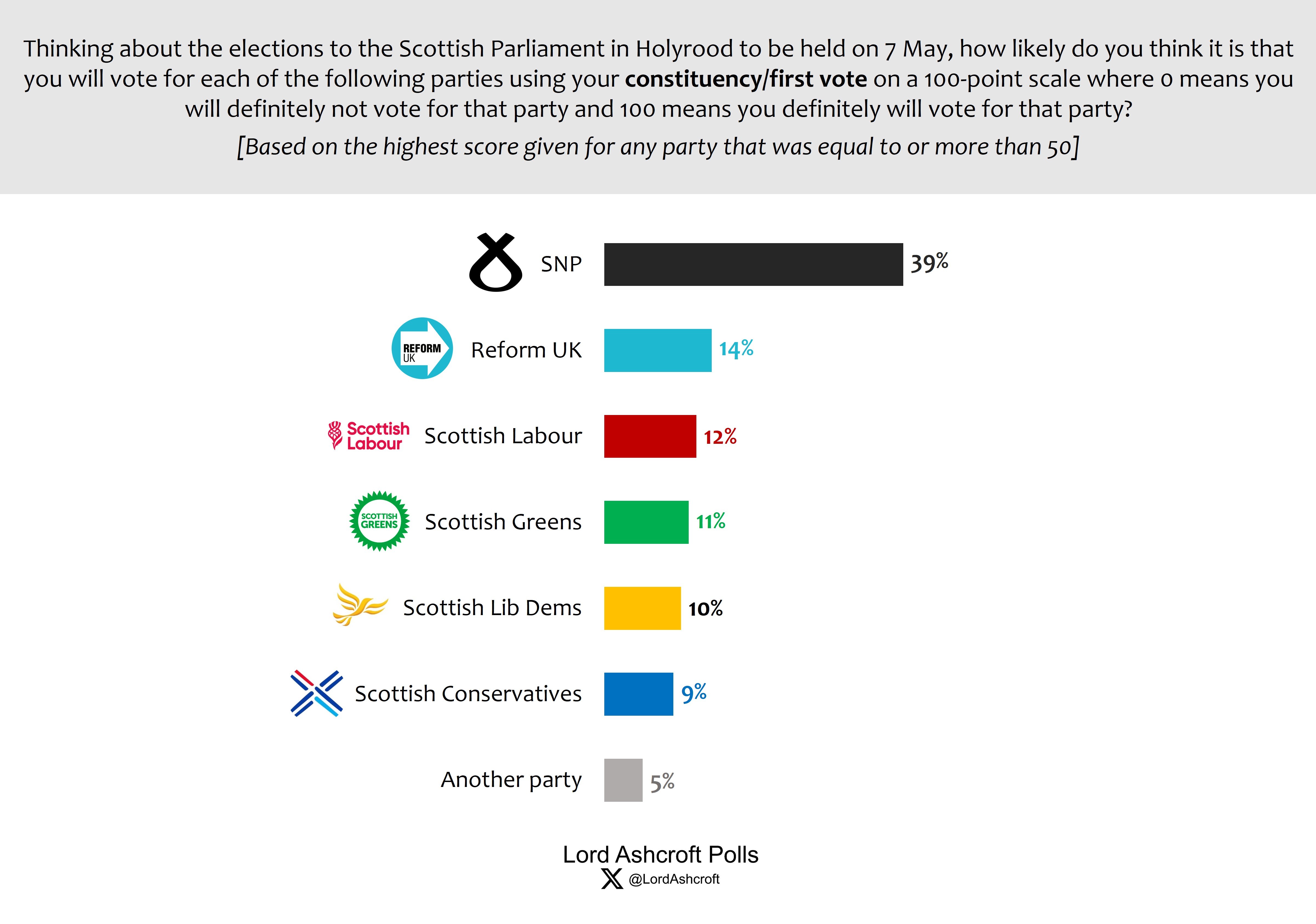
Despite outperforming the Greens in the constituency vote, Sarwar’s party has fallen into fourth on the regional list with just 12 per cent.
The Scottish Liberal Democrats and the Scottish Conservatives are closely matched, with Alex Cole-Hamilton’s party commanding 10 per cent in the constituency vote and nine per cent on the regional list, while Russell Findlay’s party is projected to receive nine per cent and 10 per cent respectively.
Due to the way the polling is conducted, with voters asked to score each party out of 100, it is not possible to generate accurate seat predictions for how the parliament will look after 7 May.
Commenting on the results, political scientist Professor John Curtice said: “The SNP are paying a price for the fact that one in four of those who voted for the party in 2021 believe that it has a poor record in government.
“Support for the party is well down on the last Holyrood election in 2021. However, the criticism of their record among their former supporters pales into insignificance compared with the fact that two-thirds of those who voted Labour in 2024 believe that the UK Government has a poor record in government. That – and Keir Starmer’s unpopularity – hang like an albatross around Anas Sarwar’s neck.”
Despite the SNP’s strategy for independence, which sets out that a majority of seats would provide a mandate for a new independence referendum, the polling indicates voters are prioritising public services such as the NHS and the cost of living.
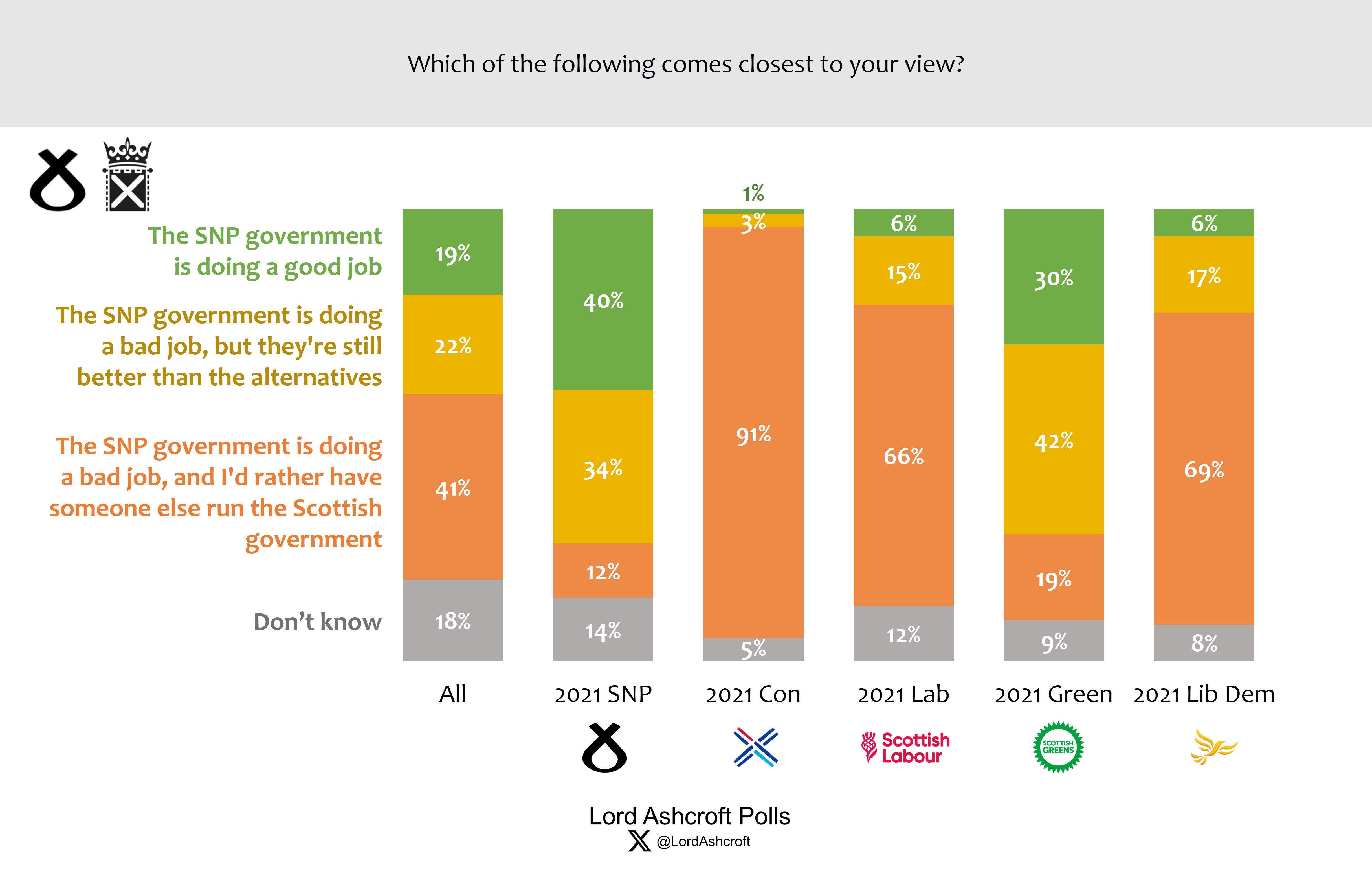
The polling also shows that only four in 10 voters who backed the SNP in 2021 think the party is doing a good job in government, while a further 34 per cent think that the party is doing a bad job of running the country, but is still better than any of the alternatives.
Looking at what all voters think of the SNP’s performance, fewer than one in five (19 per cent) believe the party is doing a good job, while 22 per cent say it is still the best option despite thinking it has done a bad job. Forty-one per cent said they would rather see another party in government.
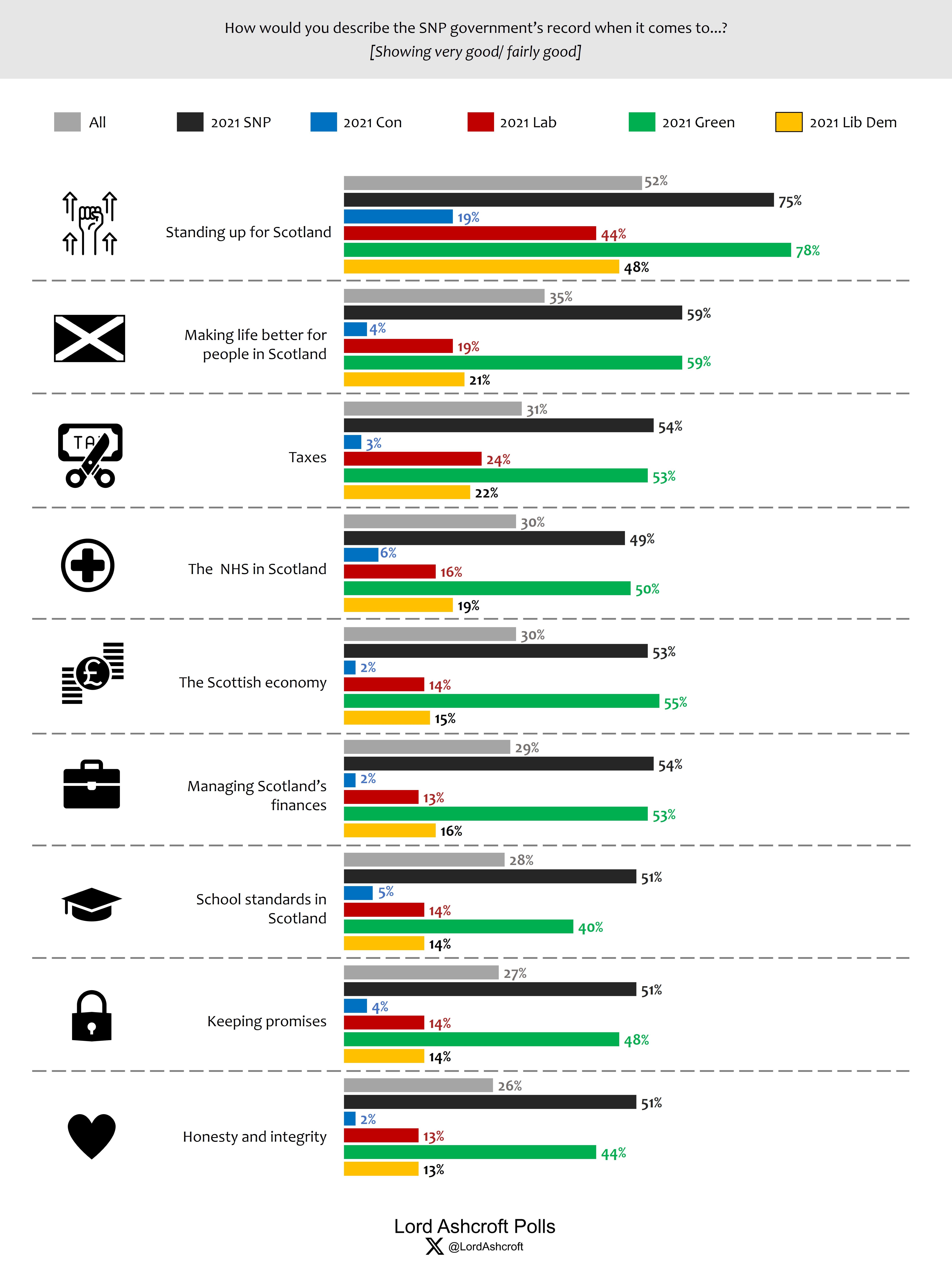
Drilling into the detail of the SNP’s record in government, its best marks overall were for “standing up for Scotland”, where a majority of voters (52 per cent) think it has performed well.
When it comes to health, which is the top priority for Labour, Conservative, Liberal Democrat and Green voters and second for SNP voters, just under half (49 per cent) of SNP voters in 2021 think the party has been ‘very good’ or ‘fairly good’. When expanded to all voters, this is just one in three.
One SNP voter who took part in a focus group as part of the research said: “It’s a mixed bag. Tuition fees, prescriptions, great. But then they shoot themselves in the foot... Sometimes you just think, ‘oh, what are you doing?’”
And across several other key issues like the Scottish economy, education, taxes, managing the nation’s finances, and more general issues like keeping promises and making life better for Scots, a similar pattern emerged showing less than 60 per cent of 2021 SNP voters and roughly three in 10 of the electorate think the Scottish Government has a very good or a fairly good record in these areas. The SNP scored lowest with all voters in ‘honesty and integrity’, with just 26 per cent.
Yet for many voters, the SNP is still the most attractive option heading into the election. A 2021 SNP voter said: “There’s something quite safe in having the SNP. Even though there are some things that they’ve not introduced, I worry that if we had a Unionist party, we would start to mimic elsewhere in the UK.”
This sentiment appears to ring true for a lot of voters. Participants were asked to describe what they thought of Labour’s record in government since the 2024 general election and the SNP’s since it entered government in Scotland in 2007. Over 70 per cent said Labour’s record was bad, compared to just 15 per cent who view it positively. The SNP’s record in the eyes of voters is also bad, but by a narrower margin of 53 and 35 per cent.
One Labour voter said if the SNP “had a top 10 hit list” of things to fix – and put independence to one side – they would vote for Swinney’s party.
On independence, 40 per cent of voters said they would vote ‘yes’ if a referendum was held tomorrow, and 43 per cent said they would vote ‘no’. Twelve per cent said they didn’t know, and six per cent said they wouldn’t vote. Removing the undecideds and those who wouldn’t vote, yes is polling at 48 per cent, and no at 52 per cent.
The apathy in the lead-up to the Holyrood election felt by voters is applicable to party leaders and other high-profile politicians. Every figure received a negative approval rating.
While the first minister has a better net approval rating (-17) than other leaders, one voter described him as coming across as “an interim manager”, and another as “a wet weekend”.
However, this could be working to his advantage. A 2021 Tory voter said: “He’s beneficial to the SNP in that he’s less controversial than Humza Yousaf and [Nicola] Sturgeon. He’s been a bit more quiet, more boring, just working away. He’s not said or done anything controversial. But he has no new ideas.”
Sturgeon had the highest favourability score, with 29 per cent. However, she also had one of the highest negative views at 53 per cent, giving her a net approval rate of –24. A majority of voters feel that she is a liability rather than an asset to her party, while just under half (46 per cent) of SNP voters said she is an asset.
Nigel Farage had a higher favourable score than Keir Starmer, but their net scores were the same at –52.
Scottish Labour leader Anas Sarwar scored –31, while the rest of the Scottish leaders’ favourability scores were in the single digits.
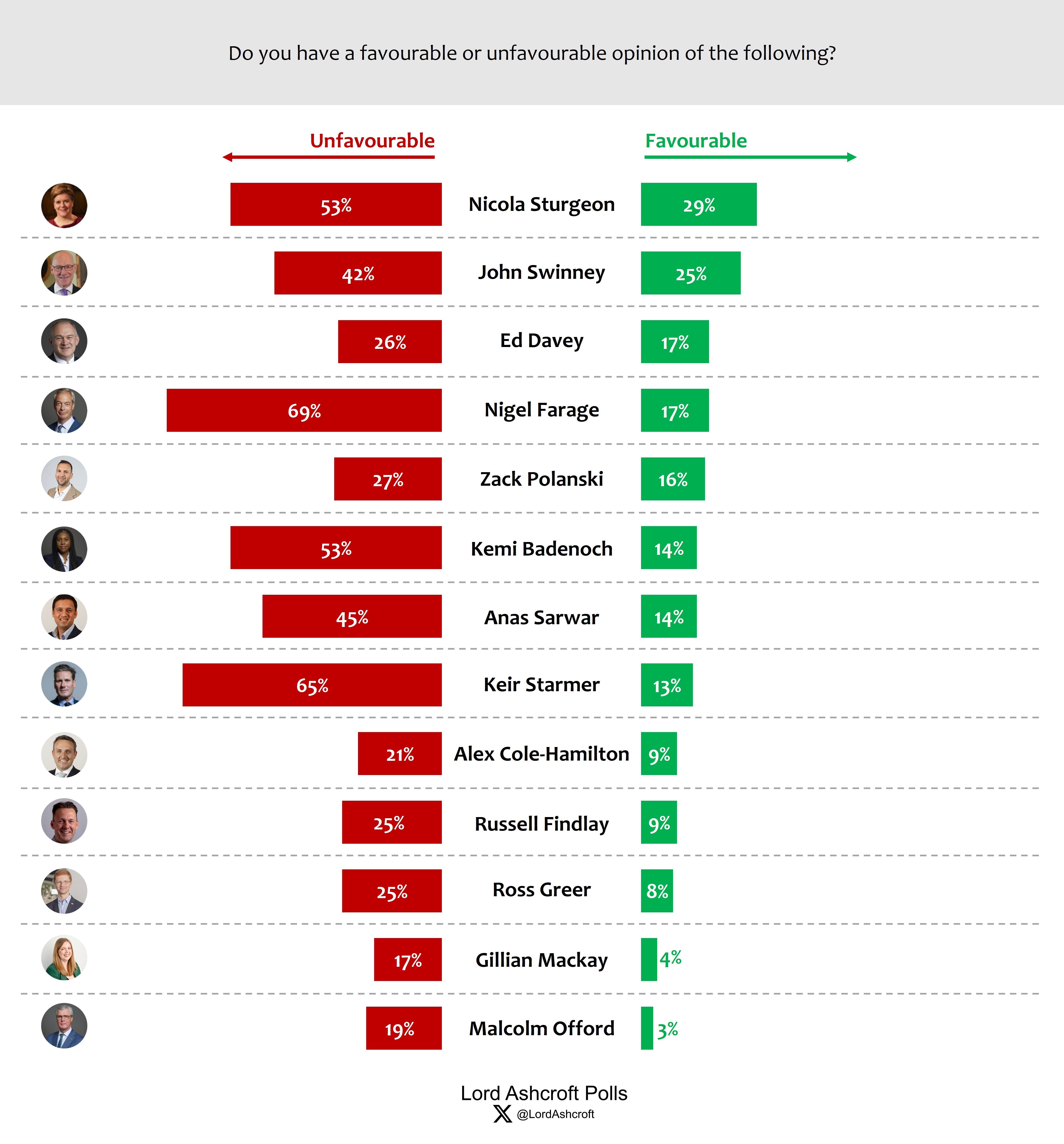
Reform UK’s leader in Scotland, Malcolm Offord, achieved the lowest favourability score of all the leaders, at just three points. But despite figures indicating voters know little about Offord, Scots were more forthcoming with their views of his party overall.
Just over half of Scots see Reform as a negative influence and wish it didn’t exist. However, 17 per cent say it raises issues others avoid – including around a third of Conservative voters – while just under one in five, rising to half of 2021 Conservative voters, say they could consider voting for it.
Curtice added: “Most voters are likely to back a party whose constitutional preference aligns with their own. That leaves former SNP supporters with few options even if they are unhappy with the SNP’s record in government.
“Disgruntled pro-Union Labour supporters in contrast have plenty of Unionist options between which to choose – and as many as one in three of those who backed the party in 2024 say they are most likely now to support one of the Conservatives, the Lib Dems, or Reform.”
Holyrood Newsletters
Holyrood provides comprehensive coverage of Scottish politics, offering award-winning reporting and analysis: Subscribe